GroupBy Enrich AI vs Hypotenuse AI: Which Catalog Enrichment Tool Is Right for You?
GroupBy Enrich AI and Hypotenuse AI both apply generative AI to product catalog problems, but they solve different problems for different buyers. GroupBy launched Enrich AI in August 2024 as a catalog enrichment module tightly coupled to its search and product discovery platform — the enrichment exists to feed better data into GroupBy's own search index. Hypotenuse AI approaches the same catalog gap from the content side: it fills missing attributes while also generating product descriptions, SEO copy, and channel-ready content in a single workspace. The overlap in feature names obscures a meaningful difference in what each tool is actually for.
If you are evaluating both tools, the deciding factor is usually one question: is your primary problem structured data quality, or content production volume? A retailer running GroupBy for site search has a different need than a DTC brand publishing hundreds of SKUs to Shopify. This page breaks down both tools honestly across the dimensions that actually matter in a buying decision, and explains where Anglera fits as the enrichment layer that neither platform was designed to replace.
| GroupBy (Enrich AI) | Hypotenuse AI | Anglera | |
|---|---|---|---|
| Core purpose | Attribute extraction and taxonomy standardization designed to improve search and faceting outcomes within GroupBy's own search platform | All-in-one content workspace: attribute enrichment plus product description generation, SEO copy, bullet points, and image editing at catalog scale | Gathers, cleans, and enriches structured product attributes across your entire SKU catalog, scores each attribute against buyer search signals, and writes enriched data back to your PIM — no copywriting layer, no search platform |
| Enrichment methods | Generative AI extracts attributes from existing product text and images; GroupBy's proprietary Global Taxonomy Library standardizes the output | Combines web scraping, UPC/barcode lookup, and image analysis to fill missing fields; AI then generates or rewrites copy from those inputs | Aggregates supplier data, distributor feeds, web scraping, and image analysis; continuously monitors source changes and re-enriches on signal rather than as a one-time pass |
| Content vs. structured data output | Structured attributes and taxonomy tags only — no long-form copy or SEO content generation | Both structured attributes AND marketing-ready copy: descriptions, bullet points, SEO metadata, and channel-specific content variants | Structured, buyer-signal-scored attributes written back to your PIM as the source of truth; Anglera does not generate marketing copy |
| Platform integration model | Tightly coupled to GroupBy's search and merchandising suite; enrichment feeds GroupBy's index directly and is most valuable inside that ecosystem | Standalone workspace with export; native connectors for Shopify and BigCommerce, but not designed for deep enterprise PIM integration | PIM-agnostic write-back to Akeneo, Salsify, inRiver, Plytix, and custom systems — enriched data lands in your existing source of truth within approximately 30 days |
| Target buyer | Mid-market to enterprise retailers and B2B wholesalers already using or evaluating GroupBy for site search and product discovery | Ecommerce brands and DTC retailers that need catalog enrichment and want to reduce content production costs without running separate tools | B2B distributors, manufacturers, and retailers managing large SKU counts in a PIM who need enrichment without replacing their current stack |
| Search and discovery feedback loop | Built-in — enriched attributes feed GroupBy search ranking, faceting, and merchandising directly; behavioral signals from search can inform re-enrichment | No search layer; enrichment improves data quality, but the feedback loop between buyer behavior and catalog data depends entirely on downstream tools | Scores each attribute against real buyer search signals before writing back to the PIM, so enriched data reflects what buyers actually query — independent of which search platform you run |
| Pricing transparency | Enterprise, custom quote only | Marketing plans from approximately $29/month listed publicly; ecommerce enrichment and attribute tagging tiers are enterprise-only, custom quote | Custom quote; implementation scope and timeline (~30 days) are scoped up front |
How to choose between GroupBy (Enrich AI) and Hypotenuse AI
Choose GroupBy Enrich AI if you are already evaluating or committed to GroupBy as your search and product discovery platform. The enrichment module is designed as an integrated part of that suite — attributes it extracts feed directly into GroupBy's search index, faceting, and merchandising logic. If you are a mid-market retailer or B2B wholesaler who wants to consolidate search and enrichment under one vendor and reduce integration work, GroupBy Enrich AI removes a connection point. Using it without GroupBy's search layer, however, significantly reduces its value: the output is harder to act on, and the built-in feedback loop disappears.
Choose Hypotenuse AI if your primary bottleneck is content volume, not just attribute completeness. Hypotenuse is the stronger fit for ecommerce brands and DTC retailers that need to produce product descriptions, SEO copy, and structured attributes together — without running separate tools for each. If you sell on Shopify or BigCommerce and need scalable content production alongside basic enrichment, Hypotenuse covers that end-to-end. It is less suited to enterprises with complex PIM environments or heavy B2B supplier data needs.
Neither tool is the right primary choice if your core requirement is a purpose-built enrichment engine that writes back to a standalone enterprise PIM, manages multi-supplier data schemas, scores attributes against live buyer signals, and integrates across a complex B2B data chain. GroupBy Enrich AI was built to serve GroupBy's search platform. Hypotenuse AI was built to serve content teams at ecommerce brands. Both assume relatively clean incoming data — which is precisely where the problem sits for most B2B distributors and manufacturers.
Whichever you pick, the data still has to get done
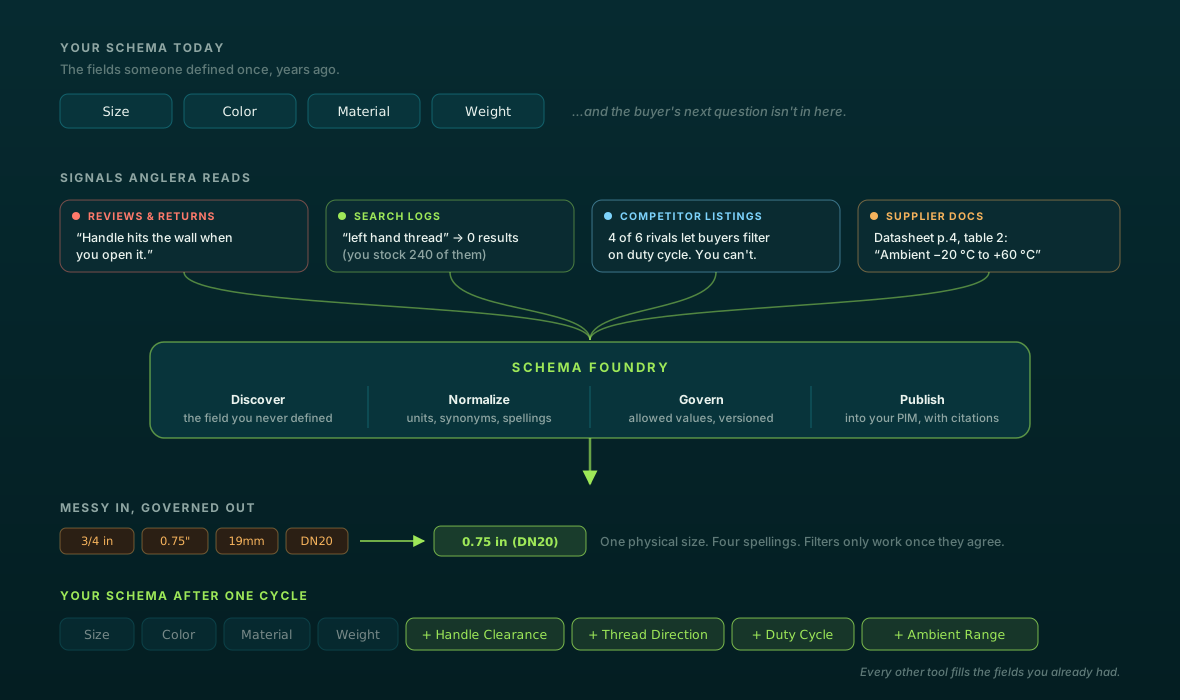
Anglera is not a search platform and not a content workspace, which means it is not competing with GroupBy or Hypotenuse for the same budget line. It sits upstream of both.
If you select GroupBy: Anglera enriches your catalog in your PIM first. GroupBy Enrich AI then has cleaner, more complete source data to extract attributes from and push into its search index. The two compound — Anglera handles the data assembly and quality problem; GroupBy handles the search and discovery layer on top of it.
If you select Hypotenuse AI: Anglera handles the structured attribute enrichment, buyer-signal scoring, and PIM write-back. Hypotenuse handles the copywriting and SEO content layer. They operate on different deliverables and can run in parallel without overlap.
In either case, Anglera solves the problem both tools assume is already solved: your product data arriving complete, clean, and consistently structured before any enrichment or content tool touches it. For B2B distributors and manufacturers managing hundreds of suppliers and tens of thousands of SKUs in a PIM, that assumption does not hold at scale. That is the gap Anglera was built for — and why the ~30-day implementation is scoped the way it is.
Frequently asked questions
Is GroupBy Enrich AI a standalone product, or does it require the full GroupBy platform?
GroupBy Enrich AI is a module within GroupBy's broader search and product discovery platform, not a standalone enrichment tool. Its core value — feeding enriched attributes into search ranking, faceting, and merchandising — requires the GroupBy search layer to be present. Buyers evaluating it solely for catalog data enrichment, without GroupBy's search platform, will find the integration story thin.
Can Hypotenuse AI write enriched data directly to an enterprise PIM like Akeneo or Salsify?
Hypotenuse AI supports native connections to Shopify and BigCommerce and allows data export. It does not offer direct write-back integrations to enterprise PIMs such as Akeneo, Salsify, or inRiver. Teams using those systems will typically need a manual import step or a custom integration to get enriched data back into their source of truth.
If I already use GroupBy or Hypotenuse for enrichment, what does Anglera add?
Anglera handles the upstream data problem neither platform was designed for: aggregating product data from multiple suppliers and feeds into your PIM, cleaning inconsistencies across schemas, scoring each attribute against real buyer search signals, and keeping enriched records current as source data changes. Both GroupBy and Hypotenuse assume clean, reasonably complete input data. Anglera produces that input.
Which tool is better suited to B2B distributors managing high SKU counts across many suppliers?
Neither GroupBy Enrich AI nor Hypotenuse AI was designed primarily for B2B distribution. GroupBy targets retail ecommerce; Hypotenuse targets DTC and ecommerce content teams. B2B distributors typically face multi-supplier data schemas, high SKU velocity, and a PIM as the system of record — a problem set that Anglera was built to address directly.
How long does Anglera take to implement alongside an existing PIM?
Anglera's standard implementation runs approximately 30 days from kick-off to enriched data writing back to your PIM. Scope and timeline are defined up front as part of the initial conversation.