All comparisons
An alternative to Hypotenuse AIAI enrichment tools

Anglera vs Hypotenuse AI

The bottom line

Buy Hypotenuse AI if your bottleneck is product copy and imagery for a D2C ecommerce catalog. Buy Anglera if it's missing specs across a multi-supplier B2B catalog, mined from supplier PDFs, cited, and written back to your PIM.

Both claim to enrich product data. This page is about where that claim stops.

The frame for this comparison

Product data is a practice, not a project.

Product data is a practice, not a project — so with an enrichment tool the argument was never about the first pass, which Hypotenuse AI is built to draft and put a human in front of before publish; it's about the second pass and the two-hundredth, and what re-opens a SKU when the vendor reissues the spec sheet or a review names an attribute the schema never had.

01

Ground it

Mine every spec from every source.

Every value traced to a document you can open. The catalog is only as honest as what it was built from.

02

Align it

Aim the catalog at the buyer who actually buys.

Grounded data still loses if it answers questions nobody asked. Alignment is what turns specs into conversion.

03

Keep it alive

Product data is a practice, not a project.

Markets move, suppliers reissue, buyers change what they ask for. A catalog that is right in March is wrong by August unless something is watching.
Capability by capability

Where Hypotenuse AI stops.

Scored against public documentation. Grouped by the three acts — so you can see which ones Hypotenuse AI leaves on your desk.

01

Ground it

Mine every spec from every source.
Source mining
Where does it get specs from?
Hypotenuse AIYes

Mines PDFs, spec sheets, images, vendor PDPs, web

AngleraYes

PDFs, spec tables, drawings, manuals, images, sites

Schema discovery
Does it find attributes that aren't in your schema yet?
Hypotenuse AILimited

Suggests new fields from web sources; mostly fills existing template

AngleraYes

Proposes fields your schema never had

Governed vocabulary
Does it turn messy free-text into a governed pick list?
Hypotenuse AILimited

Collapses synonyms, standardizes units; no versioned governed vocabulary

AngleraYes

Normalizes and governs allowed values, versioned

Taxonomy & classification
Can it classify every SKU into your hierarchy?
Hypotenuse AIYes

Auto-categorizes to internal taxonomy plus Google Shopping, Amazon

AngleraYes

Auto-classifies; channel and marketplace mapping

Citations & provenance
Can you see where any given value came from?
Hypotenuse AIYes

Web enrichment returns referenced source URLs per value

AngleraYes

Every value cites its source doc and page

02

Align it

Aim the catalog at the buyer who actually buys.
Buyer personas
Is the content written for your buyer, or generically?
Hypotenuse AILimited

Audience and brand-voice settings shape copy, not attribute selection

AngleraYes

B2B specifier and B2C shopper enriched differently

Review, search & social signals
Does it learn what buyers ask from the live market?
Hypotenuse AILimited

SEO keywords inform copy; no review or competitor signal mining

AngleraYes

Reviews, search, competitor rails, social — fed back

Copy & SEO
Does it write original, channel-ready copy?
Hypotenuse AIYes

Core strength: descriptions, titles, metadata, bullets in brand voice

AngleraYes

Original copy per persona and channel

Product imagery
Can it produce usable images for SKUs that lack them?
Hypotenuse AIYes

Generates product photography, lifestyle scenes, backgrounds; batch editing

AngleraYes

Generates studio-grade imagery for photoless SKUs

03

Keep it alive

Product data is a practice, not a project.
Continuous re-enrichment
What happens when the market moves after go-live?
Hypotenuse AIYour team

Bulk runs triggered manually; no documented autonomous re-enrichment

AngleraYes

Re-enriches on its own after go-live

Quality scoring
Does it score its own output and track catalog health?
Hypotenuse AILimited

Confidence flags and gap detection; no catalog health trending

AngleraYes

Scored against your standards; nothing publishes below bar

Write-back
Does enriched data land back in your system of record?
Hypotenuse AIYes

Bi-directional sync to Akeneo, Salsify, Plytix, Shopify, ERP

AngleraYes

Writes back to PIM, ERP, warehouse, commerce

API, MCP & webhooks
Can your own tools and agents drive it headlessly?
Hypotenuse AILimited

Public API and integrations; no MCP server found

AngleraYes

API, webhooks, and MCP servers

Who does the work
Does it do the work, or help your team do it?
Hypotenuse AIYour team

Software; team reviews and approves suggestions before publishing

AngleraYes

Anglera owns the work; review is a guardrail

KeyYesships itLimitedlimited or gatedYour teamyour team still does itNodoesn't do itAnglera differentiator
What “buyer signals” actually means

Six signals sitting in your market right now.

“Buyer signals” is the emptiest phrase in this category, so here is the literal thing. Each of these is an observation from a live market, the gap it exposes, and the field that gets created as a result.

Review signal·One- and three-star reviews on your own PDP, read newest-first

"Third pair I've owned. Great on the treadmill. Took them on a wet fire road and the outsole was a bar of soap — there are basically no lugs on these."

The record carries upper material, heel-toe drop, stack height, weight — everything the vendor spec sheet had to give. Nothing on it says what surface the shoe grips. The wrong-surface returns cluster on the SKUs a first pass called complete, because completeness was measured against the fields that existed.

Field createdintended_surface, outsole_lug_depth_mmintended_surface: road | treadmill | light trail | technical trail | track | gym court. Lug depth in mm read off the outsole drawing, not inferred from the marketing copy.
Search signal·Search Console queries landing on the cookware category page, plus internal site-search terms returning zero results

"ceramic pan no pfas", "nonstick without teflon dishwasher safe", "pfoa free frying pan oven 500f"

Shoppers are filtering on coating chemistry and on what survives a dishwasher and an oven. The copy says "premium non-stick coating" — fluent, traceable to its source, correctly approved, and an answer to none of the three questions being asked. The demand is legible in the query log; the schema has nowhere to put it.

Field createdcoating_type, pfas_status, max_oven_temp_c, dishwasher_safecoating_type: PTFE | ceramic sol-gel | seasoned cast iron | hard-anodised bare | bare stainless | vitreous enamel. pfas_status: PFAS-free (declared) | PTFE-based | not declared — "not declared" is a governed value, not a blank.
Marketplace signal·Weekly listing-health and suppression feed from the marketplace channel

"Suppressed: battery_composition and watt_hours required for items containing lithium cells." It hits the portable power stations and every cordless blower kit in the same drop.

The numbers exist. They are in the vendor's UN 38.3 test summary PDF, alongside the cell chemistry. They were never fields in the schema, so no run was ever asked to fetch them, and the next drop of the same supplier's SKUs suppresses on the identical two attributes.

Field createdbattery_composition, watt_hours, cell_count, un38_3_test_summary_urlbattery_composition: lithium-ion | lithium-metal | LiFePO4 | NiMH | alkaline | none. watt_hours as a number to one decimal, carried from the test summary rather than the box copy, with the source document URL kept on the row so a reissue is a diff and not a rediscovery.
Why catalogs rot

Catalogs rot after the approval, not before it

An enrichment run is a reading of the world at one moment. Hypotenuse AI's enrichment draws values from web research, product images, spec sheets and PDFs, vendor PDPs, and CSV uploads; their site states every AI-suggested value is traceable to its source and passes through your team's review before publishing, with bulk approval where trusted and individual inspection where it matters. That is a real first pass, and it is the half everyone demos. The second pass is a different job. The vendor reissues the spec sheet, the torque figure moves, and the question worth asking in any evaluation is what re-opens page 11 — and how you'd know it had. The run itself starts from **attributes you select, or fields the AI detects as empty**. A field the schema never had is never empty. The attribute a shopper is typing into your search box this morning doesn't read as a gap; it reads as nothing at all.

Messy in, governed out.

Values are normalized into a governed, versioned set of allowed values — so a filter works, and keeps working after the next import.

Nominal Size
3/4 in0.75"3/4"19mm3/4 inchDN20
0.75 in (DN20)

Six suppliers, six spellings, one physical size. Filters only work once they agree.

Finish
BlkblackBLACK MATTEMatte BlkRAL 9005
Black — Matte

Free text makes a colour filter useless. A governed value makes it a facet.

Material
SS316316 StainlessStainless Steel 316A4 Stainless
Stainless Steel — 316 / A4

Same alloy, four vocabularies, plus a trade name. Buyers search all of them.

And the part nobody else does

We don't just fill the template you handed us.

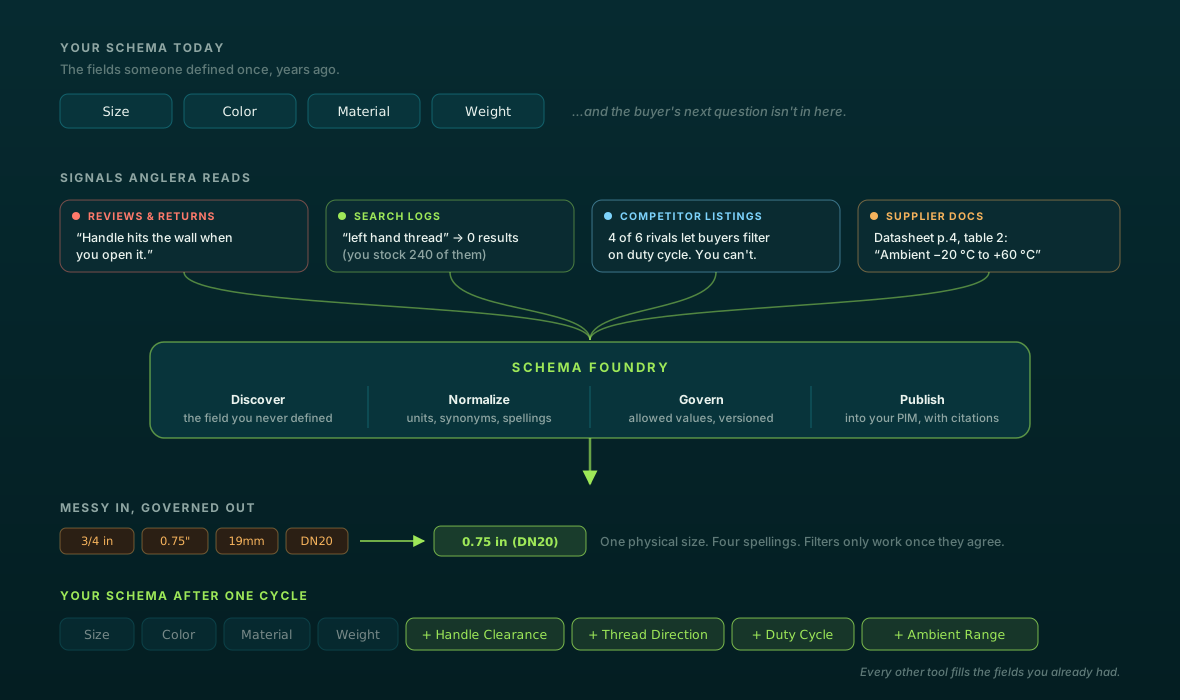
Filling the fields you defined has an invisible ceiling: a catalog can hit 100% complete and still miss the attribute that loses the sale, because completeness is measured against a schema someone drew years ago. Schema Foundry reads competitor listings, buyer searches, review complaints and your supplier docs, and proposes the fields you never defined — which is where Hypotenuse AI stops.

How Schema Foundry works
Schema Foundry: signals from reviews, search logs, competitor listings and supplier documents reveal attributes missing from your schema; the Foundry discovers, normalizes and governs them, so your schema ends the cycle with more fields than it started with.

What Hypotenuse AI does

Hypotenuse AI is an AI-native content and product data platform built primarily for ecommerce brands and retailers. It generates product descriptions, enriches missing attributes (from web scraping, UPC lookup, or image analysis), applies taxonomy tags, and produces SEO copy — all at catalog scale.

Pricing: Marketing plans from ~$29/month (public). Ecommerce enrichment plans (including attribute enrichment and tagging) are Enterprise-tier, custom quote only. Basic and Pro ecommerce tiers are also custom-priced.

Hypotenuse AI website

When Hypotenuse AI is the right call

Ecommerce and D2C brands whose gap is descriptions, SEO metadata, and product photography, with attribute fills from web and UPC lookups, taxonomy tagging, and sync back to Shopify or Akeneo.

We'd rather tell you here than in month three of an implementation.

Capability verdicts reviewed against Hypotenuse AI's public documentation on July 14, 2026. Vendors ship quickly — if something here is out of date, tell us and we'll correct it.

See it on your own SKUs.

Bring one category and your supplier files. In 30 minutes you'll see it enriched — complete, structured, and consistent enough to launch on — plus the attributes your schema didn't have yet.

Book a demo