Hypotenuse AI vs Zoovu: Which Product Data Platform Fits Your Stack?
Hypotenuse AI and Zoovu both use AI to improve product data, but they solve different problems. Hypotenuse AI is a content-first platform — its sweet spot is filling blank attribute fields and generating publication-ready copy at catalog scale. Zoovu is a product experience platform — enrichment is the foundation, but the actual pitch is the AI search, guided selling configurators, and conversational shopping assistant that sit on top of that data.
The decision comes down to what you need beyond enrichment. If you want clean, complete product data and compelling descriptions delivered to your PIM or channel feeds, Hypotenuse AI is built for that. If you want enrichment plus a merchandising and discovery layer — all bundled under one vendor — Zoovu offers that. If you are a B2B distributor or manufacturer with technically complex products and a buying journey where customers need help choosing the right SKU, Zoovu's guided selling angle is purpose-built for you.
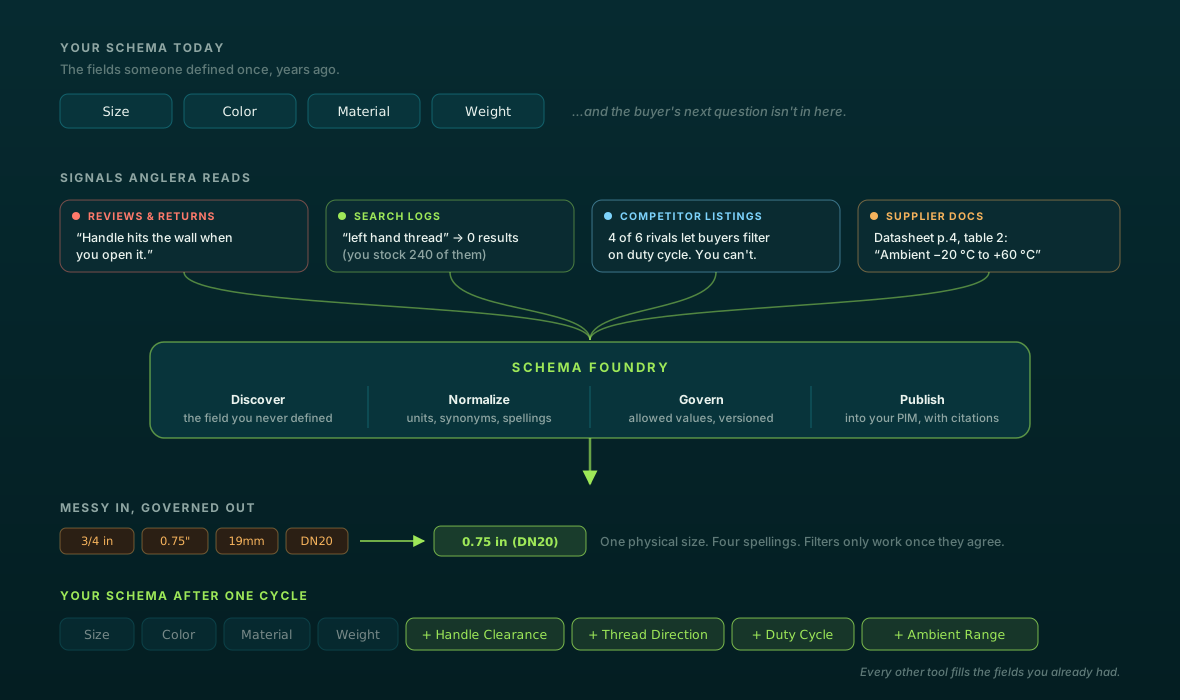
Neither tool is a PIM. Neither is a syndication platform. Both assume your product data starts somewhere and needs to be better. That is where Anglera fits: pulling from every available source, scoring attributes by what buyers actually filter on, and writing the enriched record back to wherever the data lives — so whichever platform you pick, it receives complete data from the start.
| Hypotenuse AI | Zoovu | Anglera | |
|---|---|---|---|
| Core capability | AI content generation plus attribute enrichment — fills missing fields, writes product descriptions and SEO copy, and handles product image editing in one workspace | Enrichment as the foundation for a full product experience suite — AI search, guided selling configurators, and a conversational AI assistant all draw from the enriched data layer | Pulls attributes from supplier feeds, web scraping, and image analysis; scores each field against buyer demand signals; writes enriched records back to the PIM. No front-end layer, no content studio — just complete, accurate data |
| Enrichment approach | Web scraping, UPC/barcode lookup, and image analysis to fill gaps; AI then generates missing attributes and rewrites descriptions to match brand voice or channel requirements | Normalizes and semantically enriches attributes to power downstream discovery — the enrichment is purpose-built to feed Zoovu's own search and guided selling features, not an independent data service | Source-agnostic enrichment tied to buyer signals — surfaces the attributes buyers actually search and filter on, resolves conflicts across multiple supplier feeds, and prioritizes completeness by purchase intent, not catalog coverage alone |
| Discovery and front-end features | None. Output is clean data and copy, ready for your PIM, DXP, or channel feed. No embedded search, guided selling, or customer-facing experience | Full discovery suite: AI site search, guided selling configurators that walk buyers through a few questions to find the right product, and an AI shopping assistant. Enrichment and discovery are a single bundled offering | No front-end layer. Anglera enriches the data that any search or discovery tool runs on — including Zoovu's modules — without competing with or replacing those layers |
| Best-fit buyer profile | Ecommerce brands and online retailers who need to scale product descriptions and fill catalog gaps without a copywriting team. Strong fit for DTC brands and marketplace sellers where SEO copy is a core deliverable | B2B distributors, manufacturers, and omnichannel retailers who want enrichment and guided selling from one vendor. Particularly strong for complex or configurable products where buyers need help selecting the right SKU | B2B distributors and manufacturers with attribute-sparse catalogs, multiple supplier feeds, and a PIM that needs clean, complete data written back to it — regardless of which front-end or content platform sits downstream |
| B2B distributor readiness | Primarily designed for B2C ecommerce — works best on consumer product catalogs where description quality and SEO are the core deliverables. Less purpose-built for technical attribute structures or multi-vendor supplier data | Purpose-built for B2B complexity — handles technical attributes, configurable products, and the 'which SKU do I actually need' buying journey that characterizes industrial and technical distribution | Designed specifically for B2B distributors — ingests supplier data sheets across multiple vendors, resolves conflicting attribute values, and prioritizes fields by what procurement buyers filter on |
| Pricing model | Public marketing plans from roughly $29/month; attribute enrichment and catalog-scale features are enterprise-tier, custom quote only. Basic and Pro ecommerce tiers are also custom-priced | Quote-based, billed annually. Modular by product: Data Enrichment is included in every plan; AI Search, Guided Selling, and AI Assistant each carry separate line items. Scales with traffic and interaction volume rather than SKU count | Custom quote, priced by catalog size and enrichment scope — not by traffic, user seats, or interaction volume. Approximately 30-day implementation to first enriched records in the PIM |
| Time to value | Content generation workflows can go live quickly for teams with an existing catalog. Enterprise enrichment deployments vary by catalog size and integration complexity — timeline is not published | Longer deployment cycle — enrichment plus discovery modules require taxonomy mapping, configurator setup, and front-end integration. Multi-module rollouts typically take months rather than weeks | Approximately 30-day implementation to first enriched records written back to the PIM. Single integration point; no front-end deployment, no configurator setup required |
How to choose between Hypotenuse AI and Zoovu
Choose Hypotenuse AI if your primary pain is catalog content at scale — blank description fields, inconsistent copy, missing attributes that need to be filled and rewritten for each channel or marketplace. It is the stronger fit for B2C ecommerce brands and online retailers who need a content studio and enrichment tool in one place, and whose deliverable is polished, channel-ready copy rather than a deeper product experience.
Choose Zoovu if you need enrichment and a front-end discovery layer from a single vendor, and especially if your products are technically complex or configurable. Zoovu's guided selling is built for the B2B buying journey where customers arrive knowing what they need to accomplish but not which SKU gets them there. If you are a distributor or manufacturer who wants to modernize site search, guided selling, and AI-assisted buying in the same platform contract, Zoovu reduces vendor sprawl in a way Hypotenuse AI does not.
The deciding question is scope. Hypotenuse AI is point-solution enrichment plus content generation. Zoovu is enrichment as the foundation of a broader commerce experience. If you only need the data and the copy, Hypotenuse AI keeps it simple. If you need the data and the discovery layer and want them to share a single taxonomy and vendor relationship, Zoovu makes that trade-off worthwhile — at the cost of a longer, more complex deployment.
Whichever you pick, the data still has to get done
Neither Hypotenuse AI nor Zoovu is your PIM, and neither one takes responsibility for getting complete, accurate data into your PIM before it flows downstream to every other system. That gap is exactly where Anglera operates.
Anglera connects directly to your PIM and to your supplier feeds. It pulls every available data signal — product data sheets, web listings, images, usage history — scores each attribute by what buyers actually search and filter on, and writes the enriched record back to your source of truth. With a roughly 30-day implementation, your catalog is complete before Hypotenuse AI writes its first description or before Zoovu's guided selling configurators start asking buying questions.
If you pick Hypotenuse AI, Anglera gives it complete, scored input data to work from — so the AI-generated copy and attributes are built on verified source data, not inferences made from a sparse supplier feed. If you pick Zoovu, Anglera ensures the enrichment foundation Zoovu's search and guided selling modules run on is backed by clean, supplier-resolved attributes with buyer-signal prioritization — the data is solid before any discovery layer touches it.
Whichever platform wins the evaluation, the data still needs to be enriched. Anglera does that work and writes it back.
Frequently asked questions
Can Hypotenuse AI handle the technical attribute depth a B2B distributor needs?
It depends on your catalog. Hypotenuse AI's enrichment — web scraping, UPC lookup, image analysis — works well for consumer products where attributes and descriptions are the primary deliverable. For B2B catalogs with dense technical specifications, multiple conflicting supplier data sheets per SKU, and procurement-buyer filtering requirements, it is not designed for that workflow. Zoovu and purpose-built B2B enrichment tools are better fits for that use case.
Does Zoovu work as a standalone enrichment tool, or do you have to buy the full suite?
Zoovu includes data enrichment in every plan, so you can start with enrichment alone. However, Zoovu's enrichment is optimized to feed its own AI search, guided selling, and AI assistant modules. Evaluating it purely as a standalone enrichment play — separate from the discovery products it is built to power — makes the ROI harder to justify compared with dedicated enrichment tools.
Does enriched data from Hypotenuse AI or Zoovu write back to my PIM automatically?
Both tools can export enriched data, but neither is designed to serve as the bidirectional enrichment layer for a PIM. Anglera was built specifically for that job: it enriches data and writes it back to your PIM as the source of truth, so every downstream system — including Hypotenuse AI or Zoovu — receives complete data from day one.
Which tool is better for a complex B2B catalog with configurable products?
Zoovu. Its guided selling configurators and AI assistant are purpose-built for the B2B buying journey — technically complex products, multiple variants, and buyers who need help narrowing to the right SKU. Hypotenuse AI is better suited to consumer product catalogs where description quality, SEO copy, and attribute completeness are the primary deliverables rather than interactive guided selling.
How is Anglera different from what Hypotenuse AI and Zoovu do?
Anglera does not generate marketing copy and does not run front-end search or guided selling. It does one job: pulls product data from every available source, scores attributes by buyer demand signals, and writes enriched records back to the PIM. It is the enrichment layer that completes the data before any content generation or discovery tool runs on top of it — and it works alongside either platform, not instead of them.