Constructor vs Hypotenuse AI: Which Belongs in Your Product Data Stack?
Constructor and Hypotenuse AI are both described as "AI for product data," but they solve different problems for different buyers. Constructor is fundamentally a search and product discovery platform — enrichment is how it improves its own index, not the product you buy. Hypotenuse AI is a content generation and catalog enrichment tool — its core job is filling blank fields and writing product copy at volume, without a copywriting team.
The comparison gets interesting when a buyer is sitting in the middle: they need clean, complete product attributes but are not sure whether to solve it through a search platform, a content tool, or something purpose-built for enrichment. That distinction matters because the data Constructor enriches stays inside the Constructor index, and the content Hypotenuse AI generates requires your own effort to route back to your PIM.
This page gives you an honest look at both tools — what each does well, who each is built for, and what neither was designed to handle. If your primary need is structured attribute data flowing reliably back into your source of truth, that gap is worth naming clearly before you sign anything.
| Constructor | Hypotenuse AI | Anglera | |
|---|---|---|---|
| Primary function | AI-powered on-site search and product discovery. Enrichment is a supporting feature that improves the quality of Constructor's own index — not the standalone purchase. | AI content and catalog enrichment platform. Generates product descriptions, fills missing attributes, applies taxonomy tags, and produces SEO and channel-ready copy at scale. | Purpose-built enrichment engine. Gathers, cleans, scores, and validates every SKU against buyer signals, then writes structured data back to your PIM. Not a search platform, not a CMS. |
| Enrichment data sources | Behavioral clickstream — what shoppers actually click, skip, and buy. That signal drives attribute tagging and personalization within the Constructor platform. | Web scraping, UPC/GTIN lookup, image analysis, and existing catalog data. Strong for filling gaps in consumer product catalogs; less targeted for complex B2B technical attributes. | Web sources, supplier data, image analysis, and proprietary buyer-signal scoring. Enrichment is tuned to what actually drives discovery and conversion, then returned to your existing stack. |
| Product copy and description generation | Not a copywriting tool. Attribute tagging supports search relevance but Constructor does not generate prose descriptions or channel-specific content. | Core differentiator. Bulk product descriptions, SEO copy, and channel-specific variants generated at catalog scale — the main reason most customers choose it. | Focused on structured attribute enrichment and completeness scoring, not prose copy. Pairs naturally alongside Hypotenuse AI: Anglera provides the structured data foundation; Hypotenuse writes on top of it. |
| Where enriched data lives | Enriched attributes live inside the Constructor index. The platform is not designed to push structured data back to your PIM, ERP, or MDM as a source of truth. | Content can be exported, but Hypotenuse AI is not a PIM sync platform. Integration depth and write-back behavior vary and typically require custom implementation work. | Writing back to your PIM is the core design, not an afterthought. Enriched, validated data lands in your source of truth so every downstream system — search, ERP, syndication — sees the same clean record. |
| Buyer signals and scoring | Strong. Real clickstream and purchase data ranks, personalizes, and surfaces products based on demonstrated shopper behavior. This is Constructor's primary competitive advantage. | Not present. Enrichment is attribute- and copy-focused; there is no behavioral data layer or scoring model tied to market demand or search intent. | Scores SKUs against buyer signals — market search data, catalog completeness, and attribute gaps — to surface what is missing and prioritize what to fix first, before data reaches any downstream platform. |
| Pricing and buyer profile | Enterprise only. Estimated $150K–$300K per year based on interaction volume. Designed for large ecommerce operations willing to replace or augment a legacy search platform. | Marketing tiers start around $29/month. Ecommerce enrichment at catalog scale is enterprise-tier with custom pricing. Lower entry point but enrichment capability scales up in cost. | Custom enterprise pricing. Approximately 30-day implementation. Built for B2B distributors, manufacturers, and multi-channel retailers — not DTC brands scaling ad copy. |
| PIM integration model | Constructor connects to your catalog to ingest product data into its index. Data flow is primarily inbound — your catalog feeds Constructor, not the other way around. | Integrates with Shopify and some catalog tools. PIM write-back for enterprise teams requires scoping during implementation; it is not a native bidirectional sync. | Bidirectional PIM integration is the foundation. Anglera pulls from your PIM, enriches, and pushes validated attributes back — the PIM remains the system of record throughout. |
How to choose between Constructor and Hypotenuse AI
Choose Constructor if your primary pain is on-site search performance and revenue per search session. You are running a high-traffic ecommerce operation, you have an existing catalog with reasonable attribute coverage, and you want a platform that learns from shopper behavior to personalize results over time. Enrichment in Constructor improves the quality of its index — it is a means to better search, not a standalone data operation. Budget accordingly: this is an enterprise platform decision, not a point solution purchase.
Choose Hypotenuse AI if you have a catalog full of blank description fields, missing copy, or thin content and you need to generate ecommerce-ready text at volume without growing a copywriting team. It is particularly well-suited for consumer-facing brands and retailers with high SKU counts and multiple channels requiring distinct copy variants. If attribute enrichment is a secondary need alongside content generation, Hypotenuse AI handles both in one workspace.
Neither tool is the right primary choice if your core requirement is clean, complete, scored structured attribute data flowing reliably back into your PIM for use across syndication, search, ERP, and partner portals. Constructor's enrichment serves its own index. Hypotenuse AI's enrichment is strongest for consumer product content. Neither was designed with bidirectional PIM write-back as the primary workflow. If that is the job to be done, you are looking at a different category of tool.
Whichever you pick, the data still has to get done
Whichever platform you choose, the enrichment problem does not go away — it just moves upstream.
Constructor's search index is only as good as the structured attributes feeding it. If your catalog arrives at Constructor with missing taxonomy tags, blank specifications, or inconsistent field values, the behavioral engine has less signal to work with and relevance degrades. Anglera fills those gaps at the PIM level before Constructor ever sees the record — so the index starts clean on day one rather than learning its way out of bad data.
Hypotenuse AI writes copy faster and more accurately when the underlying attribute structure is already solid. A description generated from a complete, validated attribute set is more accurate and requires less human review than one generated from sparse or inconsistent data. Anglera provides that foundation: enriched, scored, PIM-validated attributes that Hypotenuse AI can write on top of.
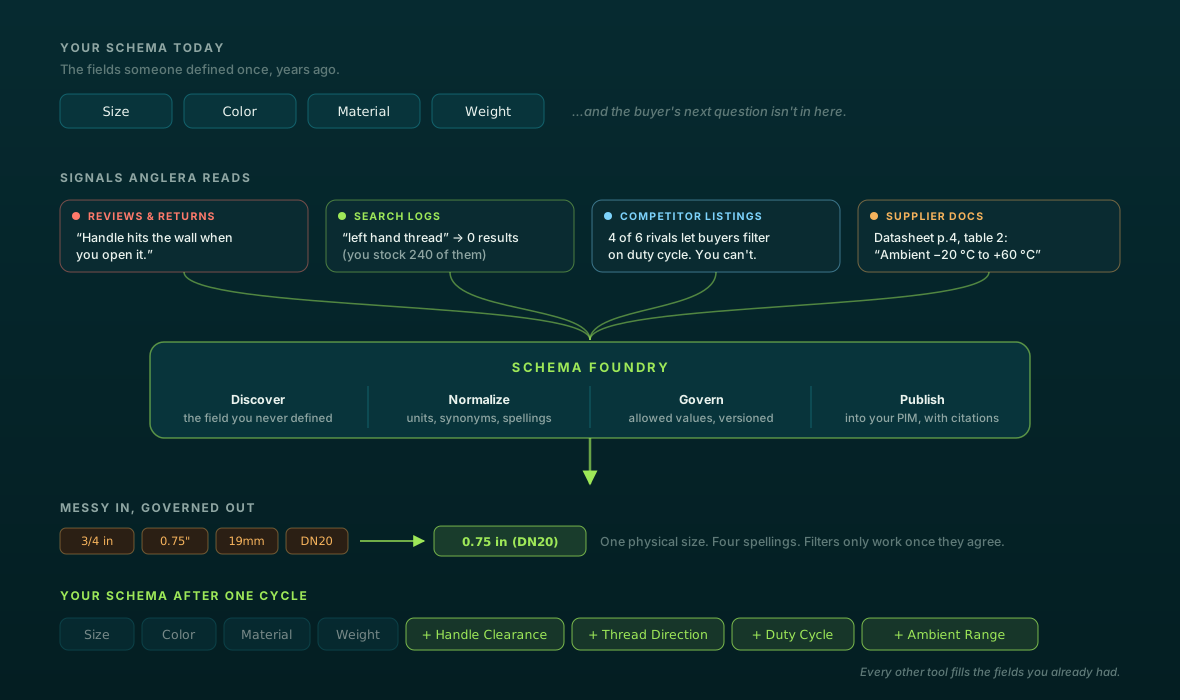
In both cases, Anglera is not a replacement for the platform you chose. It is the enrichment engine that runs in the background — pulling from your PIM, gathering and validating attribute data, scoring completeness against buyer signals, and writing results back to your source of truth. The platform you picked gets better data. Your PIM stays current. And the enrichment work that both Constructor and Hypotenuse AI assume already happened, actually happens. Implementation runs approximately 30 days. No new system of record, no rip-and-replace.
Frequently asked questions
Does Constructor do attribute enrichment, or is it primarily a search platform?
Constructor includes product data enrichment as a feature, but it is a supporting capability, not the core product. Enrichment in Constructor improves the quality of its own search index — tagged attributes help it surface more relevant results. If you are buying Constructor, you are buying a search and discovery platform. Enrichment comes along for the ride to make that platform perform better, not as a standalone data operation you can use independently.
Can Hypotenuse AI write enriched data back to my PIM?
Hypotenuse AI can export content and integrates with platforms like Shopify. Bidirectional PIM sync — where enriched attributes and content are written back to your master catalog and kept in sync — requires scoping during implementation and is not a native out-of-the-box feature for most enterprise PIM environments. If clean write-back to your PIM is a core requirement, confirm the integration design before signing.
If I am already using Constructor for search, do I still need a separate enrichment tool?
Likely yes, depending on the state of your catalog. Constructor's enrichment improves data within its index, but it does not clean up or update your PIM. If your source catalog has incomplete attributes, inconsistent taxonomy, or missing specifications, those problems persist in your PIM and affect every system downstream of it — not just search. A purpose-built enrichment layer that writes back to your PIM ensures the root record is correct, which benefits Constructor's index along with everything else.
Is Hypotenuse AI a good fit for B2B distributors with large technical catalogs?
Hypotenuse AI is strongest for consumer-facing ecommerce content — product descriptions, SEO copy, and marketing text for retail brands. Its enrichment capabilities are well-suited to fill gaps in consumer product catalogs. For B2B distributors managing complex technical attributes (dimensions, certifications, compatibility specs, regulatory data) across tens of thousands of SKUs, the platform's content-generation strengths are less directly applicable. The attribute enrichment depth for highly technical industrial or wholesale catalogs is worth evaluating closely during a trial.
Where does Anglera fit if I am already using Constructor or Hypotenuse AI?
Anglera works alongside both. If you use Constructor, Anglera enriches your PIM-level attribute data before it reaches the Constructor index — better input data means better search outcomes from day one. If you use Hypotenuse AI, Anglera provides the structured, validated attribute foundation that Hypotenuse AI writes copy on top of, reducing review cycles and improving output accuracy. In both cases, Anglera handles what neither platform was designed to do first: pulling from your PIM, enriching at catalog scale, and writing validated data back to your source of truth.