Describely vs GroupBy Enrich AI: Which Product Enrichment Tool Is Right for You?
Describely and GroupBy Enrich AI both operate in the product data enrichment space, but they are built for different buyers solving different problems — and in one important sense, they are not competing at all.
Describely is a standalone AI writing tool aimed at eCommerce teams who need product copy at scale: descriptions, titles, bullet points, meta tags, and SEO content generated from a SKU or a thin product title with no heavy implementation required. It is priced for self-service, integrates natively with Shopify, WooCommerce, and Wix, and is designed for teams that need to close catalog content gaps quickly without hiring more copywriters. The entry point is a credit card and a spreadsheet.
GroupBy Enrich AI is a catalog enrichment module inside GroupBy's broader AI-first search and product discovery platform — not a standalone product. It launched in August 2024 using Google Cloud Vertex AI and GroupBy's proprietary Global Taxonomy Library to extract and standardize product attributes from text and images, with the explicit goal of feeding better-structured data back into GroupBy's own search and merchandising engine. If you are not already evaluating or running GroupBy's search platform, Enrich AI is not a standalone option you can adopt. That single fact shapes almost every dimension of this comparison.
| Describely | GroupBy (Enrich AI) | Anglera | |
|---|---|---|---|
| Primary output | Marketing copy — descriptions, titles, bullet points, and meta tags generated at scale from minimal input; AI infers missing attributes from a SKU or title alone | Structured product attributes extracted and normalized against GroupBy's Global Taxonomy Library; output feeds GroupBy's own search and merchandising engine, not a general-purpose content layer | Both attributes and copy — enriches every dimension of a SKU against real buyer signals, then writes results back to your PIM as the system of record |
| Platform dependency | Fully standalone — operates independently of any PIM or search platform; native connectors for Shopify, WooCommerce, and Wix; no broader vendor relationship required | Module within GroupBy's search and discovery suite — Enrich AI is not a separate purchase; enrichment is designed to improve data quality inside GroupBy's engine, not write back to an external PIM | PIM-agnostic enrichment layer — connects to whichever PIM is already the system of record; not a search platform, not a PIM itself |
| Enrichment approach | Generative — produces copy from thin inputs; strong at inferring and filling content gaps when supplier data is sparse; less focused on structured attribute extraction and taxonomy alignment | Extractive and normalizing — pulls structured attributes from existing text and images and maps them to a standardized taxonomy; focused on attribute completeness and consistency rather than copy generation | Signal-driven — enriches attributes and content based on how your buyers actually search, compare, and filter; not reformatted supplier copy or internal schema rules |
| eCommerce and tech stack fit | Best matched to Shopify, WooCommerce, and Wix stores; DTC and mid-market retail eCommerce teams can get started with minimal setup | Aligned with retailers and B2B wholesale operators already committed to GroupBy's full search, merchandising, and discovery suite | Connects to any PIM via API — Akeneo, Salsify, inriver, Plytix, custom instances — regardless of which eCommerce or search stack sits downstream |
| Pricing | Public, self-serve pricing: pay-as-you-go from $28/month; data enrichment at $0.55 per product (10-product minimum); custom enterprise plans available | Not disclosed; Enrich AI is a module add-on within GroupBy's platform pricing, not a standalone purchase — requires a sales conversation with GroupBy | Per-SKU enrichment pricing — layers onto your existing PIM investment; no platform migration or replacement required |
| B2B and complex catalog support | Built for eCommerce copy volume; not purpose-built for deep attribute hierarchies, multi-source supplier data, or the cross-category normalization common in B2B distribution | Global Taxonomy Library supports B2B wholesale and retail; attribute standardization maps better to complex catalogs than copy-only tools, but is still gated behind the GroupBy platform commitment | Purpose-built for B2B distributors, retailers, and manufacturers with large, complex catalogs; enrichment is calibrated against how B2B buyers search and compare, not just DTC shoppers |
| Implementation speed | Fast — self-serve access, no lengthy onboarding; useful for teams that need to fill catalog gaps without a vendor sales cycle | Tied to the broader GroupBy platform deployment; timeline depends on the scope of the search and discovery implementation — not a quick-start tool | ~30 days from kickoff to enriched SKUs written back to the PIM; no platform migration required |
How to choose between Describely and GroupBy (Enrich AI)
Choose Describely if you run a DTC or mid-market retail eCommerce operation on Shopify, WooCommerce, or Wix, and your core problem is generating buyer-ready product copy at volume. Describely's strength is speed and accessibility: it can produce descriptions, titles, bullets, and meta tags from a SKU or a thin title, with self-serve pricing that does not require a procurement cycle. If your catalog has gaps — missing copy, weak descriptions, inconsistent titles — and you need to close them quickly without hiring copywriters or committing to a platform, Describely is a reasonable fit. It is not built for deep attribute extraction or B2B catalog complexity, but for eCommerce copy at scale it delivers without a heavy lift.
Choose GroupBy Enrich AI if you are already evaluating or running GroupBy's full search and product discovery platform and you want catalog enrichment to feed directly into that engine. Enrich AI's attribute standardization and Global Taxonomy Library are designed to improve search relevance within GroupBy's own system — it is not a tool you adopt independently. If your primary investment is in GroupBy's search and merchandising suite and you need structured product data to power it, Enrich AI is the natural module to add. If you are not already in the GroupBy ecosystem, this is not the right starting point for catalog enrichment.
A few practical signals:
- If you sell on Shopify and need catalog copy filled quickly without a long vendor relationship, Describely fits.
- If you are deploying GroupBy's search and discovery platform and want enrichment tightly integrated within that ecosystem, Enrich AI is the intended module.
- If you manage a large B2B distributor catalog with complex attributes, multiple supplier data sources, and buyers who search very differently from DTC consumers, neither tool is purpose-built for that problem — Describely focuses on copy generation, and GroupBy Enrich AI requires a full platform commitment first.
Whichever you pick, the data still has to get done
Describely and GroupBy Enrich AI each address part of the enrichment challenge. Describely fills copy gaps fast. GroupBy Enrich AI standardizes attributes within its search platform. What neither does is take the raw supplier data that most catalog teams actually start with — inconsistent specs, attributes written for the factory floor, titles that no buyer would search — and transform it into content calibrated against real buyer behavior, then write that content back to the system of record your team already uses.
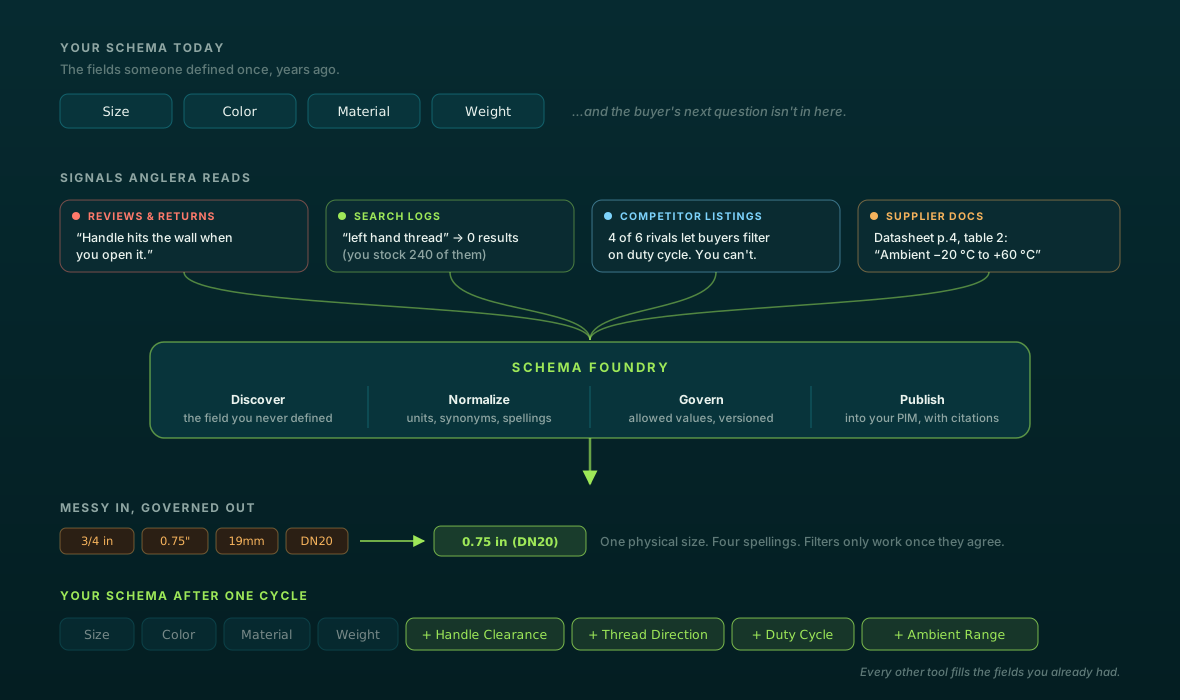
That is Anglera's role. It connects to your existing PIM via API, reads every SKU, enriches attributes and descriptions against real buyer signals — how your specific customers actually search, compare, and decide — and writes the improved content back to the same PIM record. Your downstream channels, whether that is a Shopify storefront or a GroupBy search engine, receive higher-quality data from the source. No platform migration. No new system of record to manage.
If you use Describely for copy generation, Anglera provides the buyer-signal depth that makes that copy rank and convert rather than just fill a content field. If you use GroupBy Enrich AI for attribute standardization within the GroupBy platform, Anglera handles the enrichment layer that sits upstream — filling and improving the raw data before it reaches GroupBy at all. Whichever tool fits your stack, Anglera does the work that both assume has already happened. Implementation is roughly 30 days.
Frequently asked questions
Is GroupBy Enrich AI available as a standalone product?
No. Enrich AI is a module within GroupBy's AI-first search and product discovery platform, which launched the enrichment capability in August 2024. It is not sold or accessible independently of the broader GroupBy platform. Buyers looking for standalone catalog enrichment should evaluate dedicated tools such as Describely or Anglera instead.
What is the practical difference between what Describely and GroupBy Enrich AI produce?
Describely generates marketing copy — descriptions, titles, bullet points, and meta tags — from minimal product inputs. GroupBy Enrich AI extracts and standardizes structured product attributes, mapping them to GroupBy's Global Taxonomy Library to improve search relevance within GroupBy's own engine. They solve different problems: one is a copy generator, the other is an attribute normalizer embedded in a search platform.
How does Anglera differ from Describely?
Describely generates product copy from a SKU or a thin title — it is a writing tool. Anglera enriches your full catalog against buyer signals, covering both structured attributes and content, then writes results back to your PIM as the system of record. Describely is built for eCommerce teams that need copy volume fast; Anglera is built for B2B distributors, retailers, and manufacturers with complex catalogs who need enrichment that reflects how their specific buyers actually search and compare.
Can Describely handle complex B2B distributor catalogs?
Describely can generate product descriptions across most categories, but it is not designed for B2B distribution complexity — deep attribute hierarchies, supplier-submitted data with inconsistent formats, or technical specifications that industrial buyers use to compare and specify products. Teams with those requirements typically find they still need structured attribute work and manual review on top of what Describely produces.
Which of these tools is fastest to implement?
Describely is the fastest — self-serve, priced per product, and operational the same day with no procurement cycle. GroupBy Enrich AI's timeline is tied to the broader GroupBy platform deployment, which varies by scope and is not a quick-start engagement. Anglera typically takes about 30 days from kickoff to enriched SKUs written back to your PIM — faster than a platform deployment, with no migration required.