Informatica PIM vs inriver: Which Platform Fits Your Business?
Informatica Product 360 and inriver are both enterprise-grade platforms for managing product information, but they are not solving the same problem. Informatica Product 360 is an enterprise MDM+PIM stack — a system of record for product data that lives inside a broader data governance program, operated by IT and data engineering teams managing multiple master data domains. inriver is a purpose-built SaaS PIM that bundles product content management, native syndication, and digital shelf analytics into a single composable platform for brand, product, and e-commerce teams.
The decision usually comes down to who is driving the initiative. If the project is IT-owned and the goal is to unify product master data with customer, supplier, and financial data in a governed enterprise architecture — and if Informatica is already in the stack — Product 360 is the logical extension. If the project is product-team or e-commerce-team owned and the goal is to get better product content to more channels faster, with syndication and performance analytics built in, inriver is designed for that workflow.
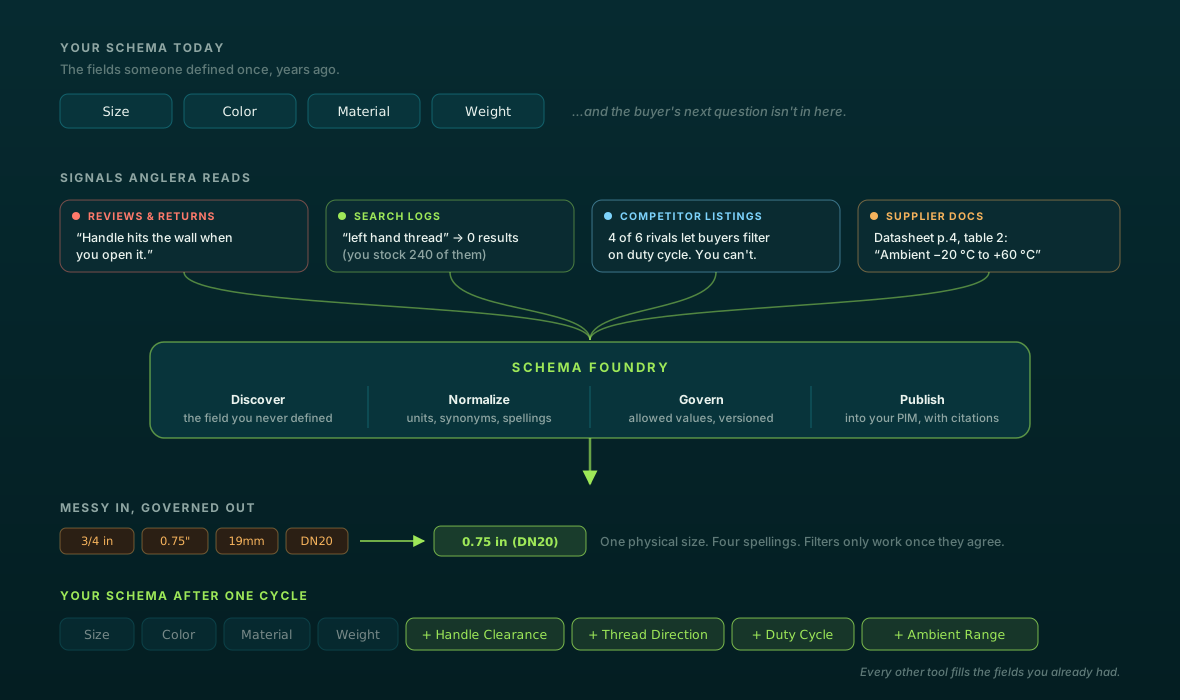
What both platforms share is an assumption: that the product data going into them is already complete, accurate, and optimized for how buyers actually search and compare. In practice, it never is. Supplier data arrives as raw specs and procurement-facing copy. Both tools give you a well-governed place to store and distribute that content; neither automatically makes it buyer-ready.
| Informatica PIM | inriver | Anglera | |
|---|---|---|---|
| Platform scope and orientation | Enterprise MDM+PIM — product data governance is one domain within Informatica's broader master data management stack (customer, supplier, location, financial); IT-led, positioned as an 'Agentic AI PIM' and authoritative system of record for product data inside a wider enterprise data architecture | Purpose-built SaaS PIM — composable platform covering the full product content lifecycle from supplier onboarding through omnichannel distribution and digital shelf performance monitoring; business-team-led, serving 1,600+ global brands | Enrichment layer only — not a PIM, not an MDM system; reads from whichever platform is the system of record, enriches every SKU against buyer signals, and writes results back |
| Syndication and digital shelf | Distribution happens via integrations into the broader enterprise stack — e-commerce platforms, ERP, downstream data consumers; no native syndication network or built-in digital shelf analytics | Native syndication and digital shelf analytics are core platform differentiators — inriver distributes content to channels and measures how it performs there, without requiring separate syndication tooling | Does not syndicate — enriches the content that Informatica or inriver then governs and distributes; works upstream of both platforms |
| AI and enrichment capability | AI agents built in under the 'Agentic AI PIM' positioning — enrich, validate, and manage product data directly inside the platform, governed by Informatica's broader AI and data intelligence infrastructure; outputs stay within the platform's governance framework | AI-assisted content generation and completeness scoring within the PIM workflow; AI helps teams fill attributes and improve channel readiness against internal schema rules and retailer requirements | Autonomous enrichment driven by external buyer signals — how real buyers in your category search, compare, and decide — not reformatted supplier copy or internal schema rules; writes results back to the PIM without a copywriter in the loop |
| Data governance and MDM depth | Full enterprise MDM built in — data stewardship, lineage, quality rules, and compliance governance across multiple master data domains; strongest compliance and audit depth of any PIM-adjacent platform | PIM-centric governance with structured workflows for supplier data onboarding and internal content teams; product data quality and channel readiness are the focus, not enterprise-wide MDM | PIM-agnostic — adapts to whichever data model and governance schema Informatica or inriver defines; no changes to governance workflows required |
| Implementation complexity and speed | Enterprise-grade implementation typically requiring dedicated IT, data architecture, and MDM expertise; full MDM+PIM configuration commonly runs 6–18 months depending on data domain scope and integration complexity | SaaS deployment is faster than on-premise MDM, but implementation still typically 3–9 months for a complex catalog; supplier onboarding configuration and channel syndication setup add scope before content flows end to end | ~30 days from kickoff to enriched SKUs written back to the PIM; no platform migration required |
| Pricing and total cost | Quote-only; Standard, Professional, and Enterprise tiers driven by users, data volumes, and configuration scope; widely cited as one of the more expensive enterprise PIM/MDM options on the market | Quote-only; Core, Professional, and Enterprise tiers sized by users, modules, and data volume; no public pricing floor; custom quotes only | Priced per SKU enriched — layers onto your existing PIM investment rather than replacing it |
| Best-fit buyer | Large enterprises with an existing Informatica MDM footprint, or those where a product data governance initiative is inseparable from a broader enterprise master data strategy managed by IT and data engineering | B2B brands, manufacturers, and distributors who want a business-team-friendly SaaS PIM that covers supplier onboarding, content governance, syndication, and digital shelf analytics in a single platform without a separate enterprise MDM program | Any B2B distributor, retailer, or manufacturer with an existing PIM who needs richer, buyer-ready product content without switching platforms |
How to choose between Informatica PIM and inriver
Choose Informatica Product 360 if you are a large enterprise where the product data governance challenge is part of a broader MDM initiative — one that also touches customer, supplier, financial, or location master data — and where Informatica is already part of the data stack. Product 360 is designed for IT-led, data-engineering-supported deployments. Its value compounds when you need a single governed system of record that connects product master data to the rest of the enterprise data architecture: ERP, data lakes, downstream analytics, compliance programs. If your PIM decision is being driven by a data governance team rather than a product or e-commerce team, and if MDM depth and audit capability are requirements alongside product content management, Informatica fits that profile.
Choose inriver if you are a brand, manufacturer, or distributor with a product-team or e-commerce-team driving the initiative, and your core pain points are content quality, supplier onboarding at scale, omnichannel distribution, and measuring how product content performs on the digital shelf. inriver's composable SaaS platform bundles PIM, syndication, and digital shelf analytics in one place — removing the integration work required to connect those three capabilities separately. Serving 1,600+ global brands, its composable architecture is built for the product content lifecycle from supplier to shelf, not for enterprise MDM governance across multiple data domains.
A few signals that clarify the choice:
- If you have an existing Informatica MDM investment and need product data to live inside that governed ecosystem, Product 360 is the natural extension — not a standalone decision.
- If your team wants PIM, syndication, and digital shelf analytics in a single SaaS contract without building a broader MDM architecture, inriver bundles all three.
- If your implementation is IT-owned and will be measured on data governance outcomes, Informatica. If it is business-owned and measured on content quality and channel performance, inriver.
- Both require a sales conversation before you see any pricing — build evaluation time accordingly, and scope the MDM requirements early if Informatica is in contention.
Whichever you pick, the data still has to get done
Both Informatica Product 360 and inriver assume your product data is already enriched — complete attributes, accurate specifications, descriptions written for how buyers actually search and compare. In practice, that data arrives from suppliers as raw specs, inconsistent formats, and copy written for procurement teams or the factory floor, not for the buyer on a product detail page.
Informatica's AI agents govern, validate, and manage data according to your established schema and governance rules. inriver's AI tools help teams fill attributes and improve completeness against internal templates. Both make the data better organized and better governed. Neither automatically generates the kind of buyer-signal-optimized content that drives search visibility, conversion, and filter performance in the channels where your customers actually make decisions.
Anglera is the layer that does that work. It connects to your PIM via API — whichever platform you choose — reads your existing SKUs, enriches every attribute and description against buyer signals, and writes the improved content back to the PIM record. Your system of record stays in place. Informatica's MDM governance workflows or inriver's syndication pipelines then operate on content that is already complete, accurate, and buyer-ready — not just well-organized. Implementation is ~30 days with no platform migration required. The two do not overlap: Informatica and inriver store and distribute product data; Anglera makes that data worth storing and distributing.
Frequently asked questions
What is the main difference between Informatica PIM and inriver?
Informatica Product 360 is an enterprise MDM+PIM platform — part of a broader data governance stack — designed for IT-led deployments where product data governance is one piece of an enterprise-wide master data strategy. inriver is a purpose-built SaaS PIM for brand, product, and e-commerce teams, bundling product content management, native syndication, and digital shelf analytics in a single composable platform. The core difference is scope and buyer: Informatica serves enterprise data teams managing multiple master data domains; inriver serves product and e-commerce teams managing content across channels.
Is Informatica Product 360 only for large enterprises?
In practice, yes. Informatica Product 360 is priced, scoped, and structured for large enterprises with IT-led data governance programs. The MDM depth, configuration complexity, and cost structure make it a poor fit for mid-market companies without a dedicated data management team and an existing Informatica footprint. Mid-market buyers evaluating enterprise PIM typically find purpose-built SaaS PIMs — like inriver, Akeneo, or Contentserv — better matched to their team structure and implementation capacity.
Does inriver replace the need for a separate syndication platform?
For most buyers, yes. inriver bundles native syndication and digital shelf analytics alongside its PIM, so there is no need for a separate syndication tool. This is one of its primary differentiators against pure-play PIMs and MDM-adjacent platforms like Informatica Product 360 — inriver handles the distribution and performance measurement side within the same platform, reducing integration complexity and vendor footprint.
How does Anglera work with Informatica PIM or inriver?
Anglera connects to your PIM via API, reads your existing SKUs, enriches every attribute and description against buyer signals — how your customers actually search, compare, and filter in your category — and writes the improved content back to the PIM record. The enrichment happens outside the PIM and is written back in, so your existing governance workflows, data models, and syndication pipelines continue to operate on better content. Implementation is ~30 days with no platform migration required.
Do I need Anglera if Informatica PIM already includes AI enrichment?
They do different jobs. Informatica's AI agents operate within the platform's governance framework — validating, classifying, and managing data according to your existing schema and stewardship rules. That is a data management function. Anglera enriches product content against external buyer signals — how real buyers search and compare in your category — and fills attribute and copy gaps that supplier data never addressed. The two are complementary: Informatica's AI governs and manages the data estate; Anglera researches, writes, and enriches the product content that lives inside it.