Informatica PIM vs Pimcore: Enterprise MDM Power vs Open-Source Flexibility
Informatica Product 360 and Pimcore both centralize product data and push it to channels. The similarity mostly ends there. Informatica is a proprietary enterprise platform that bundles PIM with Master Data Management — built for large organizations where product data governance is part of a broader data strategy and where deep integration with the rest of the enterprise stack is a requirement. Pimcore is an open-source PIM, DAM, MDM, and DXP platform built around developer extensibility and flexibility — used by over 118,000 companies across 75 countries, with published pricing and a free Community Edition that makes technical evaluation accessible before you commit.
The decision usually comes down to three factors: governance depth, total cost, and organizational fit. If you are a large enterprise with complex master data requirements, an existing Informatica footprint, and IT infrastructure to support a multi-month implementation, Product 360 is a natural extension of that stack. If you need open-source flexibility, want to avoid vendor lock-in, and have developer resources to configure and extend the platform, Pimcore offers meaningfully more transparency and control for the cost.
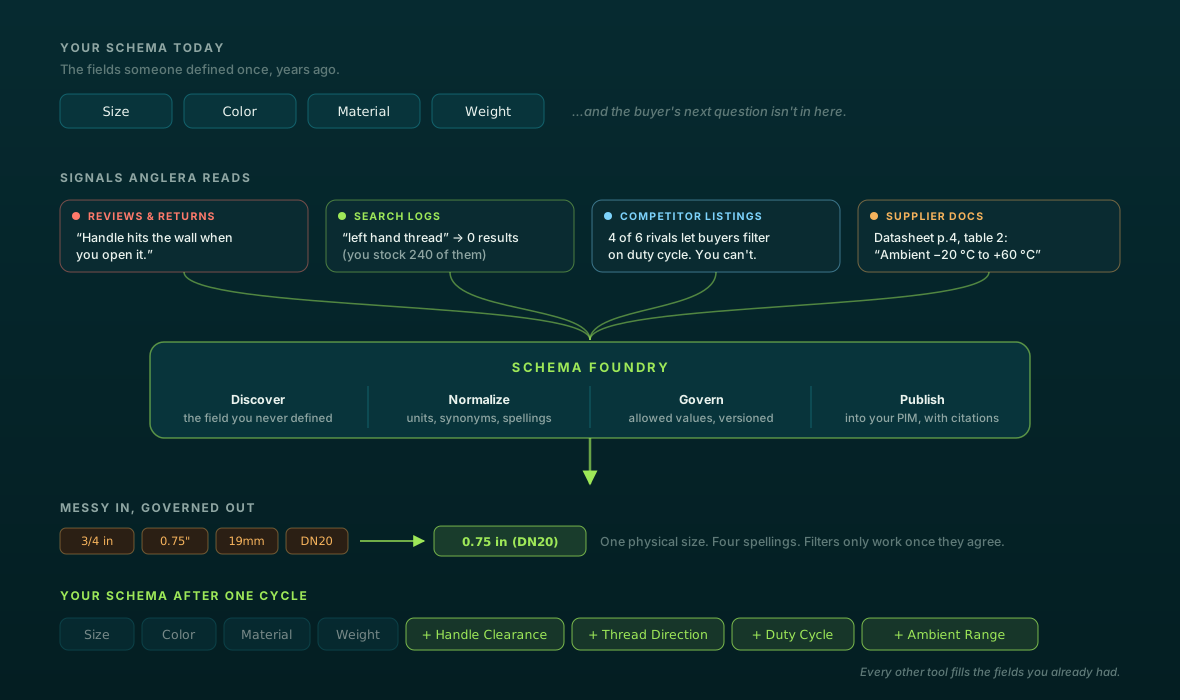
What neither platform solves is the upstream problem they share: the product data going into them is rarely buyer-ready. Supplier content arrives as raw specs, inconsistent attribute formats, and copy written for procurement teams — not for how industrial buyers, engineers, or end customers search and compare on a digital shelf. Both tools give you a well-governed, well-organized system of record. Neither automatically makes the content inside it perform.
| Informatica PIM | Pimcore | Anglera | |
|---|---|---|---|
| Platform architecture and licensing | Proprietary SaaS/cloud platform; Product 360 is part of Informatica's Intelligent Data Management Cloud (IDMC), tightly integrated with Informatica's MDM, data quality, and integration services; vendor-managed and closed-source | Open-source PIM, DAM, MDM, and DXP built on PHP/Symfony; Community Edition is free for non-commercial use; commercial tiers add SLA, support, and enterprise features; fully self-hostable or deployable on Pimcore's managed cloud | API-based enrichment layer; not a PIM or MDM; connects to either platform, enriches SKUs against buyer signals, and writes results back without changing the underlying data model or requiring platform migration |
| MDM and governance depth | Enterprise-grade MDM built in — survivorship rules, golden record management, data stewardship workflows, and data quality governance across the enterprise; one of the deepest MDM offerings in the market at large scale | MDM capabilities present within the platform but lighter than Informatica's enterprise offering; better suited to companies needing unified product and asset management than to those with complex master data survivorship and stewardship requirements across multiple data domains | Not an MDM tool; operates on product data quality and buyer-signal readiness — fills attribute gaps and improves content accuracy regardless of which governance layer sits above it |
| AI enrichment capability | "Agentic AI PIM" positioning — AI agents that enrich, validate, and suggest improvements to product data inside the platform; enrichment quality depends on the supplier copy already loaded; output is bounded by the input | No native AI enrichment; teams manually author and maintain product content; AI capabilities require custom development or third-party integrations on top of the open-source platform | Buyer-signal enrichment — determines what content each SKU needs based on how buyers actually search, filter, and decide; fills attribute gaps and rewrites copy accordingly; works alongside either platform and writes results back |
| Pricing and total cost | Quote-only; Standard, Professional, and Enterprise tiers; driven by users, data volume, and configuration scope; consistently cited as among the most expensive platforms in the PIM/MDM category; full TCO includes implementation, SI partner fees, and ongoing licensing | Community Edition free (non-commercial); Professional $9,900/year; Enterprise $29,900/year; PaaS from $39,900/year; most transparent published pricing in the PIM market; implementation and customization costs with a partner vary but are negotiable and competitive | Priced per SKU enriched — layers onto the existing PIM investment rather than replacing it; no implementation project required on the PIM side |
| Implementation timeline | Typically 6–18 months for a full enterprise deployment; involves IT, data architects, system integrators, and internal governance stakeholders; MDM configuration scope adds meaningful overhead beyond the PIM setup alone | Typically 3–12 months; experienced Pimcore implementation partners or capable in-house dev teams can reach the shorter end of that range; scope depends on catalog complexity, data model customization, and channel integration requirements | ~30 days to first enriched SKUs written back to the PIM; no platform migration, data model changes, or new implementation project required |
| Developer extensibility | Enterprise integration model via certified SI partners and Informatica Professional Services; extensions and customizations governed through IDMC APIs and platform services; best leveraged within established Informatica SI relationships rather than via internal dev teams working alone | Open-source codebase available for full inspection, forking, and extension; large community ecosystem of plugins, bundles, and implementation accelerators; internal dev teams can customize deeply without vendor gating or per-customization licensing costs | API-first integration; adapts to the existing PIM schema — no code changes to the underlying platform required on either side |
| Best-fit buyer | Large enterprises with complex MDM requirements, existing Informatica infrastructure, and the budget and IT capacity for a multi-month deployment; companies where product data governance is part of a broader enterprise data strategy spanning multiple data domains | Companies from mid-market to large enterprise that need a flexible, configurable PIM/DAM platform with developer control and published pricing; particularly strong for teams with in-house development capability who want to avoid long-term vendor lock-in at a high license cost | Any B2B distributor, retailer, or manufacturer who needs richer, buyer-ready product content without switching PIMs — works equally well as the enrichment layer on top of either platform |
How to choose between Informatica PIM and Pimcore
Choose Informatica Product 360 if you are a large enterprise already operating within the Informatica ecosystem, or if you need enterprise-grade MDM capabilities tightly coupled with your PIM. Product 360 is designed for organizations where product data governance is part of a broader master data strategy — covering survivorship rules, data stewardship workflows, golden record management, and deep integration with the rest of the Informatica IDMC stack. If your IT organization is comfortable with multi-month enterprise implementations, you have certified SI partners engaged, and a single vendor for both MDM and PIM governance is the goal, Informatica is a defensible choice. The cost is significant — expect quote-based pricing that sits materially above most alternatives — but the enterprise governance depth is difficult to replicate at a lighter price point.
Choose Pimcore if you need a flexible, extensible PIM/DAM/MDM platform without vendor lock-in. Pimcore's open-source architecture gives internal development teams genuine control over the data model, workflows, and integrations. The published pricing — starting at $9,900/year for professional production use — is unusually transparent for the PIM category, and the Community Edition allows deep technical evaluation at no cost before you commit. Pimcore scales from mid-market through large enterprise and is particularly strong for companies that need a unified PIM and DAM in a single platform, or for developer-forward organizations that want to build on an open codebase rather than be constrained by a closed enterprise platform.
A few signals that clarify the choice:
- If you are already paying for Informatica products and your MDM and PIM governance requirements are tightly coupled across multiple data domains, Product 360 is the natural extension of that investment.
- If your team has in-house developer capability and you want to avoid long-term vendor lock-in at enterprise license costs, Pimcore's open-source model offers meaningfully more flexibility.
- If budget transparency matters during evaluation, Pimcore wins clearly — Informatica's quote-only pricing typically runs well above Pimcore's commercial tiers, and the full TCO gap widens further when SI fees are included.
- If your catalog is large enough to require enterprise MDM governance — survivorship, golden records, multi-domain stewardship — Informatica's depth in that area is genuinely harder to replicate on Pimcore at the same level without significant custom development.
Whichever you pick, the data still has to get done
Both Informatica Product 360 and Pimcore assume your product data is already enriched — complete attributes, buyer-ready descriptions, and titles that match how buyers actually search. In practice, data arrives from suppliers as raw specs, inconsistent formats, and copy written for procurement teams rather than for how engineers, buyers, or end customers filter and compare on a digital shelf.
Informatica's "Agentic AI" enrichment operates on whatever supplier copy is already loaded into Product 360. It refines and validates against internal governance rules, but it starts from the supplier content you already have rather than from buyer search behavior. Pimcore has no native AI enrichment at all — content quality depends entirely on your team and whatever manual workflows you build. In both cases, the enrichment work either doesn't happen autonomously or falls on internal resources with no buyer-signal foundation to work from.
Anglera is the layer that handles it. It connects to your Informatica or Pimcore instance via API, reads your existing SKUs, enriches every attribute and description against buyer signals — how your customers actually search, compare, and filter — and writes the improved content back to the same PIM record. Your system of record stays in place, whichever platform you choose. The content it stores becomes buyer-ready rather than just well-organized. Implementation is ~30 days with no migration required on either side.
Frequently asked questions
What is the main difference between Informatica PIM and Pimcore?
Informatica Product 360 is a proprietary enterprise platform combining PIM and Master Data Management — built for large organizations with complex data governance requirements and existing Informatica infrastructure. Pimcore is an open-source PIM, DAM, MDM, and DXP platform with published pricing, a free Community Edition, and a developer-extensible architecture built for flexibility and avoiding vendor lock-in. The core trade-off is enterprise governance depth versus open-source flexibility and cost transparency.
Is Pimcore suitable for large enterprise deployments, or is it only for smaller companies?
Pimcore is used by over 118,000 companies across 75 countries, including large enterprise deployments. Its open-source architecture scales well when paired with experienced implementation partners or in-house dev teams. The Enterprise Edition ($29,900/year) and PaaS option ($39,900/year) are designed for large-scale production environments with enterprise SLAs. The main limitation at enterprise scale is that Pimcore's MDM governance capabilities are lighter than Informatica's — companies with complex master data survivorship and stewardship requirements spanning multiple data domains may find Informatica's depth worth the cost premium.
Does Informatica's Agentic AI enrichment replace the need for a separate enrichment tool?
For most B2B distributors and manufacturers, no. Informatica's AI agents work on data already inside the platform — they refine, validate, and suggest improvements based on what supplier content exists. They don't start from buyer signals: how buyers actually search, filter, and compare against competing SKUs. If your challenge is supplier data that arrives raw, incomplete, or optimized for procurement rather than digital discovery, Informatica's AI improves what you already have rather than filling the buyer-signal gap. Anglera starts from what buyers look for and works backward to determine what each SKU needs.
How does Anglera work with Informatica Product 360 or Pimcore?
Anglera connects to your PIM via API, reads your existing SKUs and attributes, enriches them against buyer signals — how your customers actually search, compare, and decide — and writes the improved content back to the same PIM record. No migration is required. Whether your system of record is Informatica or Pimcore, Anglera enriches the data inside it in roughly 30 days without any changes to the underlying platform or data model.
Which is better for B2B distributors — Informatica PIM or Pimcore?
Both serve B2B distributors, but in different ways. Informatica is the better fit if you are an enterprise organization with complex master data governance needs already embedded in the Informatica ecosystem. Pimcore tends to be the better fit for distributors who need a flexible, configurable PIM/DAM without a large license cost, especially if you have internal development capability. For most mid-market B2B distributors, Pimcore's pricing transparency and open-source flexibility are the stronger starting point; Informatica makes more sense if enterprise-grade MDM governance across multiple data domains is a non-negotiable requirement.