Informatica PIM vs Rithum: Two Different Problems, One Catalog
Informatica Product 360 and Rithum are rarely true head-to-head competitors. They address adjacent but fundamentally different problems: one governs product master data at the enterprise level, the other moves it across hundreds of retail and marketplace channels. A buyer comparing them directly is usually trying to figure out which problem to solve first — or whether they can afford to solve both.
Informatica Product 360 is an enterprise MDM and PIM platform. Its job is to make product data authoritative: a governed, clean, consistent system of record that spans business units, locales, and downstream systems. Rithum — the 2023 combination of CommerceHub, ChannelAdvisor, and Dsco — is a commerce operations engine. Its job is to get products listed, fulfilled, and optimized across 420+ marketplace and retail channels. Where Informatica organizes and governs the catalog, Rithum puts it in front of buyers at scale.
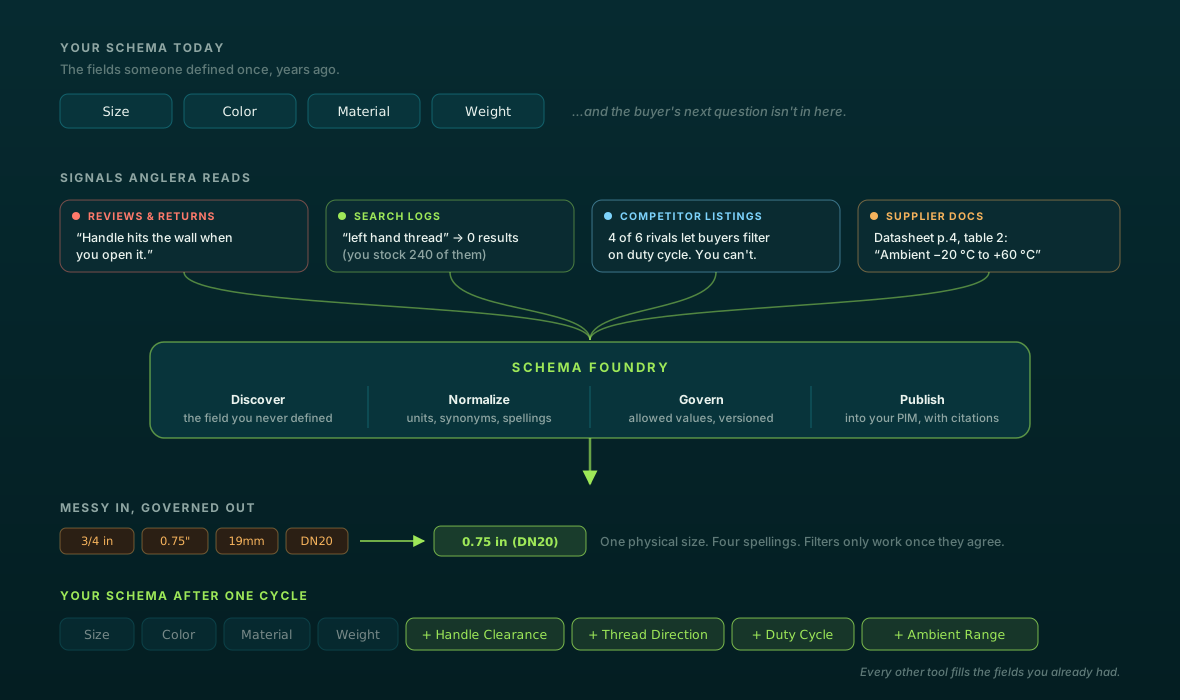
What neither platform does on its own is make the underlying product content buyer-ready. Supplier data arrives thin, inconsistent, and written for procurement teams rather than digital shoppers. Both Informatica and Rithum assume that work has already happened. In most B2B catalogs, it has not — and that is the gap Anglera fills regardless of which platform sits at the center of your stack.
| Informatica PIM | Rithum (ChannelAdvisor / CommerceHub) | Anglera | |
|---|---|---|---|
| Primary job | Centralize and govern product master data — single source of truth with MDM-grade workflows, taxonomy management, role-based approvals, and audit controls across the enterprise | Syndicate product listings and automate order and inventory workflows across 420+ marketplace and retail channels for 40,000+ brands and retailers | Enrichment layer — not a PIM or syndication platform; crawls supplier content, builds complete attributes, and writes buyer-ready records back to whichever system is the source of truth |
| Channel reach and distribution | Not a syndication tool; distributes to downstream systems via APIs and integrations, but channel publishing requires connected platforms or custom builds | Core strength: 420+ pre-built connections covering Amazon, Walmart, major retailers, drop-ship networks, and marketplaces worldwide — channel breadth is Rithum's defining advantage | Channel-agnostic; enriched content is written back to the PIM or fed into Rithum so every listing starts with complete, accurate product data regardless of destination |
| Data governance and workflow | Enterprise MDM workflows, data quality rules, data stewardship roles, hierarchical taxonomy management, and full audit trails — designed for large organizations with complex multi-domain data requirements | Feed-level rules and listing optimization within channels; not a data governance platform; product data quality is assumed to have been handled upstream before it enters the system | Complements governance by ensuring attributes meet completeness and accuracy thresholds before records enter Informatica's approval workflows — less manual cleanup for data stewards |
| Enrichment capability | Positions itself as an 'Agentic AI PIM' with AI agents that enrich and validate data inside the platform; enrichment quality depends on what was loaded in; governance remains the primary design priority | Listing optimization and analytics at the channel level — not content enrichment; better-quality product data must come from upstream; Rithum does not generate or fill attributes | Core function: extracts and normalizes attributes from supplier sources, resolves conflicts, scores completeness against buyer signals, and writes enriched records back — autonomous and not dependent on what the PIM already contains |
| Implementation complexity | Long enterprise project: significant data modeling, IT integration, and change management investment required; typical timelines range from 6 to 18 months for full deployment | Channel integrations can go live faster than a full MDM rollout, but scaling across a large catalog requires ongoing feed configuration, exception handling, and channel-specific mapping effort | ~30 days from kickoff to enriched SKUs written back to the source of truth; connects to your existing PIM or data source without a platform migration |
| Pricing model | Quote-only; Standard, Professional, and Enterprise tiers; pricing driven by user count, data volume, and configuration scope; widely cited as expensive at enterprise scale | Quote-only; custom enterprise pricing based on GMV and channel usage; cost scales with commerce volume rather than seat count or SKU volume | Priced per SKU enriched — not tied to GMV, seat count, or implementation scope; layers onto the existing platform investment rather than replacing it |
| Best buyer fit | Large manufacturers, distributors, or retailers with complex multi-domain data governance needs, multiple business units, dedicated data management teams, and a multi-year platform roadmap | Brands and retailers whose primary challenge is channel reach — getting products listed, fulfilled, and optimized across dozens or hundreds of marketplace and retail accounts at scale | Any organization that needs richer, buyer-signal-optimized product content upstream of whichever platform governs or distributes the catalog |
How to choose between Informatica PIM and Rithum (ChannelAdvisor / CommerceHub)
Choose Informatica Product 360 if your primary problem is data chaos inside the organization. You have product master data spread across business units, ERPs, or legacy systems; attributes are inconsistent, governance is ad hoc, and there is no authoritative single source of truth. Informatica is a major infrastructure investment — plan for a 6-to-18-month implementation and a dedicated data management team to run it — but it is purpose-built for exactly that problem at enterprise scale. It is the right choice when MDM governance, taxonomy control, and data quality workflows are the foundation everything else depends on.
Choose Rithum if your primary problem is channel distribution. You have a reasonably complete product catalog and need to get it in front of buyers across Amazon, Walmart, drop-ship retail networks, and 400+ other channels with minimal manual feed maintenance. Rithum's channel breadth and commerce operations automation — feed management, order routing, inventory sync — are its core strengths, and they are hard to replicate with a PIM alone. The right buyer for Rithum is a brand or retailer where marketplace reach and fulfillment automation are the metrics that matter most.
A few signals that clarify the choice:
- If product data inconsistency is causing downstream problems across teams and systems, Informatica's MDM governance solves the root cause.
- If your catalog is already reasonably governed and the problem is reach — too few channels, too much manual feed work — Rithum is the operational layer you need.
- If you need both, Informatica and Rithum are complementary: Informatica as the upstream system of record, Rithum as the downstream distribution engine. Many enterprise retailers run exactly this combination.
- Neither platform has public pricing; budget a genuine discovery call with each before drawing conclusions about total cost of ownership.
Whichever you pick, the data still has to get done
Both Informatica Product 360 and Rithum make the same implicit assumption: that the product data entering the system is already complete, accurate, and attribute-rich. Informatica assumes the records it governs are worth governing. Rithum assumes the listings it syndicates are worth listing. In practice, supplier-provided data is thin, attribute coverage is inconsistent, and descriptions are written for procurement teams rather than the buyers who search, compare, and convert on digital channels.
Anglera operates upstream of both. It connects to your existing data source — whether that is Informatica Product 360 acting as the system of record, an ERP export feeding Rithum, or a simpler PIM in between — crawls supplier content, extracts and normalizes attributes, resolves conflicts across sources, and scores every SKU against the buyer signals that actually drive search relevance and conversion. Enriched, validated records are then written back to the source of truth.
Anglera does not replace Informatica's governance or Rithum's channel network. It does the enrichment work both platforms assume already happened — so what Informatica governs is complete, and what Rithum syndicates is buyer-ready. Implementation takes roughly 30 days and requires no platform migration.
Frequently asked questions
Are Informatica PIM and Rithum actually competing products?
Not directly. Informatica Product 360 is a master data management and PIM platform — it governs and centralizes product data. Rithum is a commerce operations and channel syndication platform — it distributes that data across 420+ retail and marketplace channels. Many enterprise retailers use both: Informatica as the upstream system of record and Rithum as the downstream distribution engine. If you are choosing between them, the real question is which problem you need to solve first.
Can Rithum replace a PIM like Informatica Product 360?
No. Rithum is built for channel distribution and commerce operations — feed automation, order routing, marketplace listing management. It does not provide MDM governance, taxonomy management, or the data quality workflows that a platform like Informatica is designed to enforce. If you need an authoritative, governed source of truth for product master data, a PIM or MDM is required. Rithum assumes that data already exists and is ready to distribute.
Does Informatica Product 360 handle channel syndication?
Not natively at the scale Rithum provides. Informatica Product 360 distributes data downstream via APIs and integrations, but the 420+ pre-built marketplace and retail channel connections are Rithum's domain. Informatica is the system of record; a dedicated syndicator or commerce operations platform handles the channel distribution layer.
Where does Anglera fit if I already use Informatica Product 360?
Anglera connects upstream — it enriches and completes product records before they enter your Informatica governance workflows. Your data stewards spend less time manually filling attribute gaps and more time on the governance work Informatica is designed for. Enriched records are written back to Informatica as the system of record; your data model and approval workflows stay unchanged.
Where does Anglera fit if I already use Rithum?
Anglera enriches your product catalog at the source before it enters Rithum's feed management layer. Better input data means fewer listing errors, higher channel acceptance rates, stronger search relevance on marketplaces, and more complete content reaching end buyers — all without changing your Rithum configuration or channel setup. Implementation is approximately 30 days.