Informatica PIM vs Unilog CX1 / CIMM2: Which Platform Fits Your Stack?
Informatica Product 360 and Unilog CX1 solve different problems for different buyers, and choosing the wrong one wastes months. Informatica is an enterprise MDM and PIM platform built around data governance — it is designed to be the authoritative system of record across business units, not just a product catalog. Unilog CX1 is an all-in-one B2B commerce suite purpose-built for mid-market distributors in verticals like electrical, industrial, plumbing, and HVAC — storefront, PIM, content library, and ERP connector in a single vendor relationship.
The buyer comparing these two tools is usually not on the fence between MDM governance and a B2B storefront. More often, one platform clearly fits the organizational context and the question is whether the capabilities hold up under scrutiny. This page lays out the honest differences across the dimensions that drive real buying decisions: platform scope, product content depth, pricing structure, implementation lift, and AI / automation maturity.
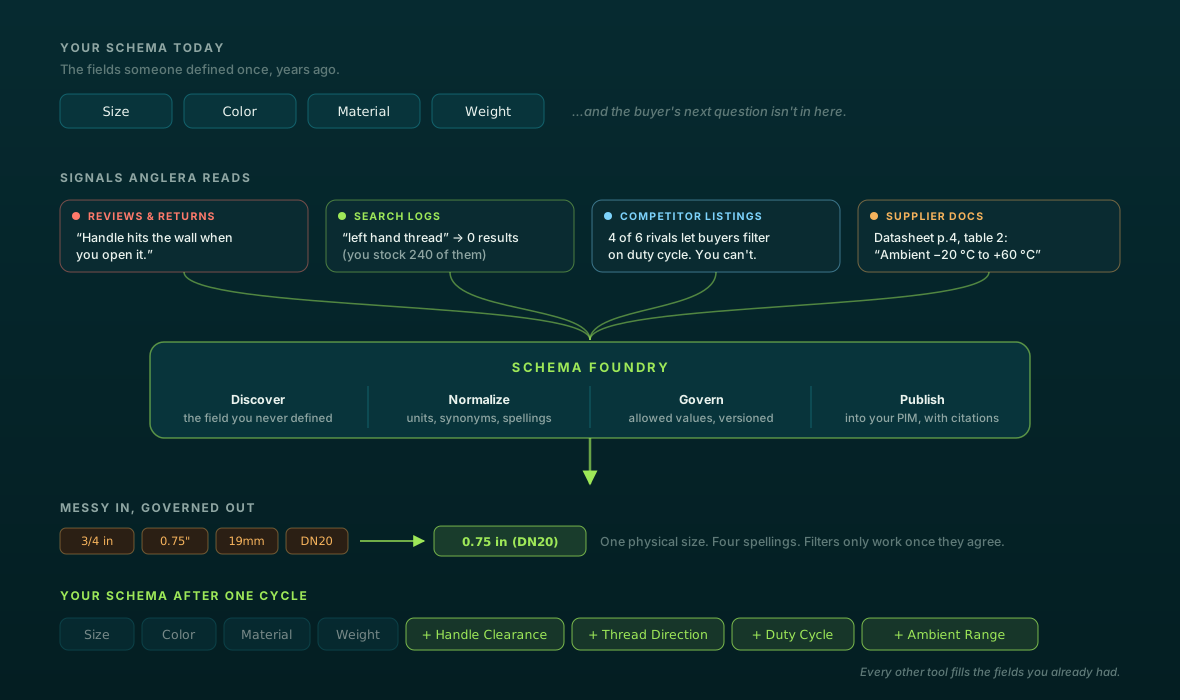
One thing both platforms share: neither is designed to continuously enrich your catalog against live buyer signals. Informatica governs and validates the data you already have. Unilog supplements it with a managed vendor content library. The ongoing work of scoring every SKU against what buyers actually search for, detecting specification gaps, and writing improved data back to your system of record is a separate problem — and that is where Anglera fits alongside either platform.
| Informatica PIM | Unilog CX1 / CIMM2 | Anglera | |
|---|---|---|---|
| Target buyer | Large enterprises — manufacturers, retailers, and distributors running multi-system MDM programs who need a governed system of record across business units, regions, and data domains. | Mid-market B2B distributors in electrical, industrial, plumbing, and HVAC who want a single vendor to handle storefront, PIM, content, and ERP connectivity without assembling a best-of-breed stack. | Works with both segments. Anglera targets catalog owners who need richer, buyer-signal-driven product data — regardless of platform size or vertical. |
| Platform scope | MDM + PIM + AI governance in one enterprise stack. Built to be the authoritative data record across the entire organization, not just a product catalog. | eCommerce storefront + PIM + CMS + site search + ERP integration in one suite. Built to run B2B digital commerce end to end for distributors. | Narrow and deep: Anglera gathers, cleans, enriches, and scores product data, then writes it back to your PIM. It does not replace your storefront, MDM layer, or CMS. |
| Product content and enrichment | Data quality governance, validation workflows, and AI agents that enrich data inside the platform — but you supply the raw content. No managed SKU library. | Managed library of 10M+ vendor SKUs from approximately 2,000 manufacturers, sold as content subscriptions. Gap-fill, taxonomy, and normalization services are available as add-ons. | Enriches your own catalog against live buyer signals — search behavior, specification gaps, competitor content, and channel requirements. Scores every SKU and surfaces what needs work. |
| Pricing model | Quote-only. Standard, Professional, and Enterprise tiers scaled by users, data volume, and configuration scope. Widely cited as among the more expensive PIM/MDM platforms on the market. | Quote-based SaaS, not self-serve. Entry pricing cited in the low hundreds of dollars per month, but real deployments scale with catalog size, modules selected, and content subscription tiers. | Separate subscription layered on top of either platform. The ~30-day implementation keeps onboarding cost well below either alternative, and enrichment value compounds over time. |
| Implementation timeline | Enterprise-grade; implementations typically run many months, involving data modeling, workflow configuration, MDM governance setup, and IT integration across the data stack. | A multi-month project scoped by catalog size, ERP connectivity, and content migration — but purpose-built for distribution workflows reduces customization overhead compared to a general MDM. | Approximately 30 days. Connects to your existing PIM or catalog and starts enriching without requiring a platform migration or additional IT infrastructure. |
| AI and automation | Positions as an "Agentic AI PIM" — AI agents enrich, validate, and manage product data directly inside the governance layer. AI is a first-class part of the platform architecture. | Content enrichment is largely managed-service driven — human-assisted taxonomy, normalization, and gap-fill from Unilog's content team rather than AI-native automation inside the PIM. | AI-driven enrichment against buyer signals, automated quality scoring, and continuous specification gap detection. Runs on your live catalog and writes updates back to the PIM. |
| ERP and channel integrations | Broad enterprise data stack integrations across ERP, MDM, DAM, and marketing systems. Designed for complex, multi-system environments with diverse integration requirements. | CX1 Connect layer built for distribution ERPs and POS systems. Native to the workflows of electrical, industrial, and HVAC distributors, particularly among AD member companies. | Reads from and writes back to your PIM. Integrates with distribution catalogs, channel feeds, and eCommerce platforms without replacing the integration layer you already have in place. |
How to choose between Informatica PIM and Unilog CX1 / CIMM2
Choose Informatica Product 360 if you are a large enterprise with a genuine MDM problem — multiple business units, cross-functional data governance requirements, and a need to make product data the authoritative record across systems that extend well beyond a single storefront. The AI governance layer and MDM breadth are real differentiators at that scale. Be prepared for enterprise pricing, a substantial implementation timeline, and an internal champion who can drive a multi-month configuration project.
Choose Unilog CX1 if you are a mid-market B2B distributor in electrical, industrial, plumbing, or HVAC and you want a single vendor to handle your storefront, PIM, content library, and ERP connection. The managed content library of 10M+ SKUs from ~2,000 manufacturers is a concrete head start for distributors with large vendor catalogs and limited internal enrichment staff. If you are an AD member, the concentration of peer companies on the platform and the vertical-specific content library make the case stronger. You give up best-of-breed flexibility, but you gain speed to launch and a vendor that already speaks distribution.
Do not choose Unilog if your organization runs complex multi-system MDM governance, operates across business units with divergent data models, or needs deep customization of the PIM layer independent of the storefront. Do not choose Informatica Product 360 if you are a mid-market distributor that needs to launch an eCommerce channel quickly — the platform scope and cost are sized for problems larger than a single B2B storefront.
Whichever you pick, the data still has to get done
Both platforms store and distribute product data — neither is designed to continuously enrich it against what buyers actually search for. Informatica's AI agents operate inside the governance layer and work on the data you have already supplied. Unilog's content services deliver vendor-supplied catalog data from a managed library. Neither replaces the ongoing work of scoring your catalog against live demand signals, detecting specification gaps as channel requirements shift, and updating records before those gaps cost you conversions.
That is where Anglera fits. After either platform is live, Anglera connects to your PIM or catalog, enriches every SKU against buyer signals, scores completeness against channel requirements, and writes the improved data back to your system of record — whether that is Informatica Product 360 or the Unilog CX1 PIM. Your PIM stores the data; Anglera does the work. Implementation takes approximately 30 days and does not require replacing or re-implementing either platform.
Whichever tool wins your evaluation, the enrichment problem does not go away once the platform is live. Anglera is the layer that handles it.
Frequently asked questions
Can Anglera replace the product content subscription from Unilog?
No — and the two are solving different problems. Unilog's managed content library provides pre-built, normalized vendor SKU data from approximately 2,000 manufacturers at catalog scale. Anglera enriches your own SKUs against buyer signals and channel requirements. They are complementary: Unilog populates baseline content for vendor SKUs you carry; Anglera keeps the full catalog accurate, scored, and competitive over time.
Does Informatica Product 360's Agentic AI make a separate enrichment tool unnecessary?
Informatica's AI agents govern and validate data inside the platform, but they operate on the data you already have. They do not continuously monitor buyer search behavior, detect specification gaps relative to what competitors surface, or score every SKU against live channel requirements. Anglera does that work and writes the output back into Product 360, so the system of record stays current without manual intervention.
We are in electrical distribution with an AD membership. Does that favor Unilog?
Yes, meaningfully. Unilog has more than 50 AD member companies on the platform, a managed content library built around electrical and industrial SKUs, and ERP integrations designed for distribution workflows. That is a real head start in your vertical — both in terms of implementation speed and the relevance of the managed content — compared to configuring a general-purpose enterprise MDM from scratch.
Which platform gets us live faster?
Unilog is designed for mid-market distributors to launch eCommerce on a faster timeline than a full enterprise MDM implementation. Informatica Product 360 implementations typically run many months given the MDM governance scope, data modeling, and IT integration requirements. Anglera adds approximately 30 days on top of either platform and can start running against your catalog while the main implementation is still underway.
Can Anglera work if we have not chosen a PIM yet?
Yes. Anglera connects to whatever catalog or data source you have — spreadsheets, ERP exports, or a staging environment — while you evaluate platforms. Most customers find it easier to migrate enriched, scored, and gap-filled data into their new PIM than to enrich after migration. Starting enrichment before the platform decision is final also gives you cleaner data to demonstrate during vendor pilots.