inriver vs Pimberly: Which PIM Is Right for Your Business?
inriver and Pimberly are both cloud PIM platforms with strong multi-channel publishing stories. On the surface they look interchangeable. Under the hood they serve meaningfully different buyers, and picking the wrong one costs you a year of implementation work before you realize it.
inriver is built for the full product content lifecycle — from supplier onboarding through omnichannel distribution and digital shelf performance monitoring. Its composable architecture and explicit B2B orientation make it a natural fit for manufacturers, brands, and distributors managing deep product hierarchies, complex attribute trees, and many channel variants. Syndication and digital shelf analytics are bundled into the same platform, not bolted on. Pimberly approaches the problem from the e-commerce and retail side: a PIM and DAM in one, purpose-built for mid-market teams managing high SKU counts across many publishing channels. Its strength is workflow automation — validation rules, channel publishing pipelines, and digital asset management that keeps product content moving without a large catalog ops team.
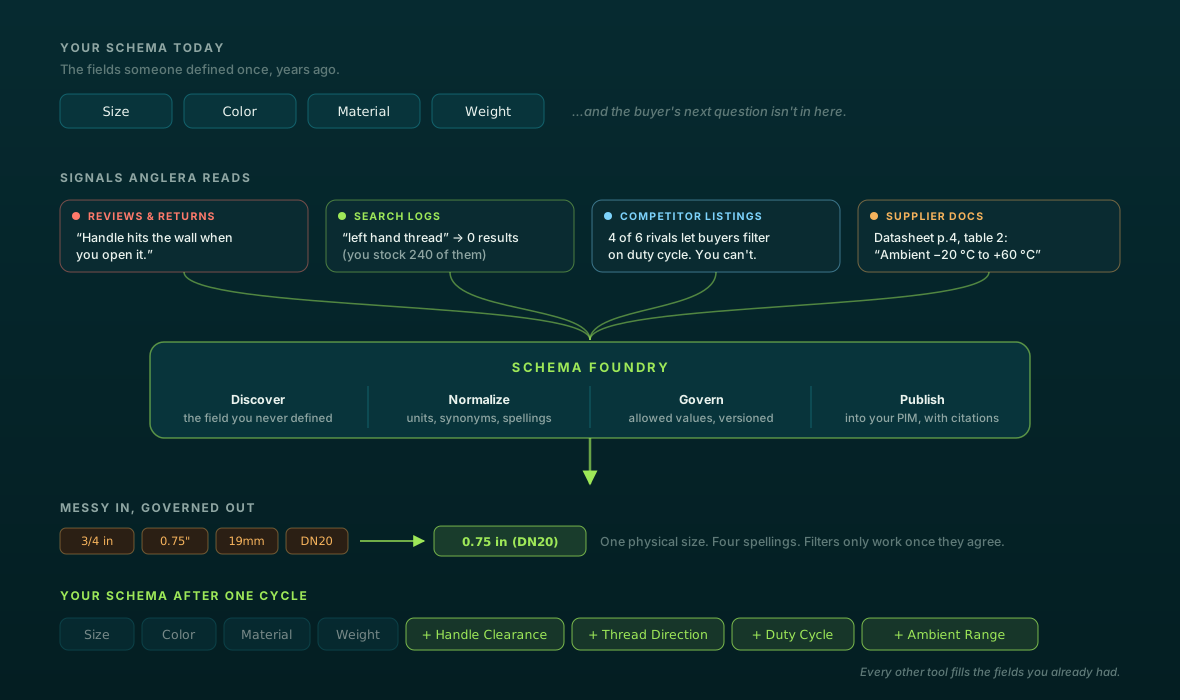
Neither platform solves the problem they share: the product data going into them is rarely buyer-ready. Supplier content arrives as raw specs written for procurement teams, not for how buyers search and compare online. Both tools give you a well-governed place to store and distribute that content; neither automatically makes it better.
| inriver | Pimberly | Anglera | |
|---|---|---|---|
| Primary orientation | PIM-first, composable — designed for the full product content lifecycle from supplier onboarding through digital shelf performance; marketed explicitly at B2B manufacturers, brands, and distributors with complex product relationships | PIM + DAM, all-in-one — designed for mid-market e-commerce and retail teams managing large SKU counts across multiple sales channels; emphasis on workflow automation, asset management, and channel publishing | Enrichment layer — not a PIM, DAM, or syndication platform; reads from whichever system you already run, enriches every SKU against buyer signals, and writes results back |
| Syndication & digital shelf analytics | Built-in syndication and digital shelf analytics are core to the platform — inriver tracks live channel performance and feeds that data back into the same PIM workflow, closing the content-to-shelf loop without a third-party tool | Automates channel publishing workflows and integrates with major e-commerce channels, but digital shelf analytics is not a bundled core module in the same way — publishing automation is the strength, post-publication performance monitoring less so | Does not syndicate or track digital shelf metrics — enriches the content that inriver or Pimberly then distributes; works upstream of both platforms |
| DAM / digital asset management | DAM capabilities exist but are not the platform's primary selling point — most inriver deployments integrate with a separate DAM or use the PIM-side asset association rather than a full-featured native DAM | Native DAM is a first-class feature — Pimberly stores, versions, and links digital assets (images, video, documents) directly to product records, making it a single source of truth for both data and assets in mid-market e-commerce deployments | Not a DAM; enriches structured product data including copy, attributes, and specifications — asset management stays with the PIM or DAM of record |
| Data model & product relationship complexity | Designed for complex B2B product hierarchies — multi-level product relationships, deep attribute trees, variant management across many channels and locales; composable architecture means it fits into an existing enterprise tech stack without replacing it | Handles large SKU catalogs well but is optimized for breadth and volume over deep relational complexity; better suited to retailers and e-commerce teams managing many products across many channels than manufacturers with intricate component-level product relationships | PIM-agnostic — adapts to whatever data model and attribute schema inriver or Pimberly defines; no data model changes required on your end |
| Pricing & total cost | Subscription-based across Core, Professional, and Enterprise tiers; no public pricing — custom quotes only; positioned for mid-market and enterprise, typically in line with or above Pimberly's entry point | Starts at approximately $30,000/year with custom pricing above that based on SKU volume and channel count; lower stated entry point than most enterprise PIM alternatives, though total cost scales with scope | Priced per SKU enriched — layers onto your existing PIM investment rather than replacing it; no platform migration cost |
| Implementation speed | Enterprise PIM implementations typically run 3–12 months depending on data model complexity, supplier onboarding scope, and integrations; the full lifecycle value (including digital shelf analytics) takes time to configure and activate | Typically several months for full onboarding and governance setup; mid-market positioning means implementations can move faster than inriver for teams with simpler data models, but a full multi-channel PIM + DAM rollout still takes time | ~30 days from kickoff to enriched SKUs written back to the PIM — no platform migration required; connects to whichever PIM is already in place |
| Best fit | B2B manufacturers, brands, and distributors managing complex product hierarchies, multi-level relationships, and multi-channel distribution who need syndication and digital shelf analytics built into the same lifecycle platform | Mid-market e-commerce and retail teams managing high SKU counts across many sales channels who need a combined PIM and DAM with strong publishing workflow automation — and a lower entry price than enterprise-tier competitors | Any B2B distributor, retailer, or manufacturer with an existing PIM who needs richer, buyer-ready product content without switching platforms |
How to choose between inriver and Pimberly
Choose inriver if you are a B2B manufacturer, brand, or distributor managing complex product relationships — deep attribute hierarchies, multi-level component relationships, many channel variants, and supplier onboarding at scale. inriver's composable architecture and full lifecycle model (supplier onboarding through digital shelf performance monitoring) are purpose-built for that complexity. The bundled syndication and digital shelf analytics mean you are not stitching together a separate channel monitoring tool on top of your PIM. If your product data is inherently complex and your channels are many, inriver's design assumptions match your operational reality more closely than Pimberly's.
Choose Pimberly if you are a mid-market e-commerce or retail team managing large SKU volumes across many channels and you need a combined PIM and DAM without the enterprise price tag. Pimberly's publishing workflow automation, native DAM, and lower stated entry point (~$30,000/year) make it a practical choice for teams that need to move product content to market quickly and keep assets and data in one place. If your primary pain point is channel publishing automation and asset management — not deep B2B product hierarchy modeling — Pimberly tends to fit better.
A few signals that clarify the choice:
- If your catalog is industrial or technical with many inter-related product variants and you need supplier onboarding tools, inriver's B2B lifecycle model wins.
- If you are a retailer or e-commerce-first business managing thousands of SKUs and digital assets without deeply complex relational data models, Pimberly's PIM + DAM combo is more straightforward to operate.
- If digital shelf performance monitoring is a core KPI — not a nice-to-have — inriver's built-in analytics give you that loop without a separate integration.
- If budget ceiling matters, Pimberly's lower entry point gives more room to pilot before committing to enterprise-scale pricing; inriver requires a sales conversation with no public floor.
Whichever you pick, the data still has to get done
Both inriver and Pimberly assume your product data is already enriched — complete attributes, buyer-ready descriptions, titles written the way your actual customers search. In practice, data arrives from suppliers as raw specs formatted for procurement teams, not for digital shelf performance. Both platforms give you a sophisticated, well-governed place to store and distribute that content. Neither automatically makes it better.
The work that still falls on your team — researching how buyers search, identifying which attributes are missing and which ones actually drive conversions, writing copy that converts rather than just describes — is the same regardless of which PIM you choose. That work is what Anglera handles.
Anglera connects to your inriver or Pimberly instance via API, reads your existing SKUs, enriches every attribute and description against buyer signals — how your customers actually search, compare, and filter in your specific categories — and writes the improved content back to the same PIM record. Your system of record stays in place. The enrichment quality lifts across the catalog. The content inriver or Pimberly then governs and distributes is buyer-ready from the start, not just well-organized. Implementation is ~30 days with no platform migration required — whichever PIM you pick, Anglera is the layer that does the work the PIM assumes already happened.
Frequently asked questions
What is the main difference between inriver and Pimberly?
inriver is a composable, lifecycle-oriented PIM built for B2B manufacturers, brands, and distributors managing complex product hierarchies — with built-in syndication and digital shelf analytics as part of the same platform. Pimberly is an all-in-one PIM and DAM aimed at mid-market e-commerce and retail teams managing high SKU volumes across many channels, with a lower entry price and stronger native asset management. Both store and govern product data; the difference is vertical orientation, data model complexity, and which bundled capabilities matter most for your workflow.
Does inriver include DAM features, or do I need a separate tool?
inriver includes some asset association capabilities within the PIM, but a full-featured DAM is not its primary strength. Most enterprise inriver deployments integrate with a dedicated DAM. Pimberly's native DAM is a more central feature of its offering, making it a better fit for teams that need asset management and product data management in one platform without an additional integration.
How does Anglera work with inriver or Pimberly?
Anglera connects to your PIM via API, reads your existing SKUs, runs enrichment against buyer signals — how your customers actually search, compare, and filter — and writes the improved attributes and copy back to the same record in inriver or Pimberly. No migration is required. Anglera works alongside whichever platform you choose and typically goes live in about 30 days.
Is Pimberly suitable for B2B manufacturers, or is it primarily for retail and e-commerce?
Pimberly can support B2B use cases, but its design strengths — multi-channel publishing automation, native DAM, and retail-focused channel integrations — are most pronounced for e-commerce and retail teams. B2B manufacturers with deeply complex product hierarchies, supplier onboarding requirements, and multi-level product relationships typically find inriver's data model and lifecycle tooling a better match.
Do I need a separate enrichment tool if I already have inriver or Pimberly?
For most B2B distributors and manufacturers, yes. Both platforms store and distribute product data, but neither automatically generates buyer-signal-optimized content. Supplier data arrives raw and incomplete; someone still has to research, write, and fill every attribute. Anglera automates that work and writes results back to whichever PIM you already run — so the system of record gets better content, not just better organization.