inriver vs Salsify: Which PIM Is Right for Your Business?
inriver and Salsify are both platforms that centralize product data, govern it, and push it to channels. At a surface level they look similar: both handle PIM, both include syndication, and both claim to be the system of record for product content. The differences that matter to a real buyer are in where each platform concentrates its design energy.\n\ninriver is a composable PIM built around the full product content lifecycle — from supplier onboarding through omnichannel distribution and digital shelf monitoring. It serves 1,600+ global brands, with a particular strength in B2B manufacturing, industrial, and multi-brand contexts where complex product hierarchies and lifecycle governance matter. Salsify positions itself as a Product Experience Management (PXM) platform and leads with digital shelf activation: helping brands author product content centrally and syndicate it to the retailers and marketplaces where buyers convert. Its identity is squarely "own the digital shelf."\n\nThe practical question is which problem you are actually trying to solve. If the pain is governing a complex B2B catalog across many channels with supplier onboarding and lifecycle controls, the two platforms land differently. If the pain is getting the right content to Amazon, Walmart, and major retail accounts and measuring how it performs there, they land differently again. Neither platform solves the problem they share: the product data going into either one is rarely buyer-ready when it arrives.
| inriver | Salsify | Anglera | |
|---|---|---|---|
| Primary orientation | Composable PIM built around the full product content lifecycle — supplier onboarding, data governance, omnichannel distribution, and digital shelf analytics in one platform; marketed as a single source of truth for complex B2B manufacturers, brands, and retailers | Product Experience Management (PXM) platform built around brand-side product authoring and digital shelf activation; positioned to help brands 'own the digital shelf' and win at the point of purchase across major retailers and marketplaces | Enrichment layer — not a PIM or syndication platform; reads from whichever PIM is the system of record, enriches every SKU against buyer signals, and writes results back without touching the platform architecture |
| Target buyer | B2B manufacturers, brands, and distributors managing complex product hierarchies, supplier data onboarding at scale, and multi-channel distribution across 1,600+ global deployments | Brands and manufacturers focused on the digital shelf — particularly those syndicating content to major retail accounts such as Amazon, Walmart, and Target; also serves distributors and retailers, but the design strengths are most pronounced for brand-to-retailer content activation | B2B distributors, retailers, and manufacturers across verticals who need richer, buyer-ready product content without switching the PIM they already run |
| Syndication and channel reach | Built-in syndication with digital shelf analytics as a native lifecycle capability; positions end-to-end coverage from supplier to shelf as a core differentiator for manufacturers | Broad syndication network purpose-built for brand-to-retailer content activation; deep relationships with major retail accounts; digital shelf analytics track content performance at those accounts | Does not syndicate — enriches the content that inriver or Salsify then distributes; sits upstream of both platforms |
| Enrichment capability | AI-assisted content generation applied to attributes within the PIM; supplier onboarding tools help normalize incoming data; enrichment is template-driven and governed by internal data rules | AI-assisted content authoring and completeness scoring within the platform; tools measure content against retailer requirements and surface gaps; teams still write or approve final copy | Autonomous enrichment driven by buyer signals — how real buyers search, compare, and decide — not reformatted supplier copy or internal schema rules; writes results back to the PIM without a copywriter in the loop |
| Pricing and total cost | Subscription-based; Core, Professional, and Enterprise tiers priced by users, modules, and data volume; no public pricing — custom quotes only | Quote-based only; no public pricing; tied to user count, SKU volume, and feature tier; onboarding typically requires a third-party consulting engagement adding approximately $16,000 or more; reviewers consistently flag the platform as expensive relative to alternatives | Priced per SKU enriched — layers onto your existing PIM investment rather than replacing it |
| Implementation speed | Enterprise implementations typically run several months; supplier onboarding configuration, data model setup, and channel syndication scope determine the timeline before content flows end to end | Similar enterprise timeline; a consulting engagement alongside vendor onboarding is the reported norm before content goes live, adding cost and calendar time before value is realized | ~30 days from kickoff to enriched SKUs written back to the PIM; no platform migration required |
| B2B vs. brand-side fit | Explicitly designed for B2B complexity — industrial catalogs, complex product hierarchies, supplier onboarding workflows, and lifecycle governance across manufacturing and distribution | Strongest where the primary workflow is brand authoring for the digital shelf; serves distributors and retailers but is most differentiated for brand-to-retailer content activation at major accounts | PIM-agnostic — adapts to the data model and schema of whichever platform is chosen; no architecture changes required on either side |
How to choose between inriver and Salsify
Choose inriver if your primary challenge is governing a complex B2B catalog across the full product content lifecycle. inriver's composable architecture, supplier onboarding tools, and explicit focus on B2B manufacturers and distributors make it the stronger fit when your catalog has deep specification trees, many product relationships, and multiple channel variants that need lifecycle controls from supplier data intake through digital shelf performance. If you are a manufacturer or distributor managing thousands of SKUs with complex attribute hierarchies and you need a platform that treats lifecycle governance as a first-class requirement, inriver's design philosophy aligns with that problem.\n\nChoose Salsify if you are on the brand or manufacturer side and your primary pain point is winning the digital shelf with major retailers. Salsify's syndication network and digital shelf analytics are purpose-built for the brand-to-retailer content workflow: getting the right attributes, images, and descriptions to Amazon, Walmart, Target, and other retail partners, measuring how that content performs against retailer scorecards, and updating it quickly when requirements change. If retail account content compliance and digital shelf visibility are your primary KPIs, Salsify's native tooling in that lane is hard to replicate.\n\nA few signals that clarify the choice:\n- If you manage a complex B2B catalog with deep product hierarchies, supplier onboarding requirements, and multi-channel lifecycle governance as the core operational challenge, inriver's architecture is built for that problem.\n- If you are a brand syndicating content to 20 or more major retail accounts and digital shelf performance at those accounts is the primary metric, Salsify's syndication network and retailer relationships are a meaningful differentiator.\n- If consulting cost upfront is a budget concern, note that Salsify onboarding commonly adds a third-party consulting engagement on top of the platform fee; inriver is also custom-quoted but has no widely-reported equivalent add-on cost.\n- Both require a direct sales conversation before you see a real number — build evaluation time for a proper discovery call with each vendor before committing to a procurement timeline.
Whichever you pick, the data still has to get done
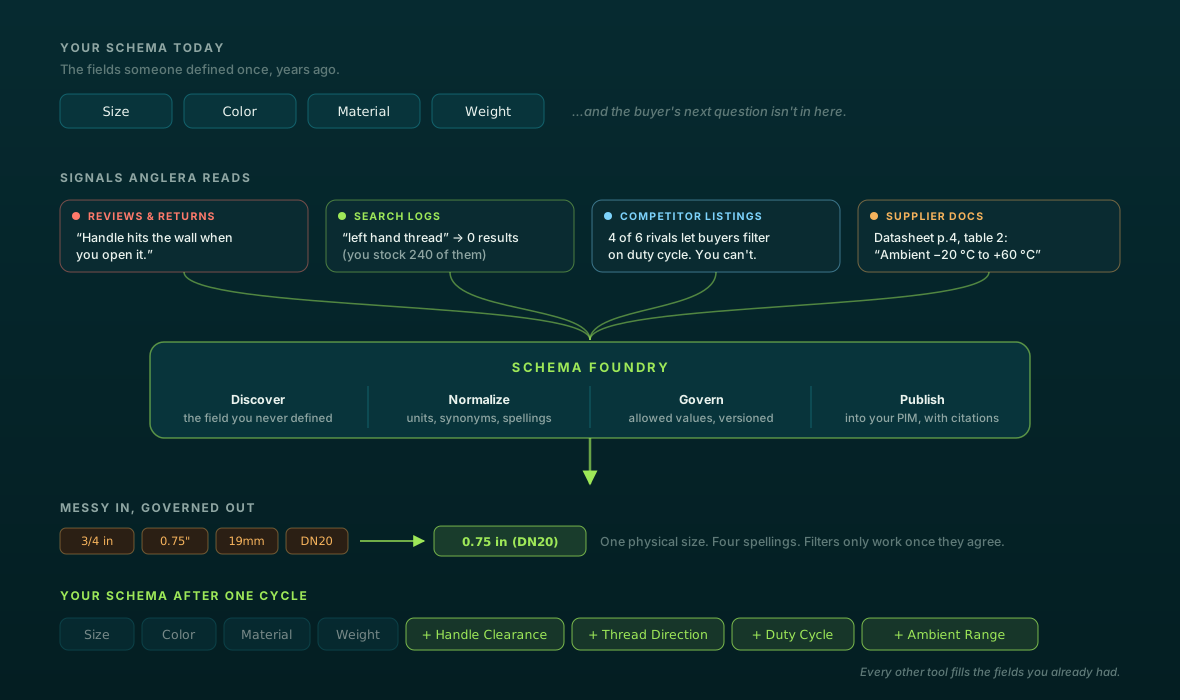
Both inriver and Salsify assume your product data is already enriched — complete attributes, buyer-ready descriptions, and titles that match how shoppers actually search. In practice, data arrives from suppliers as raw specs, incomplete fields, and copy written for procurement teams, not for the digital shelf or the B2B buyer doing technical comparison.\n\nBoth platforms give you a sophisticated, well-governed place to store and distribute that content. Neither automatically makes it buyer-ready. The work of researching what buyers search for, identifying which attributes are missing or misleading, writing copy that converts, and scoring content readiness still falls on your team — or stays undone.\n\nAnglera is the layer that does that work, regardless of which platform you choose. It connects to your inriver or Salsify instance via API, reads your existing SKUs, enriches every attribute and description against buyer signals — how your customers actually search, compare, and filter — and writes the improved content back to the PIM record. Your system of record stays in place. The enrichment quality lifts across the catalog. The content inriver or Salsify then governs and distributes is buyer-ready from the start, not just well-organized. Implementation is ~30 days with no platform migration required.
Frequently asked questions
What is the main difference between inriver and Salsify?
inriver is a composable PIM built around the full product content lifecycle — supplier onboarding, governance, omnichannel distribution, and digital shelf analytics — with a strong emphasis on B2B manufacturers and distributors managing complex product hierarchies. Salsify is a Product Experience Management platform built around brand-side product authoring and digital shelf activation, strongest for brands syndicating content to major retail accounts and tracking performance there. Both store product data and include syndication; the difference is in design priority and where each platform is most differentiated.
Which is better for B2B manufacturers and distributors — inriver or Salsify?
inriver tends to be the stronger fit for B2B manufacturers and distributors. Its architecture and supplier onboarding tools are explicitly designed for complex product hierarchies, lifecycle governance, and multi-channel distribution in industrial and manufacturing contexts. Salsify serves manufacturers too, but its design strengths are most pronounced for brand-to-retailer digital shelf activation — a workflow that is less central to most B2B distributors whose primary buyer is a business purchaser, not a retail shopper.
How does Salsify's syndication compare to inriver's?
Both platforms include built-in syndication as part of their core offering. Salsify's syndication network is purpose-built for brand-to-retailer content activation at major accounts — its depth in the retailer relationship layer is a recognized strength. inriver includes syndication and digital shelf analytics as part of its lifecycle platform, but it positions those capabilities in the context of full B2B lifecycle governance rather than leading with retail account relationships. For buyers whose primary syndication need is getting content to Amazon, Walmart, or major grocery accounts, Salsify's network has a reputation advantage. For broader B2B channel distribution, inriver's lifecycle approach is competitive.
What does Salsify typically cost compared to inriver?
Neither platform publishes pricing. Both require a custom quote based on user count, SKU volume, and feature tier. Salsify is consistently flagged by reviewers as expensive relative to alternatives, and onboarding typically requires a third-party consulting engagement that adds approximately $16,000 or more to the initial project cost. inriver uses a similar custom-quote model with Core, Professional, and Enterprise tiers, but no equivalent consulting add-on cost has been widely reported. For an accurate comparison, both vendors require a direct sales conversation.
How does Anglera work with inriver or Salsify?
Anglera connects to your PIM via API, reads your existing SKUs, runs enrichment against buyer signals — how your customers search, compare, and filter — and writes the improved attributes and copy back to the same PIM record. No migration is required. Anglera works alongside whichever platform you choose in roughly 30 days. Your system of record stays unchanged; the product content inside it gets buyer-ready without a manual rewrite project.