inriver vs Stibo Systems: Which PIM Is Right for You?
inriver and Stibo Systems both manage product data at scale, but they come from meaningfully different starting points. inriver is a SaaS PIM built around the product content lifecycle — getting data in from suppliers, enriching it, and pushing it to channels with visibility into how it performs on the digital shelf. Stibo Systems STEP is an enterprise MDM platform with PIM capability at its core, designed for organizations that need a single authoritative record not just for products but across customer, supplier, location, and other data domains.
That distinction shapes almost every other decision. A brand managing tens of thousands of SKUs across retail and marketplace channels has different needs than a large manufacturer whose product data governance cannot be separated from supplier onboarding and customer hierarchies. This guide walks through the dimensions that actually matter to buyers choosing between these two platforms — honestly, without vendor spin — and explains where an enrichment tool like Anglera fits regardless of which direction you go.
| inriver | Stibo Systems | Anglera | |
|---|---|---|---|
| Platform type | SaaS PIM with built-in syndication and digital shelf analytics. Covers the full product content lifecycle from supplier onboarding to channel performance monitoring. | Enterprise MDM + PIM (STEP). Manages product, customer, supplier, location, and asset data under a single governance layer. PIM is one domain among several. | Neither. Anglera is a pure enrichment engine — it ingests your SKU catalog from whichever platform you choose, fills attribute gaps using buyer signals, and writes enriched data back. |
| Primary use case fit | Brands, manufacturers, and retailers managing complex product catalogs across omnichannel touchpoints. Strongest where the core problem is product content quality and distribution. | Large enterprises where product data governance intersects with other master data domains. Strongest where a single system needs to govern product, supplier, and customer records together. | Filling the enrichment gap that both platforms assume is already solved. Thin descriptions, missing category attributes, unscored completeness — Anglera handles that work before governance and syndication take over. |
| Implementation complexity | SaaS with a composable architecture. Faster to stand up than legacy MDM, though enterprise configurations still require real planning. Typically measured in months. | Known for involved, multi-month implementations — commonly 6 to 18 months — that typically require a certified systems integrator. Powerful, but not quick to reach production. | Approximately 30-day implementation alongside either platform. Connects via API, maps to your existing taxonomy, and begins enriching immediately — independent of PIM or MDM go-live timelines. |
| Data governance depth | Product-scoped governance: role-based access, completeness scoring, workflow task management, and data quality controls. Governance is thorough within the product domain. | Deep, configurable governance across all master data domains. Workflow engine, data stewardship, data modeling, lineage tracking, and compliance controls at enterprise scale — well beyond product alone. | Enriches data before or after governance workflows run. Completeness and quality scores Anglera produces feed directly into whichever stewardship process your platform enforces. |
| Syndication and channel distribution | Built-in syndication to retailers, marketplaces, and partners. Digital shelf analytics are included — you can see how your content performs after it leaves the PIM. | Syndication capabilities are present, but the platform's primary strength is governance and MDM rather than channel performance analytics. Organizations often layer in a dedicated channel tool. | Not a syndication layer. Anglera enriches data upstream so that whatever your syndication path — inriver's native channel, Stibo's connectors, or a third-party tool — the content going out is complete and high quality. |
| AI and enrichment built in | AI-driven content scoring, attribute suggestions, and workflow automation are part of the platform. Enrichment is a meaningful feature set, but the platform's job is PIM — not enrichment at depth. | Data quality and governance controls are robust; AI enrichment features exist within STEP but the platform is primarily a governance and data modeling system, not an enrichment-first product. | Enrichment is the entire product. Crawls supplier and retailer sources, applies buyer signals to fill missing attributes, scores completeness against channel requirements, and pushes clean data back — this is all Anglera does. |
| Pricing and contract structure | Custom subscription across Core, Professional, and Enterprise tiers, scoped by users, modules, and data volume. No public pricing. | Custom enterprise pricing scoped by domains, users, and modules. Typically among the larger platform investments in an enterprise data stack. No public pricing. | Separate subscription layered on top of either platform, priced by SKU volume enriched rather than seat count. Costs are offset by the manual enrichment labor it replaces. |
How to choose between inriver and Stibo Systems
Choose inriver if your core problem is product content — getting accurate, complete, channel-ready data from suppliers into your catalog and out to retailers, marketplaces, and partners. inriver is built around that specific lifecycle and bundles syndication and digital shelf analytics in the same platform. It is a strong fit for brands, manufacturers, and distributors that do not need to govern customer or supplier master data under the same roof, and who want a SaaS deployment without the integration weight of a full MDM.
Choose Stibo Systems STEP if your product data problem cannot be cleanly separated from other master data domains. If accurate product records depend on knowing which supplier relationship is authoritative, or if customer-facing product content has to reconcile with customer or location hierarchies, STEP's multi-domain architecture handles that complexity in ways a product-only PIM does not. STEP is also the right answer for large enterprises with strict data stewardship requirements — regulatory compliance, audit trails, complex approval workflows across business units — where the governance capabilities alone justify the investment and implementation timeline. Budget for a systems integrator and a realistic go-live window.
If you are still unsure, the decision usually comes down to one question: is your problem primarily about product content, or about master data governance across multiple domains? If you answered product content, inriver is the more direct fit. If you answered master data governance — or if the two cannot be separated in your organization — STEP is worth the heavier investment.
Whichever you pick, the data still has to get done
Both inriver and Stibo Systems STEP assume that incoming product data is reasonably complete — accurate attributes, populated category-specific fields, quality descriptions — before governance workflows and channel syndication take over. In practice, supplier-provided data rarely meets that bar. Attributes are missing, descriptions are thin or duplicated from spec sheets, and completeness scores are unknown until someone goes looking.
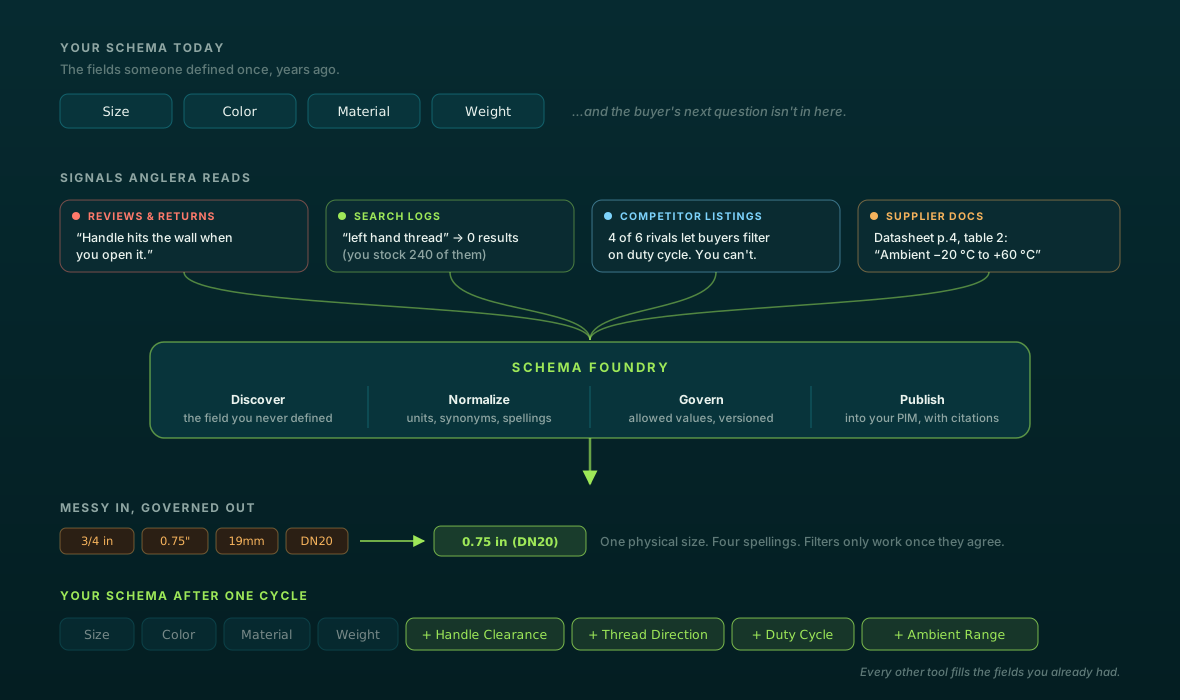
Anglera sits upstream of both platforms and handles that work. It connects to inriver or STEP via API, reads your existing SKU catalog, crawls supplier and retailer sources to fill attribute gaps, applies buyer signals to identify what content actually needs to improve, scores every SKU against channel requirements, and writes enriched data back to your source of truth. Implementation takes approximately 30 days — it does not depend on your PIM or MDM go-live timeline, and it does not require replacing any part of your existing stack.
The practical effect: your governance workflows in either platform start with better data, your syndication sends complete records, and your teams spend less time manually hunting for missing product information. Whichever platform you choose, the enrichment problem is the same — and Anglera is built specifically to solve it.
Frequently asked questions
Is inriver a true MDM platform?
No. inriver is a PIM platform with strong product-centric governance. It does not manage customer, supplier, or other non-product master data domains. If your governance requirements span multiple data types, Stibo Systems STEP is the more direct fit.
Does Stibo Systems STEP replace a standalone PIM?
STEP includes PIM functionality and many organizations use it as both their MDM and PIM. That said, its scope and implementation overhead are larger than a product-only PIM. Teams whose problem is purely product content management — with no need for multi-domain MDM — often find that inriver or a comparable PIM gets them to value faster.
How long does each implementation typically take?
inriver's SaaS architecture generally means a faster path to production than STEP — configurations are measured in months rather than years, though complex enterprise setups still take time. Stibo STEP implementations commonly run 6 to 18 months and typically require a certified systems integrator. Anglera can be implemented alongside either platform in roughly 30 days, independent of the underlying PIM or MDM timeline.
Does inriver include digital shelf analytics, or do I need a separate tool?
inriver includes digital shelf analytics as part of its core offering — you can see how product content performs after it is distributed to channels. Stibo STEP focuses on governance and MDM rather than post-distribution performance; teams that need digital shelf visibility typically integrate a separate tool alongside STEP.
Can Anglera connect to both inriver and Stibo STEP?
Yes. Anglera is not a PIM or MDM competitor — it connects to whichever system you use as your source of truth via API. It reads your catalog, enriches attributes against buyer signals and external sources, and writes clean data back. The enrichment work is the same regardless of which platform sits underneath.