inriver vs Syndigo: Which Product Content Platform Is Right for You?
inriver and Syndigo both live in the product content space, but they approach it from opposite ends of the same problem. inriver is a PIM-first platform: its design energy goes into governing a complex catalog, modeling deep product relationships, onboarding supplier data, and tracking how that content performs on the digital shelf. The syndication is built in, but the core value is data lifecycle management. Syndigo starts from the network: its defining asset is the 2,500+ retail and GDSN recipients it reaches — a footprint built by combining its own platform with the 1WorldSync acquisition. If inriver is a system of record that happens to distribute, Syndigo is a distribution engine that happens to include PIM and MDM capabilities.
The buyer who is choosing between them is usually resolving one of two root problems. The first: "We have a complex catalog — many attributes, multiple channels, supplier data arriving in inconsistent formats — and we need to govern it rigorously before it goes anywhere." That is an inriver problem. The second: "We need our product content in front of hundreds of retail partners, GDSN trading partners, or regulated-category endpoints, and we need to pass their validation requirements at scale." That is a Syndigo problem. Some buyers have both problems at once, in which case the comparison is really about which pain point is costing more.
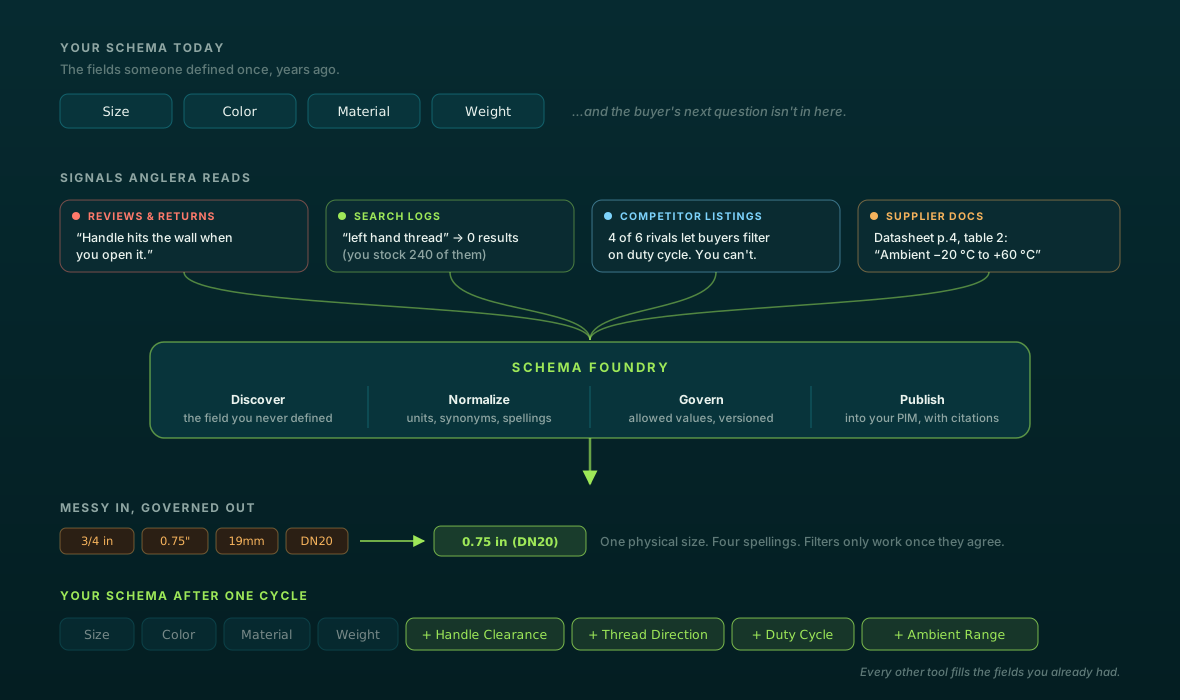
What neither platform resolves on its own: both assume the data going in is already buyer-ready — enriched attributes, complete descriptions, search-optimized titles. In practice, product data arrives from suppliers as raw specs written for procurement, not for the buyers who will evaluate and purchase. The enrichment work — figuring out what buyers search for, which attributes are missing, what copy will convert — happens before the PIM or syndication platform ever touches the SKU. That upstream gap is where Anglera operates, and it applies equally regardless of which platform you choose.
| inriver | Syndigo | Anglera | |
|---|---|---|---|
| Primary orientation | PIM-first — a composable system of record that manages the full product content lifecycle: supplier onboarding, catalog governance, enrichment workflows, omnichannel distribution, and digital shelf analytics, all in one platform | Network-first — an end-to-end content supply chain platform anchored by its distribution reach (2,500+ retail and GDSN recipients); PIM, DAM, and MDM capabilities are bundled to support that syndication core | Enrichment layer — not a PIM or syndication platform; connects to whichever system is the source of record, enriches every SKU against buyer signals, and writes results back without replacing either tool |
| Syndication reach and network | Built-in syndication to omnichannel endpoints; syndication is a native module of the PIM rather than the primary product differentiator; network breadth is not independently marketed | 2,500+ retail and GDSN recipients globally — one of the largest content distribution networks available, significantly expanded by the 1WorldSync acquisition; this breadth is the central value proposition | Does not syndicate — enriches the content that inriver or Syndigo then distributes; works upstream of both platforms so what reaches the retailer or trading partner is buyer-ready from the start |
| GDSN, MDM, and compliance coverage | PIM governance and channel-specific data rules; does not position heavily on GDSN data pool participation or regulated-category MDM; compliance is managed within the PIM schema | Full GDSN data pool via 1WorldSync; MDM capabilities for regulated verticals (food, healthcare, CPG); 10,000+ data validations and 23,000+ unique retailer requirements pre-built into the platform | PIM-agnostic; enriches content to the quality level each platform or trading partner requires — Anglera does not handle GDSN syndication, but improves the content that flows through it |
| Digital shelf and content analytics | Built-in digital shelf analytics module tracks content performance at retail endpoints after distribution; positioned as a native part of the lifecycle platform, not a bolt-on | Content performance monitoring included within the platform; analytics focus on syndication health, content compliance status, and readiness scoring against retailer requirements | Scores every SKU for buyer-readiness before it goes live — identifying content gaps that reduce conversion — so issues are fixed proactively rather than measured after the fact |
| Target buyer and vertical | B2B manufacturers, brands, and distributors managing complex product hierarchies, multi-channel distribution, and supplier onboarding at scale; 1,600+ global brand customers across industrial, consumer goods, and retail | Brands and manufacturers for whom distribution breadth is the primary challenge — particularly those in CPG, food, healthcare, and regulated categories that require GDSN compliance and broad retailer network reach | B2B distributors, retailers, and manufacturers across verticals who need their existing product data to be buyer-ready — regardless of which PIM or syndication platform they run |
| Pricing and total cost of ownership | Subscription-based; Core, Professional, and Enterprise tiers priced by users, modules, and data volume; no public pricing — custom quotes only; implementation timelines of 3–12 months add professional services cost | Subscription-based, custom-quoted; no public pricing tiers; third-party TCO estimates place Syndigo $10,000–$30,000 higher per year than smaller PIM alternatives for mid-market buyers; implementation scope scales with recipient count and validation rule configuration | Priced per SKU enriched — layers onto the existing PIM or syndication investment rather than replacing it; ~30-day implementation with no platform migration |
How to choose between inriver and Syndigo
Choose inriver if your core problem is catalog governance and product lifecycle management. You have a complex product catalog — deep attribute hierarchies, multiple channels, supplier data arriving in inconsistent formats — and you need a rigorous system of record that can handle the full journey from supplier onboarding through digital shelf performance. inriver's composable architecture is purpose-built for B2B manufacturers, distributors, and brands where the PIM itself is the strategic asset. The built-in syndication and digital shelf analytics mean you are not stitching together a separate distribution tool once the data is in order.
Choose Syndigo if distribution breadth is the dominant pain point. You need product content reaching dozens or hundreds of retail accounts, GDSN trading partners, or regulated-category endpoints — and you need to pass their validation requirements reliably. Syndigo's network (2,500+ recipients, GDSN data pool via 1WorldSync, 10,000+ validations, 23,000+ retailer-specific requirements) is genuinely hard to replicate by assembling point solutions. If you operate in CPG, food, healthcare, or any category where GDSN compliance is a hard requirement, Syndigo's post-1WorldSync infrastructure is the most direct path.
A few signals that clarify the choice:
- If you manage a large, technically complex catalog across many channels and need tight governance workflows, inriver's PIM-first architecture tends to win.
- If you are a brand or manufacturer whose primary KPI is content reaching and passing validation at 50+ retail partners, Syndigo's network reach tends to win.
- If GDSN data pool participation is a non-negotiable requirement (as it is for most major US grocery accounts), Syndigo's 1WorldSync heritage is a significant practical advantage.
- Both require a custom sales engagement before you see pricing; budget for professional services and a realistic implementation timeline with either platform.
Whichever you pick, the data still has to get done
Both inriver and Syndigo assume your product data is enriched before it enters the platform. inriver governs and distributes what you give it. Syndigo validates and syndicates it to 2,500+ endpoints. Neither platform automatically researches what buyers search for, identifies which attributes are missing or thin, writes copy optimized for how buyers actually compare products, or scores SKUs against real demand signals before content goes live.
That upstream work — turning raw supplier specs into buyer-ready product content — still falls on your team unless something else handles it. Both platforms have AI-assisted tools that reformat or generate content based on data already loaded into the system, but neither analyzes actual buyer behavior to determine what content gaps are costing you conversion.
Anglera fills that gap, and it works with either choice. It connects to your inriver or Syndigo environment via API, reads your existing SKUs, enriches every attribute and description against buyer signals — how your customers search, filter, and decide — and writes the improved content back to the system of record in roughly 30 days. No platform migration. No rip-and-replace. The content that inriver then governs and distributes, or that Syndigo validates and syndicates to its 2,500+ recipients, is buyer-ready from the start — not just well-organized and broadly distributed.
Frequently asked questions
What is the main difference between inriver and Syndigo?
inriver is a PIM-first platform built around catalog governance and the full product content lifecycle — supplier onboarding, data modeling, enrichment workflows, syndication, and digital shelf analytics in a composable system. Syndigo is a network-first platform built around distribution breadth — its core differentiator is the 2,500+ retail and GDSN recipients it reaches, expanded significantly by its acquisition of 1WorldSync. Both include PIM, syndication, and analytics capabilities; the difference is where each concentrates its design energy and what it considers the primary problem to solve.
Which platform is better for GDSN and regulated categories like food or healthcare?
Syndigo has a clear advantage here. Its acquisition of 1WorldSync made it one of the world's largest GDSN data pools, with pre-built support for 10,000+ data validations and 23,000+ unique retailer requirements. If GDSN data pool participation or compliance with major US grocery and healthcare retailer schemas is a hard requirement, Syndigo's post-1WorldSync infrastructure is the most direct path. inriver can support regulated-category content within its PIM governance framework, but it does not position as a GDSN data pool.
Can distributors and manufacturers use Syndigo, or is it mainly for consumer brands?
Syndigo serves brands, manufacturers, and distributors — but its network and compliance tooling is most valuable for companies that need to push content to a large number of retail or GDSN endpoints. B2B distributors with complex product hierarchies, deep attribute requirements, and internal data governance needs often find inriver's PIM-first model a better fit, since the challenge is catalog management rather than broad retail distribution.
How does Anglera work with inriver or Syndigo?
Anglera connects to your inriver or Syndigo environment via API, reads your existing SKUs, enriches every attribute and description against buyer signals — how your customers search, compare, and filter — and writes the improved content back to the same system of record. No migration is required. Anglera works alongside whichever platform you choose, typically going live in about 30 days. Your PIM or syndication platform stays in place; the content inside it gets better.
Do I need enrichment tooling if I already have inriver or Syndigo?
For most B2B distributors and manufacturers, yes. Both platforms store, govern, and distribute product data — but neither automatically generates content optimized for how buyers actually search and decide. Both have AI-assisted tools that work on data already in the platform, but the enrichment is driven by internal schema rules and supplier-provided specs, not by buyer-signal intelligence. Anglera automates that upstream work and writes the results back to whichever platform you already run, so the content flowing through inriver or Syndigo converts — not just complies.