Pimberly vs Pimcore: Which PIM Is Right for Your Business?
Pimberly and Pimcore both solve the same root problem: a place to store, govern, and distribute product data across channels. But they represent fundamentally different philosophies about how that should work.
Pimberly is a cloud SaaS platform purpose-built for mid-market e-commerce and retail teams. It packages PIM and DAM in a fully managed service, emphasizes automated channel publishing workflows, and trades configuration flexibility for operational simplicity. If your team wants to be up and running without owning platform infrastructure, Pimberly is designed for exactly that.
Pimcore takes the opposite approach — open-source, self-hosted or PaaS, and far broader in scope: PIM, DAM, MDM, and DXP in a single platform used by over 118,000 companies across 75 countries. That breadth is a genuine advantage if you have developer capacity to build what you need. It becomes a liability if you don't. The license price is lower — or zero for non-commercial use — but total cost of ownership includes whoever configures, maintains, and extends the system. Neither platform enriches product data against buyer signals; that gap exists regardless of which one you choose.
| Pimberly | Pimcore | Anglera | |
|---|---|---|---|
| Deployment model | Cloud SaaS only — Pimberly manages infrastructure, updates, and uptime; no self-hosting option | Flexible — self-hosted Community, Professional, or Enterprise editions, or fully managed PaaS; you choose how much infrastructure responsibility to carry | Connects via API to either platform in either deployment model; no infrastructure changes required on your end |
| Platform scope | PIM + DAM combined in one managed platform; designed specifically for e-commerce and retail teams managing large SKU catalogs across multiple sales channels | PIM + DAM + MDM + DXP in a single open-source platform — product data, digital assets, master data, and digital experience delivery; one of the broadest platform footprints in this category | Enrichment layer only — reads from whichever platform you run, enriches every SKU against buyer signals, and writes results back; not a storage or distribution platform |
| Target buyer | Mid-market e-commerce and retail teams with large SKU counts and multi-channel publishing needs that want a managed SaaS solution without platform engineering overhead | Companies of any size with developer capacity to configure and extend an open-source platform; particularly suited to organizations needing custom data models, complex integrations, or MDM and DXP capabilities alongside PIM | Any B2B distributor, retailer, or manufacturer on either platform whose product data needs to be buyer-ready — complete, accurate, and matched to how customers actually search and compare |
| Enrichment & data quality | Workflow automation and validation rules help teams enforce data completeness standards; no autonomous enrichment against buyer signals — human-in-the-loop processes fill gaps | No native enrichment or AI-driven content generation; developer-built workflows or third-party integrations required to automate data quality improvements beyond what teams manually enter | Autonomous enrichment driven by buyer signals — researches missing attributes, writes buyer-ready copy, scores each SKU, and writes results back to Pimberly or Pimcore via API; no human copywriter required in the loop |
| Pricing & total cost | Approximately $30,000/year starting; custom pricing based on SKU volume and channels; not published as fixed tiers; no self-serve option | Community Edition free (non-commercial use only); Professional $9,900/year; Enterprise $29,900/year; PaaS $39,900/year. Self-hosted editions carry developer and infrastructure costs not reflected in the license price | Priced per SKU enriched — layers onto your existing PIM investment without replacing it |
| Implementation speed | SaaS onboarding removes infrastructure setup; catalog configuration, integration builds, and workflow design still require significant effort for large catalogs — expect several months for a full rollout | Timeline depends heavily on developer capacity and customization scope; simple cases can be running in days; enterprise deployments with custom data models and integrations run months to over a year | ~30 days from kickoff to enriched SKUs written back to the PIM — no platform migration, no catalog restructuring required |
| Extensibility & customization | Extensible through integrations and workflow configuration; constrained by SaaS architecture — you configure within what the platform exposes, not beyond it | Fully open-source PHP/Symfony framework; developers can customize any part of the data model, UI, or workflow — the most extensible option in this comparison, but engineering resources are required to realize it | PIM-agnostic by design — adapts to any data model and attribute schema without requiring changes to the Pimberly or Pimcore setup |
How to choose between Pimberly and Pimcore
Choose Pimberly if your team is a mid-market e-commerce or retail operation that wants a fully managed SaaS PIM+DAM without the IT overhead of self-hosting. Pimberly is strongest for companies with large SKU catalogs that need automated channel publishing workflows and don't want to build and maintain custom integrations from scratch. The ~$30,000/year starting price reflects a platform that comes largely configured for its intended use case — you are buying operational simplicity as much as features.
Choose Pimcore if you need maximum platform flexibility and you have developer capacity to use it. Pimcore's open-source architecture means you can model data exactly as your business requires, build custom integrations to any system, and extend the platform in ways a SaaS product would not allow. The Community Edition being free (for non-commercial use) also makes Pimcore a realistic starting point for organizations that want to prove the value before committing significant license costs. The tradeoff: every dollar saved on licensing becomes an engineering hour spent on configuration, integration, and maintenance.
A few signals that clarify the choice:
- If your team has no developer capacity dedicated to platform maintenance, Pimberly's managed SaaS removes that burden. Pimcore without engineering resources consistently underdelivers on its potential.
- If you need MDM or DXP capabilities alongside PIM — master data management across non-product entities, or digital experience delivery — Pimcore's broader scope may eliminate the need for additional tools.
- If budget transparency matters upfront, Pimcore's published tiers ($9,900–$39,900/year) give you firmer numbers to plan against; Pimberly requires a sales conversation before you see a real figure.
- If multi-channel e-commerce publishing automation is your primary use case and you want it handled without bespoke integration work, Pimberly's pre-built workflows are the faster path to that outcome.
Whichever you pick, the data still has to get done
Both Pimberly and Pimcore assume the product data going into them is reasonably complete and accurate. In practice it rarely is. Supplier content arrives as inconsistent specs, empty attribute fields, and copy written for procurement documents rather than buyers. Both platforms give you a well-structured place to store and distribute that content — neither makes the content itself better.
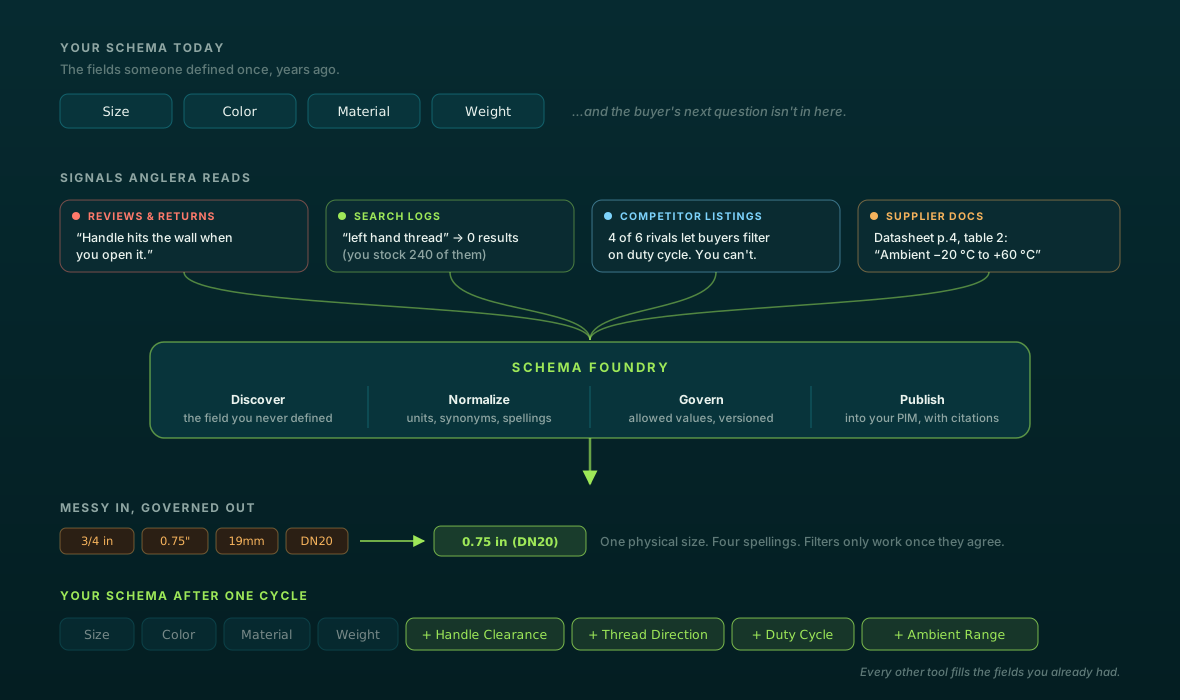
Anglera is the layer that does that work. It connects to your Pimberly or Pimcore instance via API, reads your existing SKUs, enriches every attribute and description against buyer signals — the terms, filters, and comparisons your customers actually use when searching and deciding — and writes the improved content back to the same product record. Your PIM stays in place. Your team's workflows stay in place. The data that Pimberly's channel publishing automation or Pimcore's distribution layer then moves is buyer-ready from the start, not just well-organized.
Implementation is ~30 days with no platform migration required, and Anglera works equally well whether you have chosen Pimberly or Pimcore. Whichever system of record you settle on, the enrichment problem is the same — and Anglera solves it without touching your platform choice.
Frequently asked questions
What is the main difference between Pimberly and Pimcore?
Pimberly is a cloud SaaS platform built specifically for mid-market e-commerce and retail teams — fully managed, focused on PIM+DAM and automated channel publishing, with no self-hosting option. Pimcore is an open-source platform covering PIM, DAM, MDM, and DXP — more flexible, more developer-dependent, and available as a free Community Edition or paid tiers. The core decision is managed SaaS simplicity versus open-source extensibility.
Is Pimcore really free to use?
The Community Edition has no license cost, but it is restricted to non-commercial use. Commercial deployments require a Professional ($9,900/year), Enterprise ($29,900/year), or PaaS ($39,900/year) license. Beyond licensing, self-hosted Pimcore installations carry developer and infrastructure costs that can exceed the license fee depending on the complexity of your implementation.
Which platform is faster to implement?
Pimberly's SaaS model removes infrastructure setup and some configuration overhead, giving it a head start in time to initial deployment. Pimcore's timeline depends heavily on developer capacity and customization scope — simple setups can be running quickly, while enterprise implementations with custom data models and integrations commonly run many months. For either platform, getting enriched and buyer-ready data into the system is a separate challenge that Anglera addresses in ~30 days.
Does Pimcore require developers to use effectively?
For anything beyond basic out-of-the-box configuration, yes. Pimcore is built on an open PHP/Symfony framework and designed to be extended by developers. It is genuinely powerful in the hands of an engineering team; it underdelivers for organizations that expect a SaaS-style product they can configure without code. Pimberly is the better fit for teams without dedicated PIM developers.
How does Anglera work with Pimberly or Pimcore?
Anglera connects to your PIM via API — Pimberly's or Pimcore's — reads your current product catalog, enriches each SKU's attributes and descriptions against buyer signals, and writes the results back to the same product record. No migration is required. Your existing data model, workflows, and channel integrations stay intact. Anglera adds the enrichment layer that both platforms assume is already handled but do not provide natively.