Pimberly vs Rithum (ChannelAdvisor / CommerceHub): Which Platform Fits Your Commerce Stack?
Pimberly and Rithum solve different problems, which is why this comparison is less about "which is better" and more about "which gap is actually costing you revenue." Pimberly is a PIM and DAM — it is where you build and govern product content. Rithum (the 2023 merger of CommerceHub, ChannelAdvisor, and Dsco) is a commerce operations platform — it is where you push that content to 420+ marketplaces, manage feeds, and route orders and inventory.
Many mid-market and enterprise teams eventually need both. But most buyers arrive at this decision with one specific pain: either their product data is inconsistent and ungoverned (Pimberly's territory) or their channel operations are slow, manual, and incomplete (Rithum's territory). Identifying which problem is suppressing more revenue tells you where to start.
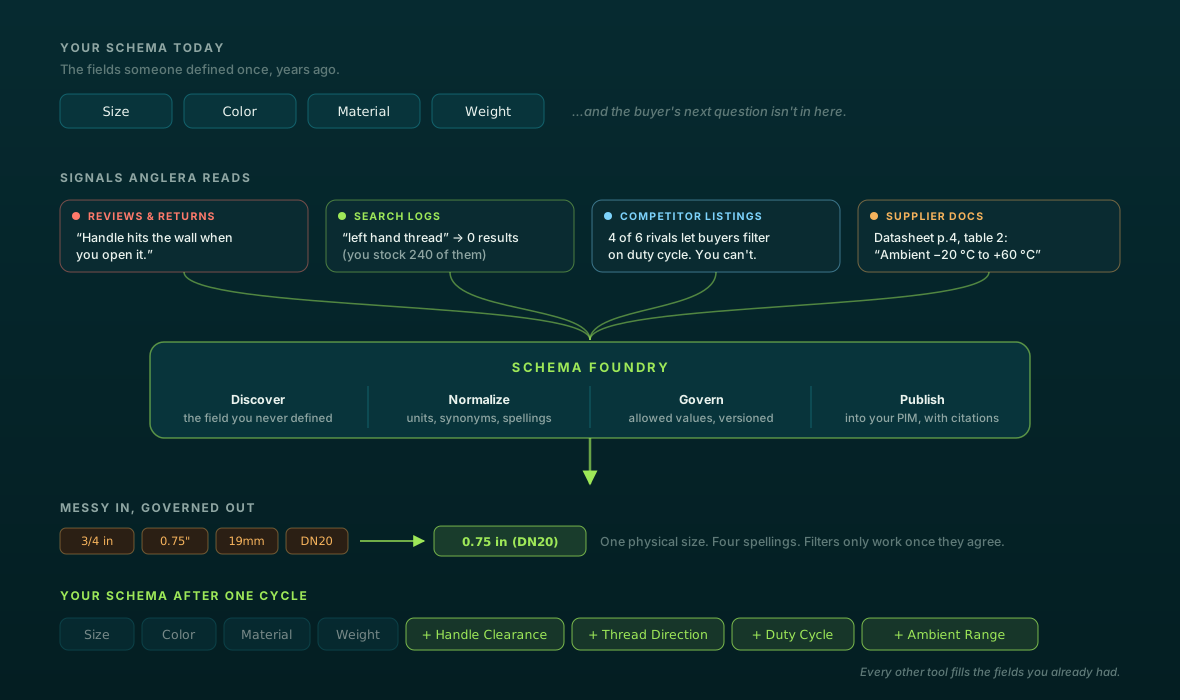
The wrinkle neither platform fully addresses is the enrichment problem: raw supplier data arriving with missing specs, non-standard terminology, and no scoring against what buyers actually search for. Pimberly can govern and publish clean data — but someone has to create it. Rithum can distribute listings at scale — but it amplifies whatever quality it receives. That upstream gap is where Anglera operates.
| Pimberly | Rithum (ChannelAdvisor / CommerceHub) | Anglera | |
|---|---|---|---|
| Core job to be done | PIM + DAM. Centralizes product content, enforces data governance rules, manages digital assets, and automates channel publishing via configurable workflows. | Commerce operations. Syndicates product listings, automates marketplace feeds, and manages orders, inventory, and drop-ship workflows across 420+ channels. | Enriches the product data before it reaches either platform — standardizing specs, filling missing attributes, and scoring content against buyer signals — then writes it back. |
| Channel / marketplace reach | Publishes to multiple sales channels via built-in connectors and workflow automation. Channel breadth is not the primary differentiator; the focus is on controlling what gets published. | 420+ pre-built connections to Amazon, Walmart, Target, and hundreds of other marketplaces and retailers. Broadest channel network in its category, serving 40,000+ brands and retailers. | Channel-agnostic. Enriched data writes back to your PIM or feeds directly into Rithum's syndication layer — no additional channel wiring required. |
| Data governance and content quality | Core strength. Validation rules, completeness scoring, approval workflows, version history, and role-based access enforce what 'good' looks like before any record goes live. | Minimal. Feed mapping and basic attribute transformation are available, but Rithum assumes data arrives structured and reasonably clean. It distributes what it receives — it does not remediate it. | Generates structured, enriched product content — specs, descriptions, compliance attributes — from raw supplier inputs so that Pimberly's governance rules have complete material to enforce and Rithum's feeds carry accurate listings. |
| Order management and fulfillment | Not in scope. Pimberly is a content platform; order routing and fulfillment live in adjacent systems. | Core capability. Drop-ship orchestration, marketplace order routing, inventory synchronization, and fulfillment automation are central to Rithum's value proposition. | Not a fulfillment platform. Anglera's output is enriched product content, not order or inventory management. |
| Implementation profile | Typical PIM implementation: taxonomy design, data modeling, validation rule configuration, workflow setup. Plan for several months; complexity scales with SKU count and channel variety. | Feed mapping, channel configuration, and order routing setup. Timeline depends on channel count and integration complexity; ongoing feed maintenance is expected as channel requirements change. | ~30-day implementation. Connects to existing data sources and writes enriched content back without requiring a platform migration or replacing existing systems. |
| Pricing | Starts at approximately $30,000/year. Custom pricing based on SKU volume and channel count; no publicly listed fixed tiers. | Custom enterprise pricing based on GMV and channel usage. Not publicly listed. | Custom pricing based on SKU volume. Complements either platform as an add-on layer, not a replacement. |
| Who it is built for | Mid-market to enterprise retailers and brands with large, complex catalogs who need a single governed source of truth for product content and digital assets before publishing. | Brands and retailers that need to list and fulfill products across a large number of marketplaces efficiently — particularly those running drop-ship operations or managing marketplace seller relationships at scale. | Companies whose product data arrives incomplete or inconsistent — distributors, retailers, and manufacturers who need enrichment upstream before governance or syndication can deliver their full value. |
How to choose between Pimberly and Rithum (ChannelAdvisor / CommerceHub)
Choose Pimberly if your primary problem is product data governance. Specs are inconsistent across your catalog, teams disagree on the authoritative version of an attribute, digital assets are scattered across shared drives and inboxes, or you need workflow-controlled approval before content goes live. Pimberly is the right investment when the bottleneck is managing and owning product content — and when you need that ownership enforced with rules, not just conventions.
Choose Rithum if your primary problem is channel operations. You are trying to maintain product listings on Amazon, Walmart, and dozens of other marketplaces without building and babysitting separate feed pipelines for each. Or you need drop-ship and marketplace order fulfillment stitched together at scale. Rithum is the right investment when the bottleneck is distributing and operating across channels — and when channel breadth and order automation matter more than content governance.
Consider both if you have a large catalog, significant marketplace volume, and the need to control content quality before it ships out to 420+ destinations. Pimberly and Rithum are not competitors; they are sequential. Pimberly governs the record; Rithum distributes it. Many enterprise commerce teams run them together.
One thing this comparison will not resolve: neither platform solves the upstream data problem. If incoming supplier data is patchy, abbreviated, and inconsistently formatted, Pimberly will govern incomplete records and Rithum will syndicate incomplete listings. Fixing that gap before it reaches either system is the enrichment problem — and it is distinct from governance and syndication.
Whichever you pick, the data still has to get done
Whether you pick Pimberly, Rithum, or both, Anglera operates upstream — on the raw data before it reaches either platform.
For Pimberly users: Anglera scrapes, standardizes, and enriches supplier data against buyer signals, then writes clean, structured attributes directly back to Pimberly via API. Your validation rules and publishing workflows run on complete records instead of your team spending hours patching gaps manually. The PIM does what it was built to do; Anglera handles the work the PIM assumes already happened.
For Rithum users: Anglera ensures that the product content entering Rithum's syndication layer is enriched, not just formatted. Listings that go out to 420+ channels carry the specifications, copy, and search terms that buyers actually use — not the abbreviated supplier data that arrived in a CSV three months ago. Rithum's channel reach compounds when the listings it distributes are genuinely complete.
Anglera is not a replacement for either tool. It is the enrichment layer that makes PIM governance and channel syndication worth their investment. Implementation is approximately 30 days and writes back to wherever your data lives today — no rip-and-replace, no new source of truth to manage.
Frequently asked questions
Are Pimberly and Rithum competitors?
Not directly. Pimberly is a PIM and DAM — it governs and publishes product content. Rithum syndicates listings and manages orders across 420+ channels. They address sequential problems: Pimberly controls what the content looks like; Rithum controls where it goes. Many enterprise teams run them together, with Pimberly as the content source of truth and Rithum as the distribution layer.
Can Rithum replace a PIM?
No. Rithum can transform and map feeds, but it does not provide the data governance, taxonomy management, digital asset management, or approval workflows that a PIM like Pimberly offers. If your catalog is complex and you need a governed, versioned source of truth for product content, you need a PIM — Rithum's feed layer is not a substitute.
Can Pimberly replace Rithum?
Only partially, and only at smaller channel counts. Pimberly can publish to multiple channels via connectors, but it does not offer Rithum's 420+ marketplace connections, drop-ship orchestration, or order and inventory automation. For heavy multi-marketplace operations — particularly at scale with drop-ship suppliers — Rithum's channel depth and operational tooling are hard to replicate through a PIM alone.
What does Anglera do that Pimberly and Rithum don't?
Anglera enriches raw product data — filling missing specs, standardizing terminology, generating accurate copy, and scoring attributes against buyer signals — before the data reaches your PIM or syndication layer. Neither Pimberly nor Rithum creates enriched product content from raw supplier inputs; they govern and distribute what they receive. Anglera is the step that makes that incoming data worth governing and distributing.
How long does it take to add Anglera alongside an existing PIM or syndication platform?
Approximately 30 days. Anglera connects to your existing data sources and writes enriched content back to your source of truth — whether that is Pimberly, Rithum's feed layer, or another system. No platform migration is required.