Pimberly vs Unilog CX1 / CIMM2: Best-of-Breed PIM or All-in-One Distribution Suite?
Pimberly and Unilog CX1 both carry the PIM label, but they are built for different buyers solving different problems. Pimberly is a focused PIM and DAM — a governed system of record for product content that publishes to any channel via connectors. You bring the commerce front-end; Pimberly manages and distributes the content behind it. Unilog CX1 is an all-in-one B2B commerce suite: storefront, built-in PIM, CMS, site search, and ERP connectivity bundled under one vendor, backed by a managed library of 10M+ pre-enriched vendor SKUs. Comparing them as direct substitutes misses the point — the real question is whether you want a best-of-breed content layer that slots into your existing stack, or a single-vendor suite that handles storefront, PIM, and distribution-specific integrations together.
Pimberly fits teams that already have or plan to select a commerce platform independently, and need a governed, scalable place to author, validate, and publish product content across multiple channels. Unilog CX1 fits mid-market B2B distributors — especially in electrical, industrial, plumbing, and HVAC — who want to launch eCommerce without stitching together best-of-breed tools and who benefit from Unilog's pre-built ERP connectors and vendor content library. More than 50 AD member companies run on Unilog for exactly this reason.
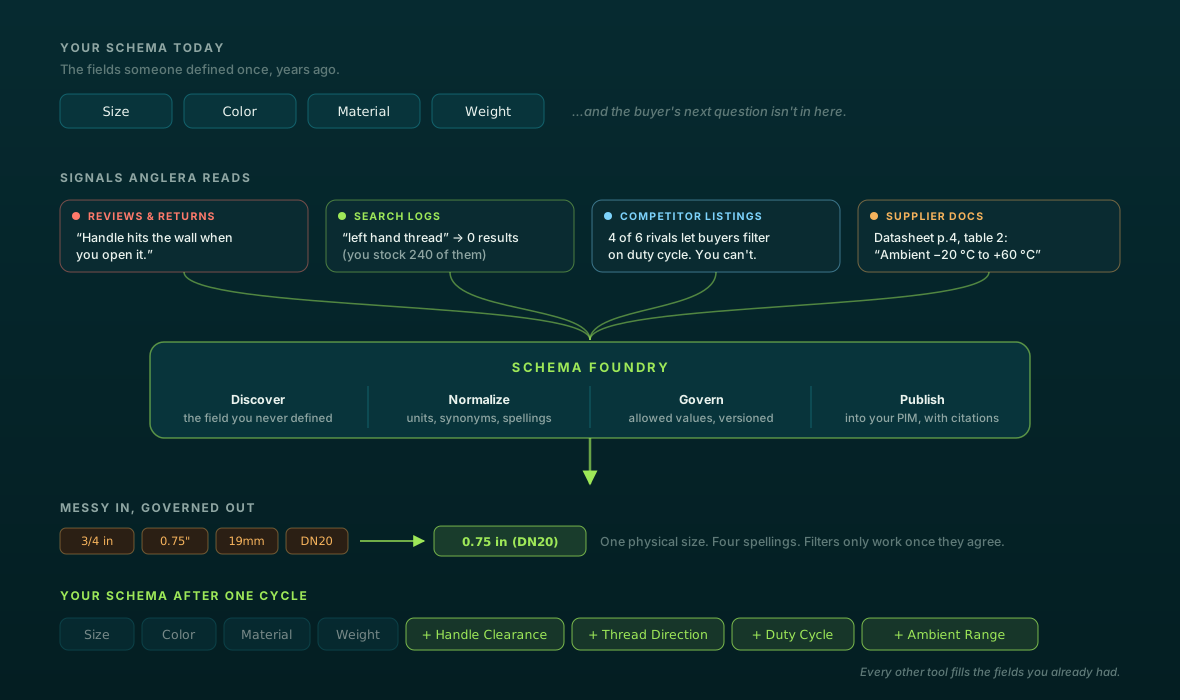
What neither platform handles is the hardest upstream problem: raw supplier data arriving in inconsistent formats, missing critical attributes, and unscored against how buyers actually search and evaluate products. Pimberly enforces your validation rules and publishes what you give it — incomplete data stays incomplete. Unilog's content library covers roughly 2,000 manufacturers well, but your long-tail SKUs, private-label items, and out-of-library suppliers still arrive with gaps. That preparation gap is where Anglera works, regardless of which platform you choose.
| Pimberly | Unilog CX1 / CIMM2 | Anglera | |
|---|---|---|---|
| Platform scope | PIM and DAM only. Centralizes product content and digital assets, enforces validation rules, and publishes to channels via connectors and APIs. No native storefront, CMS, or ERP layer — you build or buy those separately. | All-in-one B2B commerce suite: native storefront, built-in PIM, CMS, site search, and CX1 Connect for ERP/POS integration. One vendor covers the full digital commerce stack for distributors. | Works upstream of either PIM as the enrichment layer. Fills attribute gaps, normalizes supplier data, scores completeness, and writes enriched records back to Pimberly or Unilog's built-in PIM via API. |
| Industry and buyer profile | Mid-market e-commerce and retail teams managing large SKU counts across multiple consumer channels — retailers, brands, and distributors with a strong digital content and multi-channel publishing need. | Mid-market B2B distributors, manufacturers, and wholesalers — especially in electrical, industrial, plumbing, and HVAC. More than 50 AD member companies run on Unilog; deep vertical fit in trades distribution. | Effective for both profiles. Highest ROI in distribution catalogs where hundreds of thousands of supplier SKUs arrive in inconsistent, incomplete formats across dozens of vendors. |
| Product content and enrichment services | Platform only — no managed content library or enrichment services. Your team owns data quality, completeness, and enrichment. Pimberly provides the infrastructure to govern and distribute whatever you put in. | Managed content library of 10M+ vendor SKUs from ~2,000 manufacturers, available via content subscription with continuous updates. Unilog teams also run custom taxonomy, gap-fill, and normalization services on top. | Automated enrichment against buyer search signals across your full catalog — including long-tail SKUs and suppliers outside Unilog's 2,000-manufacturer library. Runs continuously; no content queue or per-project ticket. |
| Commerce and storefront | No native storefront. Pimberly publishes clean content to your existing commerce platforms, marketplaces, and retail feeds via connectors. You choose and operate the front-end stack independently. | Native B2B storefront with integrated CMS and site search included in the CX1 platform. You launch your eCommerce site on Unilog's stack alongside the PIM and content library — one vendor for the full experience. | Enriches the product content that powers storefront search relevance and conversion quality. Works upstream of the display layer in either architecture. |
| ERP and systems integration | API-first with connectors to major e-commerce platforms and marketplaces. ERP integration is handled by your existing middleware or a separate integration layer — Pimberly does not own that connection. | CX1 Connect is purpose-built to sync inventory, pricing, and order data with the ERP and POS systems common in distribution. This is a core reason distributors choose Unilog over stitching best-of-breed tools together. | Reads from and writes enriched data back to your existing PIM or ERP; flows downstream through your current integrations without requiring new middleware. |
| Pricing model | Starts at approximately $30,000/year; custom pricing based on SKU volume and channel count. Not self-serve or publicly listed as fixed tiers. | Quote-based. Third-party sources cite entry pricing in the low hundreds per month for the platform, but real deployments are scoped by catalog size, modules, and optional content subscriptions. Multi-month implementation adds services cost. | Separate enrichment layer with ~30-day implementation alongside either platform. Priced per SKU enriched — not an annual platform seat — so it adds to your existing investment without replacing it. |
| Implementation scope | Timeline scales with catalog complexity, integration requirements, and workflow configuration. Enterprise-grade deployments involving multiple channels and DAM migration typically take several months. | Multi-month implementation project covering storefront, PIM, CMS, and ERP integration. Broader scope means more to configure, but fewer third-party vendors to coordinate compared to a best-of-breed stack. | ~30 days. Connects to your existing PIM or data store without replacing it; enrichment runs in parallel with whatever implementation phase the primary platform is in. |
How to choose between Pimberly and Unilog CX1 / CIMM2
Choose Pimberly if you already have or plan to independently select a commerce front-end, and need a best-of-breed PIM and DAM that slots into that stack. Pimberly fits teams with large SKU counts across multiple consumer channels — ecommerce storefronts, marketplaces, print catalogs, and retail feeds — where rich content governance, digital asset management, and multi-channel publishing automation are the core requirement. It also fits organizations that want to choose their commerce platform, ERP integration, and search layer separately, rather than bundling everything with one vendor. If your business model is not squarely B2B distribution, or if architectural flexibility matters more than simplicity, Pimberly gives you more room to build the stack your way.
Choose Unilog CX1 if you are a mid-market B2B distributor who wants a single-vendor suite that covers storefront, PIM, and ERP connectivity without a multi-vendor integration project. The strongest case is a distributor in electrical, industrial, plumbing, or HVAC who needs to launch B2B eCommerce relatively quickly, benefits from Unilog's 10M+ SKU content library for vendor coverage, and values the built-in CX1 Connect ERP integration over platform flexibility. If you are already an AD member company, Unilog is a known quantity in your peer group and the implementation path is well-documented. The trade-off is that you are buying into Unilog's storefront and CMS — if you later want a different front-end, migrating is a larger project than switching a standalone PIM.
Neither is a fit for large enterprises that need a fully composable commerce architecture — separate, best-of-breed choices at every layer with global channel requirements and deep localization needs. At that scale, buyers typically evaluate Akeneo, Salsify, or Contentserv alongside a separate commerce platform rather than an all-in-one suite.
Whichever you pick, the data still has to get done
Both platforms share one critical assumption: the product data arriving in your PIM is already reasonably complete and accurate. It almost never is.
Pimberly enforces your validation rules and publishes what you give it. If an attribute is missing, Pimberly flags it and waits — the gap stays until a human fills it. That is the right architecture for a governed system of record. It is not a solution to incomplete supplier content.
Unilog's content library is a genuine head start for distributors whose vendors are among the roughly 2,000 manufacturers covered. But it does not cover your full catalog. Private-label items, niche suppliers, and SKUs outside the vendor library still arrive incomplete. The gap-fill and normalization services Unilog offers are a managed-services engagement — there is a queue, a scope, and a price per project. Your long tail waits.
Anglera fills that gap with software rather than a content team. It connects to your PIM — Pimberly or Unilog's built-in PIM — reads every incomplete SKU, enriches missing attributes against buyer search signals and live web sources, normalizes values across inconsistent supplier inputs, and writes the results back to your source of truth in approximately 30 days. No queue. No offshore production. Your PIM stores the data; Anglera does the work. Whichever platform you choose, the enrichment gap is the same problem — and Anglera solves it the same way.
Frequently asked questions
Does Unilog CX1 include a PIM or do I need to buy one separately?
Unilog CX1 includes a built-in PIM as part of its all-in-one suite. You do not need a separate PIM if you are running on Unilog — the product information management layer is bundled with the storefront, CMS, and ERP integration. Unilog's content subscription and managed enrichment services are add-ons that improve the data flowing into that built-in PIM, not a separate platform.
Can Pimberly and Unilog CX1 work together?
In principle you could use Pimberly as a PIM layer feeding content into a commerce stack that includes Unilog's storefront, but this is not how either vendor is positioned or typically sold. Unilog CX1 is designed as an integrated suite and its customers generally use the built-in PIM. Buying both would mean paying for redundant PIM functionality and creating an integration project with limited upside. If you need a best-of-breed PIM alongside a Unilog storefront, the more common path is a direct API integration rather than a second PIM platform.
Unilog has a 10M+ SKU content library. Does that mean I do not need a separate enrichment tool?
Unilog's content library is a real advantage for distributors whose catalog overlaps with the roughly 2,000 covered manufacturers. But most distribution catalogs carry far more variety than that. Private-label items, niche or regional suppliers, and any SKU outside the library still arrive incomplete. Even covered SKUs may lack the specific attributes — compatibility specs, application notes, precise dimensions — that drive search and purchase behavior for your specific buyers. Anglera covers your full catalog continuously, including everything the library does not reach.
How does Anglera work with Pimberly specifically?
Anglera connects to Pimberly via API, reads SKUs with incomplete or missing attributes, enriches them against buyer search signals and live web sources, and writes the improved records back into Pimberly. From Pimberly's perspective, it receives clean, complete product data that passes validation and publishes well to every downstream channel. The implementation runs alongside your existing Pimberly setup in approximately 30 days without disrupting current workflows.
What does Anglera do that neither Pimberly nor Unilog CX1 does?
Both platforms govern and distribute product content — they are designed for data that is already complete. Neither is built to automatically research missing product attributes from external sources, normalize inconsistent supplier inputs at catalog scale, or score every SKU against how your buyers actually search and filter before purchase. Anglera does those things and writes the results back to your existing PIM, so whichever platform you choose gets better data to work with from day one.