Pimcore vs Sales Layer: Which PIM Fits Your B2B Operation?
Pimcore and Sales Layer both sit in the PIM category, but they are aimed at fundamentally different buyers — and the gap is wider than it appears on a feature checklist.
Pimcore is an open-source platform that combines PIM, DAM, MDM, and digital experience management in a single codebase. Its design premise is developer extensibility: you get a highly configurable foundation you can shape to almost any data model or integration requirement, but realizing that flexibility requires engineering resources and a meaningful implementation commitment. Companies that need a customized, deeply integrated system of record — and have the technical team to build and maintain it — tend to get strong returns from Pimcore. Companies that need to be live in weeks typically do not.
Sales Layer is a cloud PIM that markets itself as the easiest PIM to implement, with a stated six-week onboarding timeline and a Supplier Portal built specifically for B2B manufacturers and distributors. It is purpose-built for teams that want to centralize product content, onboard supplier data, and push it to channels and marketplaces without standing up infrastructure or writing code. The tradeoff is less flexibility in the underlying data model and a SaaS pricing floor that starts around $1,000 per month.
Neither platform solves the problem both share: the product data flowing into them is rarely buyer-ready. Supplier content arrives as raw specs and factory-floor copy. Both Pimcore and Sales Layer give you a governed place to store and distribute that content — neither automatically makes it better.
| Pimcore | Sales Layer | Anglera | |
|---|---|---|---|
| Deployment model | Open-source; self-hosted or Pimcore PaaS. Community Edition is free; Professional and Enterprise editions add support and enterprise features; PaaS starts at $39,900/year. Engineering resources required to deploy, configure, and maintain. | Cloud SaaS only. Hosted and maintained by Sales Layer; no infrastructure required. 30-day free trial available; plans start around $1,000/month. | Connects via API to either deployment model — cloud or self-hosted — and writes enriched content back to the same records; no infrastructure changes required |
| Platform scope | Unified platform covering PIM, DAM, MDM, and digital experience (DXP) in one codebase. Broad scope suits organizations consolidating multiple data management functions into a single system. | PIM-focused with native DAM and syndication capabilities. Narrower scope than Pimcore but purpose-built for product content management; positions itself as an 'agentic PIM' for B2B content workflows. | Not a PIM or DAM; enriches the product data records stored in either platform and writes results back — scope is content quality, not content storage |
| Supplier onboarding | No dedicated supplier portal out of the box; supplier data ingestion is handled through custom integrations, imports, and developer-built workflows. | Built-in Supplier Portal: suppliers receive a login to submit and update product content directly, with validation rules applied at entry. A meaningful differentiator for distributors managing many supplier relationships. | Works downstream of supplier onboarding — once supplier content is in the PIM, Anglera enriches it against buyer signals and writes the improved version back |
| Implementation speed | Implementation timelines vary widely — from several months for a self-hosted Professional deployment to a year or more for enterprise configurations with custom integrations. Developer resources are on the critical path. | Sales Layer markets a 6-week onboarding for standard deployments. Cloud architecture and pre-built connectors reduce the technical lift significantly compared to self-hosted open-source alternatives. | ~30 days from kickoff to enriched SKUs written back to the PIM; runs in parallel with — not after — the PIM go-live |
| Syndication and channel reach | Channels and syndication handled through third-party integrations and custom development; Pimcore itself is a data repository and DXP, not a syndication network. | Native syndication to channels, marketplaces, and retailer portals is a core feature; pre-built connectors to major e-commerce and marketplace platforms are included. | Does not syndicate — enriches the content that Pimcore or Sales Layer then distributes; works upstream of both platforms |
| Pricing and total cost | Community Edition free (non-commercial use only); Professional Edition $9,900/year; Enterprise Edition $29,900/year; PaaS from $39,900/year. Self-hosted deployments add engineering and infrastructure cost that often exceeds license fees. | Starts around $1,000/month; custom quotes for most plans. No publicly listed ceiling. 30-day free trial. Total cost is more predictable than self-hosted Pimcore but scales with team size and feature tier. | Priced per SKU enriched — adds onto your existing PIM investment rather than replacing it |
| Best fit | Technology-capable organizations — enterprises, digital agencies, and companies with in-house development teams — that need a deeply customizable, unified data platform and are willing to invest in implementation to get it. | B2B manufacturers, distributors, and retailers that need a fast, cloud-native PIM with supplier onboarding and multi-channel syndication built in — and want to go live without standing up infrastructure or writing code. | Any B2B distributor, retailer, or manufacturer with an existing PIM that needs richer, buyer-ready product content without switching platforms |
How to choose between Pimcore and Sales Layer
Choose Pimcore if your organization has in-house development resources, needs deep customization, and wants a platform that can serve as a unified foundation for product data, digital assets, master data, and digital experiences — all in a single codebase. Pimcore's open-source model is particularly compelling for companies that want full control over their data model, integration architecture, and hosting environment. The free Community Edition allows meaningful evaluation before any licensing commitment. If your PIM requirements are non-standard, your catalog structure is genuinely complex, or you need the platform to behave differently for different parts of the business, Pimcore's extensibility tends to deliver over the long run.
Be clear-eyed about the tradeoffs: Pimcore without developers is a liability, not an asset. Implementation timelines are real. Self-hosted infrastructure adds ongoing cost and maintenance responsibility. And Pimcore's broader scope — covering DXP and MDM alongside PIM — can be an advantage if you actually need those capabilities, or a distraction if you do not.
Choose Sales Layer if you are a B2B manufacturer, distributor, or retailer who needs a PIM running in weeks rather than months, does not want to manage infrastructure, and needs a purpose-built Supplier Portal to onboard product content from multiple suppliers. Sales Layer's cloud architecture, pre-built channel connectors, and stated six-week onboarding make it the lower-friction path to a functioning PIM for teams without a dedicated technical implementation capacity.
The constraint is flexibility: Sales Layer's data model and platform boundaries are less configurable than Pimcore's. If your catalog structure is genuinely unusual, or if you need the PIM to integrate with a proprietary system in a custom way, that ceiling will eventually surface.
A few signals that clarify the choice:
- If you have a development team and need a platform you can shape to your exact requirements, Pimcore's open-source model rewards the investment.
- If you need to go live quickly and your primary problem is supplier content onboarding and multi-channel distribution, Sales Layer's out-of-the-box capabilities win on speed.
- If total cost predictability matters, Sales Layer's SaaS model is more legible upfront than a Pimcore self-hosted deployment where engineering time is the wildcard.
- If your operation spans PIM, DAM, and MDM and you want to consolidate those functions into one platform, Pimcore's unified scope is relevant; if you need a focused PIM, Sales Layer's narrower scope is an advantage, not a gap.
Whichever you pick, the data still has to get done
Pimcore and Sales Layer make the same underlying assumption: the product data flowing into them is already enriched — complete attributes, buyer-ready descriptions, titles that match how your customers actually search. In practice, that assumption rarely holds.
Supplier content arrives as raw spec sheets, part numbers, and copy written for procurement teams rather than for the people making buying decisions. Both Pimcore and Sales Layer give you a well-organized, governed place to store and distribute that content. Neither automatically makes it better. The research, attribute gap analysis, copy that reflects real buyer search behavior, and content completeness scoring — that work still falls on your team once the PIM is live.
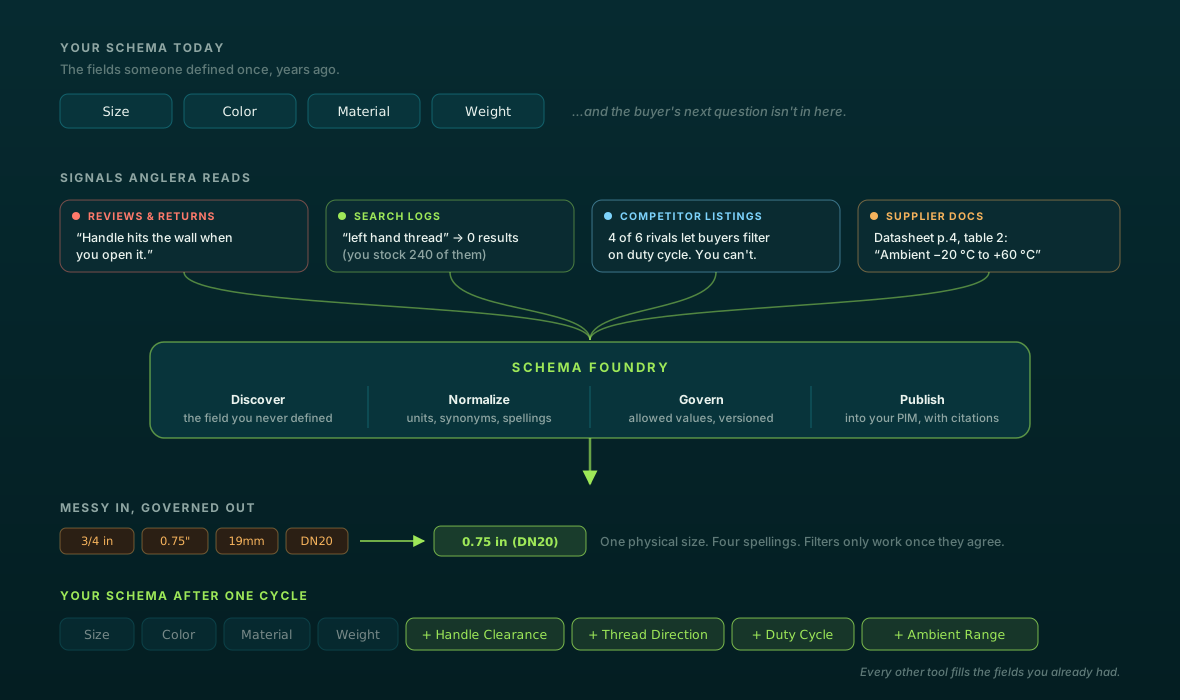
Anglera is the layer that does that work, regardless of which PIM you choose. It connects to your Pimcore instance or Sales Layer account via API, reads your existing SKUs, enriches every attribute and description against buyer signals — how your customers actually search, compare, and filter — and writes the improved content back to the same PIM record. Your system of record stays in place. No platform migration. No parallel content database to maintain.
Whichever platform you select, the content Pimcore stores or Sales Layer syndicates becomes buyer-ready from the start, not just well-organized. Implementation is approximately 30 days and runs alongside your PIM rollout rather than after it.
Frequently asked questions
What is the main difference between Pimcore and Sales Layer?
Deployment model and flexibility. Pimcore is open-source software you install and configure — highly customizable but developer-dependent and slower to implement. Sales Layer is a cloud SaaS PIM designed for fast deployment, with a built-in Supplier Portal and native channel syndication, but less flexibility in how you shape the data model. Both centralize product data; the difference is how much technical investment you are prepared to make to get there.
Is Pimcore really free?
The Community Edition source code is free for non-commercial use, but 'free' in licensing cost is not the same as free in total cost. Self-hosting Pimcore requires engineering time to install, configure, integrate, and maintain. Most production deployments either carry Professional or Enterprise license fees ($9,900–$29,900/year) or run on Pimcore PaaS ($39,900/year), plus the ongoing cost of development resources. The Community Edition is best suited for evaluation or non-commercial internal projects.
Does Sales Layer actually deliver in six weeks?
Sales Layer markets a six-week onboarding for standard deployments, and the cloud architecture removes the infrastructure setup that typically extends open-source PIM timelines. Six weeks is plausible for a catalog with clear data structures and straightforward channel requirements. Complex catalogs, large supplier onboarding workflows, or non-standard integrations will push that timeline out. Verify scope and assumptions before holding vendor commitments against a fixed date.
How does Anglera work with Pimcore or Sales Layer?
Anglera connects to your PIM via API, reads your existing product records, enriches every SKU against buyer signals — how your customers actually search, compare, and filter — and writes the improved attributes and content back to the same record. No migration is required. Anglera runs alongside whichever PIM you choose in approximately 30 days, so the content your PIM governs and distributes is buyer-ready rather than just well-organized.
Do I need Anglera if Pimcore or Sales Layer already has AI features?
Both platforms include AI-assisted tools for content generation or completeness checking — but these work within the data already in the PIM, using internal rules and supplier-provided content as the source. Anglera's enrichment is driven by external buyer signals: how real customers search, which attributes drive purchase decisions, and what competitors' listings include. The distinction is the source of truth for 'good content' — internal schema compliance versus actual buyer behavior.