Pimcore vs Salsify: Which Product Data Platform Fits Your Business?
Pimcore and Salsify both sit in the product data space, but they are built around fundamentally different bets about who runs the platform and what the primary job is.
Pimcore is an open-source platform that unifies PIM, DAM, MDM, and digital experience management in a single, developer-extensible codebase. Its promise is control: your team configures the data model, owns the infrastructure, and extends the platform however the business requires. That flexibility comes with a real technical overhead — Pimcore implementations are driven by developers, not business users clicking through a SaaS UI. The trade-off is deliberate: companies that need a highly tailored, multi-domain data foundation get it without vendor lock-in.
Salsify takes the opposite approach. It is a managed SaaS platform built around brand-side product authoring and digital shelf syndication — getting the right content to the right retailers and marketplaces, measuring how it performs, and iterating quickly. There is no infrastructure to run, but there is also no public pricing and a well-documented reliance on third-party consulting to get live. Salsify's strength is the syndication network and the brand-to-retailer workflow; its limitation is that it costs more than reviewers expect and fits brands more naturally than it fits technical or B2B-heavy organizations.
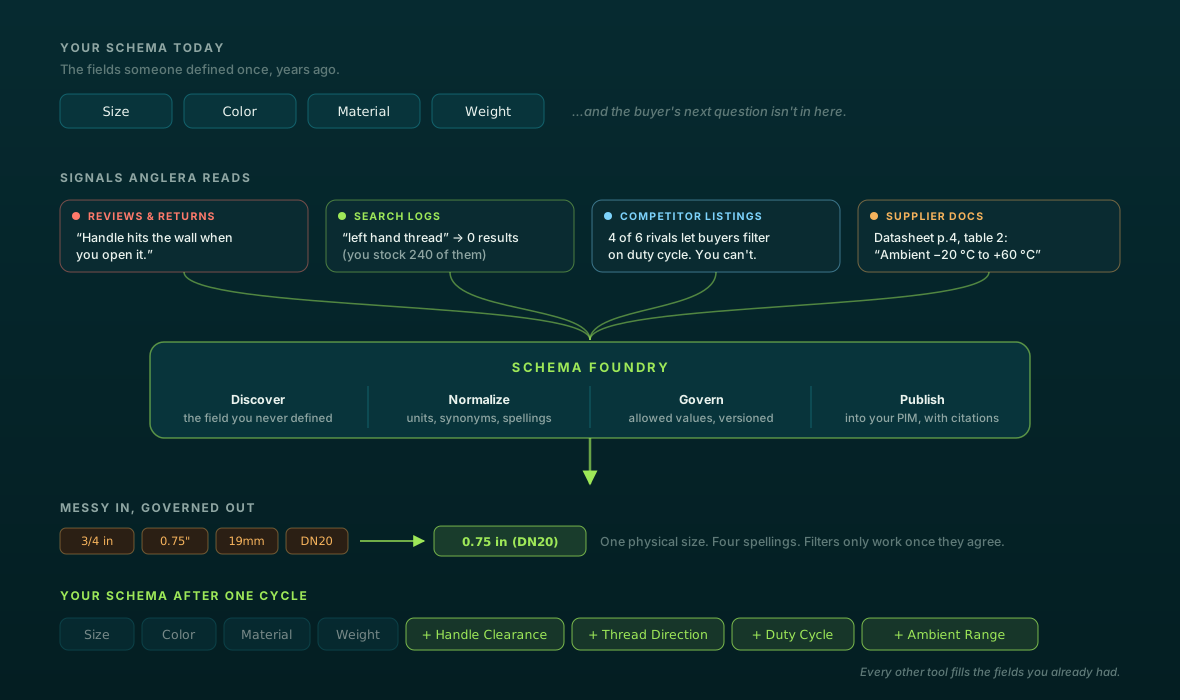
What neither platform does is automatically improve the product data flowing through it. Both assume the content going in is already buyer-ready — accurate, complete, described the way buyers actually search. In practice, it rarely is.
| Pimcore | Salsify | Anglera | |
|---|---|---|---|
| Platform type & deployment | Open-source PIM/DAM/MDM/DXP — runs on your infrastructure or Pimcore's PaaS; your team installs, configures, and maintains the platform; used by 118,000+ companies across 75 countries | Managed SaaS PXM — fully hosted and operated by Salsify; no infrastructure overhead, but complete vendor dependency; your team works within the platform's UI and workflow model | SaaS enrichment layer — no infrastructure to run; connects via API to whichever platform is the system of record and writes enriched content back; not a PIM or deployment platform |
| Technical requirements | Developer-driven — a skilled technical team is required to configure data models, build integrations, customize workflows, and maintain the platform; business users work in the UI once developers set the foundation | Business-user-friendly SaaS — onboarding is guided by Salsify and typically by a third-party consulting partner; less internal dev dependency, but third-party consulting adds roughly $16,000 or more to the initial cost | ~30-day implementation requiring no platform migration and no dedicated dev team; Anglera's team handles the connection, configuration, and first enrichment run |
| Syndication & digital shelf | Multi-channel distribution capabilities built in, but not primarily known for brand-to-retailer digital shelf syndication; channel reach depends on integrations your team builds or configures | Core strength — broad syndication network built specifically for brands pushing product content to retailers and marketplaces; digital shelf analytics measure content performance at retail accounts | Does not syndicate — enriches the content that Pimcore or Salsify then distributes; works upstream of both platforms |
| Enrichment capability | No native buyer-signal enrichment; data quality depends on what suppliers provide and what your team authors within the platform; extensible via custom integrations if developers build them | AI-assisted content authoring and completeness scoring within the platform; authoring is guided by retailer content requirements, not by how buyers actually search; teams review and approve output | Autonomous enrichment driven by buyer signals — how real buyers search, compare, and decide — not reformatted supplier copy or internal schema rules; writes results back to the PIM without a copywriter in the loop |
| Pricing & total cost | Community Edition (free, non-commercial use); Professional Edition $9,900/year; Enterprise Edition $29,900/year; PaaS starting at $39,900/year; published pricing is a real differentiator | Quote-based only; no public pricing; cost tied to user count, SKU volume, and feature tier; onboarding typically adds ~$16,000 or more in third-party consulting; reviewers consistently flag it as expensive relative to alternatives | Priced per SKU enriched — layers onto your existing PIM investment rather than replacing it |
| Best fit by buyer type | Technical teams, enterprises, and mid-market companies that need a flexible, multi-domain data platform they can own and extend — and have the developer capacity to build on an open-source foundation | Brands and manufacturers whose primary pain point is digital shelf performance — syndicating the right content to Amazon, Walmart, and major retail partners and measuring how it converts | Any B2B distributor, retailer, or manufacturer with an existing PIM who needs richer, buyer-ready product content without switching platforms |
| Implementation speed | Highly variable — a basic deployment can take weeks with an experienced dev team; full enterprise rollouts spanning DAM, MDM, and PIM with custom integrations commonly run 6–18 months | Comparable enterprise timeline; a third-party consulting engagement alongside vendor onboarding is the reported norm before content goes live; budget for a multi-month project | ~30 days from kickoff to enriched SKUs written back to the PIM; no platform migration required |
How to choose between Pimcore and Salsify
Choose Pimcore if your organization has strong developer capacity and needs a highly configurable, multi-domain data platform it can fully control. Pimcore shines when the requirements span more than PIM alone — when you also need DAM, MDM, or digital experience management in a single, extensible codebase without recurring per-module licensing. Companies with complex data models, a need to avoid vendor lock-in, or unusual integration requirements that no SaaS vendor supports out of the box will find Pimcore's open architecture a genuine advantage. The published pricing — including a free Community Edition — also makes evaluation accessible in a way that Salsify's quote-only model does not.
Choose Salsify if you are a brand or manufacturer whose primary problem is performing on the digital shelf with major retail accounts. Salsify's syndication network and digital shelf analytics are purpose-built for the brand-to-retailer content workflow: authoring product content centrally, pushing it to Amazon, Walmart, and dozens of other retail partners, and tracking how it performs against competitors on the shelf. If retailer content scorecards and digital shelf visibility are your operating metrics, Salsify's native tooling in that lane outpaces Pimcore's more general-purpose approach. Accept that you will need to budget for third-party consulting and a vendor-led onboarding before you go live.
A few signals that clarify the choice:
- If you have a dedicated development team and need a platform you can fully customize, Pimcore's open-source model is a strong fit; if you want managed infrastructure with no dev overhead, Salsify's SaaS model wins.
- If transparent, predictable pricing matters before you commit, Pimcore's published tiers are a real advantage over Salsify's quote-only model.
- If your primary distribution channels are major retail partners and marketplaces where digital shelf content directly drives sales, Salsify's syndication network is hard to replicate with Pimcore alone.
- If your catalog spans multiple data domains — products, digital assets, master data, and digital experiences — Pimcore's unified platform avoids the cost and complexity of stitching together multiple point solutions.
Whichever you pick, the data still has to get done
Both Pimcore and Salsify assume your product data is already enriched — complete attributes, accurate specs, descriptions written the way buyers actually search and compare. That assumption breaks down almost immediately when real data arrives: supplier content is written for procurement, not for the digital shelf; attribute sets are incomplete; titles are part-number strings rather than buyer-facing copy.
Pimcore gives you a highly configurable place to store and organize that content. Salsify gives you a well-governed place to distribute it to retail accounts. Neither platform automatically fixes what the content says or fills the gaps that matter to buyers.
Anglera is the layer that does that work — and it runs alongside whichever platform you choose. It connects to your Pimcore or Salsify instance via API, reads your existing SKUs, enriches every attribute and description against buyer signals — how your customers actually search, compare, and filter — and writes the improved content back to the same PIM record. Your system of record stays in place. The enrichment quality lifts across the catalog. The content Pimcore stores and manages, or the content Salsify syndicates to retail partners, is buyer-ready from the start rather than just well-organized.
Implementation takes roughly 30 days with no platform migration. Whichever direction you go on the PIM decision, Anglera's value is the same: better content going in means better outcomes coming out.
Frequently asked questions
What is the main difference between Pimcore and Salsify?
Pimcore is an open-source, developer-extensible platform that unifies PIM, DAM, MDM, and digital experience management — built for companies that need full control over a multi-domain data foundation and have the technical team to run it. Salsify is a managed SaaS platform built for brand-side product authoring and digital shelf syndication — strongest for brands pushing content to major retail partners and measuring performance on the digital shelf. Both store product data; the difference is who operates the platform, what the primary workflow is, and which distribution channel is the priority.
Is Pimcore really free?
Pimcore's Community Edition is free and open-source, but the "free" refers to licensing cost, not total cost. Running Pimcore in production requires server infrastructure, developer time to configure the data model and build integrations, and ongoing maintenance. For many companies, the total cost of ownership — including the technical resources required — is comparable to a commercial SaaS PIM. Pimcore's Professional ($9,900/year), Enterprise ($29,900/year), and PaaS ($39,900/year+) editions add vendor support and managed infrastructure.
How does Anglera work with Pimcore or Salsify?
Anglera connects to your PIM via API, reads your existing SKUs, runs enrichment against buyer signals — how your customers search, compare, and filter — and writes the improved attributes and descriptions back to the same PIM record. No migration is required; Anglera works alongside whichever platform you already run in roughly 30 days. Your system of record stays unchanged; the content inside it gets better.
Does Salsify replace the need for a separate PIM like Pimcore?
For brands focused on digital shelf syndication, Salsify can serve as the primary system of record for product content — it is designed to fill that role. For companies with complex multi-domain data needs, industrial or technical catalog structures, or a requirement for deep customization, Pimcore's configurability typically makes it a stronger system of record. The two platforms are not direct substitutes; they serve different primary use cases and buyer types.
Do I still need an enrichment tool if I already have Pimcore or Salsify?
For most B2B distributors and manufacturers, yes. Both platforms store and distribute product data, but neither automatically generates buyer-signal-optimized content. Pimcore is extensible enough to integrate enrichment tooling, but it does not include it. Salsify has AI-assisted authoring within its workflow, but it works from supplier content already inside the platform — it does not independently research how buyers search and decide. Anglera automates that upstream work and writes the results back to whichever platform you already run.