Pimcore vs Stibo Systems: Which Platform Fits Your Data Strategy?
Pimcore and Stibo STEP both aim to be the authoritative source of truth for product data, but they serve fundamentally different buyers and reflect different philosophies about how that data should be managed.
Pimcore is a developer-extensible, open-source platform that bundles PIM, DAM, MDM, and digital experience management in a single codebase. Transparent pricing, no vendor lock-in at the code level, and a large open-source community make it a practical fit for organizations that want flexibility and the ability to customize without writing a seven-figure check. Stibo STEP is an enterprise-grade MDM platform purpose-built for large organizations running complex, multi-domain data environments — product, customer, supplier, and location data governed under one model. It is a Gartner Magic Quadrant Leader in MDM, and it earns that recognition by going deep in exactly the scenarios where PIM-only tools come up short: stewardship workflows, audit trails, multi-domain data modeling, and enterprise compliance.
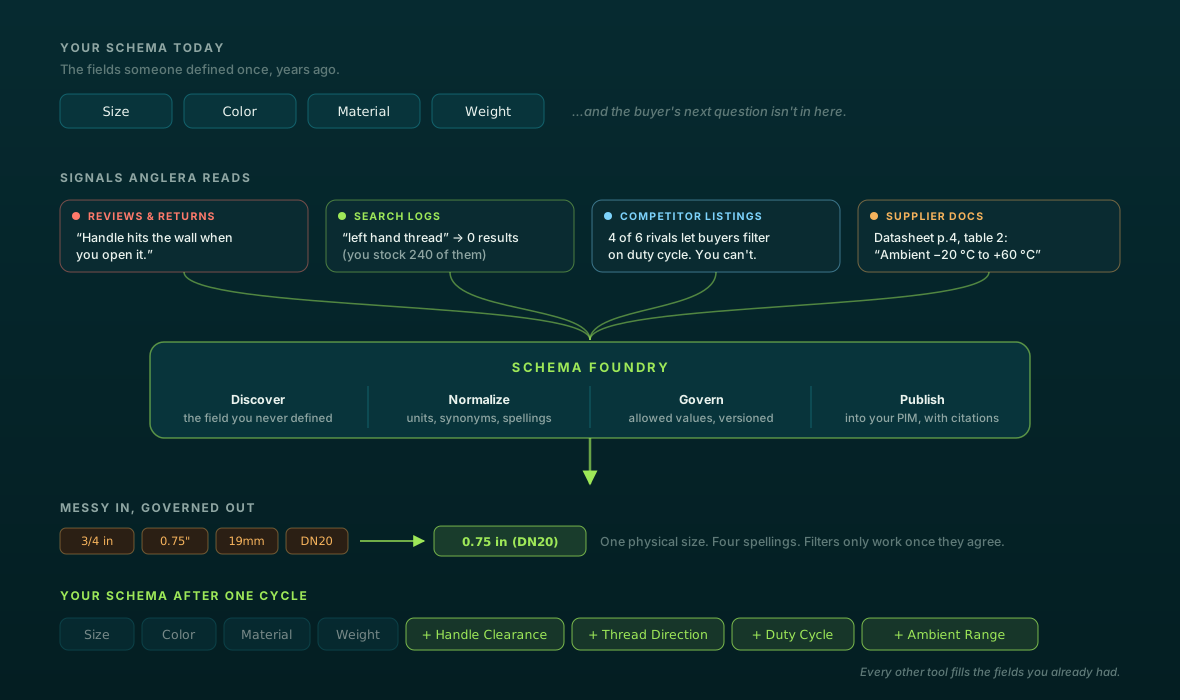
Neither platform solves the upstream problem they share: the product content going into either system is rarely buyer-ready. Both platforms govern and distribute whatever your data team feeds them — but enriching that content against how buyers actually search, compare, and decide is still on your team, regardless of which system you run.
| Pimcore | Stibo Systems | Anglera | |
|---|---|---|---|
| Platform scope | Unified open-source platform covering PIM, DAM, MDM, and DXP in a single codebase. Teams manage product data, digital assets, master data, and digital experiences from one system. Breadth across capabilities is the core pitch. | Enterprise MDM platform focused on multi-domain data governance — product, customer, supplier, location, and financial data under one governed model. PIM is one domain within a broader master data strategy rather than the platform's only purpose. | Operates independently of platform scope. Connects to either system via API, enriches product SKUs against buyer signals, and writes results back — not a PIM, MDM, DAM, or DXP. |
| Target buyer | Mid-market to enterprise organizations wanting a flexible, all-in-one open platform across industries. Requires internal developer resources for full customization; suits manufacturers, distributors, and digital-experience-driven brands that want control without vendor lock-in. | Large enterprises — typically 1,000+ employees — with multi-domain data complexity, often in regulated industries or global supply chains where a single authoritative MDM source of record is an operational and compliance necessity, not just a convenience. | Any B2B distributor, retailer, or manufacturer with an existing PIM or MDM that needs buyer-ready product content — regardless of platform size or vertical. |
| Pricing & total cost | Community Edition is free (non-commercial). Professional Edition $9,900/year; Enterprise Edition $29,900/year; PaaS starting at $39,900/year. Public, tiered pricing at every level. Implementation costs scale with customization scope and partner involvement. | No public pricing. Custom enterprise contracts scoped by users, data volume, and modules. License fees typically run six figures annually; systems integrator implementation often adds equal or greater cost. First-year total cost frequently exceeds $500K for large deployments. | Subscription pricing based on SKU volume enriched. No SI required; ~30-day implementation keeps onboarding cost predictable and scoped. |
| Implementation timeline | Community Edition can be deployed in days by a developer team. Full enterprise implementations typically take 3–12 months depending on data model complexity, channel integrations, and migration scope. | Enterprise implementations typically run 6–18 months with a systems integrator handling data modeling, workflow configuration, and migration. Complex multi-domain rollouts can extend beyond 18 months. | ~30 days from kickoff to enriched SKUs flowing back to the source PIM or MDM. No platform migration required — connects to the existing system you already run. |
| Governance & multi-domain MDM | Solid data governance for PIM use cases — workflow management, versioning, role-based access, and channel publishing rules. Multi-domain MDM is available but is not the platform's primary differentiator. | Industry-leading enterprise MDM governance — hierarchical data modeling, stewardship workflows, audit trails, data quality rules, and multi-domain support purpose-built for regulated industries and complex global environments. Gartner Magic Quadrant Leader for MDM. | Complements governance by ensuring product data arrives in either system already enriched, scored, and buyer-ready — reducing the volume of manual stewardship work that governance workflows must absorb. |
| Open source vs. vendor lock-in | Fully open-source Community Edition with a public, modifiable codebase. No lock-in at the code level; commercial tiers add support and cloud hosting. Large developer community and ecosystem of community-built extensions. | Proprietary enterprise software. Customization runs through the vendor or certified SI partners. Switching costs are high after implementation — the depth of data modeling and workflow configuration invested in STEP makes migration a major undertaking. | Cloud-native and PIM-agnostic. Connects to Pimcore, STEP, or any other system via standard APIs. Switching the underlying PIM or MDM does not affect the enrichment layer. |
| Data enrichment capability | No built-in AI enrichment against buyer signals. Content quality depends entirely on what teams manually author and enter. Third-party integrations or custom development are required to add enrichment automation. | AI-assisted features (including ProductGen) help content teams work within the platform, but enrichment logic is driven by internal rules and supplier copy — not by how buyers actually search, compare, and decide. Manual authoring remains the primary enrichment mechanism. | Core capability. Reads every SKU from the PIM or MDM, enriches attributes and descriptions against live buyer signals, scores completeness against purchase-intent benchmarks, and writes production-ready content back to the source system automatically. |
How to choose between Pimcore and Stibo Systems
Choose Pimcore if you want an open-source foundation with transparent pricing and no vendor lock-in. Pimcore's Community Edition is a legitimate starting point for a developer team, and the Professional and Enterprise tiers add commercial support without requiring a seven-figure commitment. The platform works well when your primary need is a configurable, multi-capability system — PIM, DAM, MDM, and digital experience in one place — and you have the developer resources to extend it. Mid-market companies and enterprises that value flexibility and cost predictability over a deep, SI-led engagement consistently land here.
Choose Stibo STEP if you are a large enterprise with multi-domain master data complexity that genuinely demands enterprise-grade MDM governance. STEP earns its Gartner leadership in scenarios where a single governed system must handle product, customer, supplier, and location data simultaneously — with stewardship workflows, audit trails, and data quality rules embedded at the platform level. If your data problem is fundamentally a governance and compliance problem (not just a PIM organization problem), STEP's depth is hard to match. Be prepared for the commitment: budget for a systems integrator, plan 6–18 months of implementation runway, and model the full total cost of ownership before signing — license fees alone rarely tell the whole story.
A few signals that clarify the choice:
- If you are a mid-market company with a clear PIM and DAM need, developer resources in-house, and a preference for cost transparency, Pimcore's open-source model is hard to beat.
- If you are a large enterprise where master data governance spans multiple domains, regulatory obligations, and global supply chains, STEP's governance depth justifies the cost and implementation investment.
- If price transparency matters early in your evaluation, Pimcore publishes real numbers at every tier; Stibo requires a sales engagement before any figure appears.
- If you need to move quickly, Pimcore's faster implementation path is a genuine advantage over STEP's SI-led timeline.
Whichever you pick, the data still has to get done
Neither Pimcore nor Stibo STEP enriches product data against buyer signals. Both platforms govern and distribute the content your data team feeds them — attributes arrive from suppliers as raw specs, inconsistent formats, and copy written for the warehouse floor, not the buying journey. A well-configured Pimcore instance stores that content cleanly across channels. A well-governed STEP implementation distributes it with enterprise-grade authority. Neither makes the content itself better.
That gap is where Anglera sits, regardless of which platform you choose. Anglera connects to your Pimcore or STEP instance via API, reads every SKU in your catalog, and enriches each attribute and description against buyer signals — how your customers actually search, filter, and compare products in your category. The improved content is written directly back to the source system, so your PIM or MDM stays the system of record and the enriched data flows through every downstream channel it already serves. Implementation is approximately 30 days, with no platform migration and no rip-and-replace — whichever platform you pick, Anglera does the enrichment work both platforms assume already happened.
Frequently asked questions
What is the main difference between Pimcore and Stibo STEP?
Pimcore is an open-source, multi-capability platform — PIM, DAM, MDM, and digital experience management in one system — built for organizations that want flexibility and transparent pricing across a range of budget levels. Stibo STEP is a proprietary enterprise MDM platform built for large organizations that need deep, multi-domain data governance across product, customer, supplier, and location data simultaneously. Pimcore is broader in scope and more accessible by cost; STEP is deeper in governance and substantially higher in total investment.
Does Pimcore or Stibo STEP include built-in product data enrichment?
Neither platform enriches product data against buyer signals automatically. Pimcore has no built-in AI enrichment capability; content quality depends on what your team manually enters. Stibo STEP includes AI-assisted features (including ProductGen) to support content teams working inside the platform, but enrichment is still driven by internal rules and supplier copy rather than external buyer behavior. Teams using either platform typically rely on manual authoring, offshore vendors, or a third-party enrichment layer to actually improve content quality at scale.
Is Pimcore actually free?
The Community Edition is free for non-commercial use. Commercial deployments require a Professional ($9,900/year), Enterprise ($29,900/year), or PaaS ($39,900/year) license. Implementation costs — internal developer time or partner fees — are separate and scale with your data model complexity and integration scope.
How long does a Stibo STEP implementation typically take?
Enterprise STEP implementations typically run 6–18 months and require a certified systems integrator. The timeline reflects the depth of data modeling, stewardship workflow configuration, and master data migration involved. Complex multi-domain deployments that span product, customer, supplier, and location domains can run longer. This is one of the most significant practical differences from Pimcore, where mid-market implementations commonly land in the 3–6 month range.
Where does Anglera fit if I already use Pimcore or Stibo STEP?
Anglera connects to either platform as an enrichment layer running alongside your existing system of record. It reads your catalog via API, enriches every SKU against buyer signals — how your customers search, filter, and compare — scores content completeness, and writes the results back to Pimcore or STEP. Your source system stays in place; Anglera handles the content work both platforms assume already happened. Implementation is approximately 30 days with no platform migration required.