Pimcore vs Syndigo: Which Platform Fits Your Product Data Stack?
Pimcore and Syndigo occupy different ends of the product data spectrum — and they rarely compete in the same deal. Pimcore is a developer-centric, open-source platform that unifies PIM, DAM, MDM, and DXP into a single configurable repository. Syndigo is a closed-network content supply chain platform built around syndicating compliant product content to 2,500+ retail and GDSN trading partners. The fact that both can be called "PIM" obscures how different their core value propositions actually are.
If your primary problem is organizing, governing, and distributing product data across internal teams, channels, and digital experiences — and you want the flexibility to build on top of an open-source foundation — Pimcore is solving for that. If your primary problem is getting compliant product content to major retailers and GDSN trading partners at scale, with automated validation against tens of thousands of retailer-specific requirements, Syndigo is solving for that. Very few organizations genuinely need both at once.
What neither platform solves is the upstream content quality problem they share. Supplier data arrives raw: inconsistent attribute values, thin descriptions, copy written for procurement rather than buyers. Pimcore gives you a well-structured place to store and govern that content. Syndigo gives you a well-connected place to push it. Neither automatically makes it buyer-ready — and that gap matters whether you pick one, the other, or eventually both.
| Pimcore | Syndigo | Anglera | |
|---|---|---|---|
| Primary orientation | Unified open-source platform for PIM, DAM, MDM, and DXP — a configurable system of record for organizations that need a single governed repository for product data, digital assets, and master data across teams and channels | Product Experience Cloud (PXM) built around content supply chain — a closed network where brands and manufacturers store, validate, and push product content to 2,500+ retail and GDSN recipients from a single hub | Enrichment layer — not a PIM or syndication platform; reads from whichever system is the source of truth, enriches every SKU against buyer signals, and writes results back |
| Syndication network & GDSN | No built-in syndication network; distribution requires custom integrations or third-party connectors — the platform manages data, not the pathways to trading partners | One of the largest product content networks in the world following the 1WorldSync acquisition; 2,500+ retail and GDSN recipients, GDSN-compliant syndication, and coverage of 23,000 unique retailer content requirements | Does not syndicate — enriches the content that Pimcore governs or Syndigo distributes; works upstream of both |
| Data validation & compliance | Configurable validation rules within the platform driven by your own schema definitions; compliance against external retailer or trading partner requirements requires custom development or third-party tooling | 10,000+ built-in data validations mapped to retailer and GDSN requirements; content readiness scoring against specific trading partner schemas is a core product feature, not a configuration task | Does not validate against retailer schemas — enriches the content quality itself so that whatever reaches Syndigo's validation layer is more complete and buyer-ready going in |
| Pricing model | Community Edition free (non-commercial); Professional $9,900/year; Enterprise $29,900/year; PaaS starting at $39,900/year — the only platform in this comparison with published pricing tiers | Subscription-based, custom-quoted only; no public pricing tiers; TCO has been estimated $10,000–$30,000 higher per year than smaller PIM alternatives for mid-market buyers; pricing scales with data volume, users, and feature tier | Priced per SKU enriched — layers onto your existing platform investment rather than replacing it |
| Extensibility & technical fit | Open-source (PHP/Symfony stack), developer-friendly, highly extensible — organizations with engineering resources can build custom workflows, data models, and integrations directly on the codebase; no vendor lock-in on the software layer | SaaS-only with a managed architecture; customization happens within the platform's configuration layer, not at the code level; suited to teams that want managed infrastructure and network access, not maximum flexibility | PIM-agnostic — connects via API to whichever platform you run; no data model changes required on either side |
| Enrichment capability | Stores and organizes product data with no native enrichment against buyer signals; content quality depends entirely on what internal teams or suppliers provide and maintain | Content readiness scoring and validation against retailer requirements; identifies what is missing relative to a trading partner's schema — but does not generate buyer-signal-driven attributes or descriptions autonomously | Autonomous enrichment driven by buyer signals — how real buyers search, compare, and decide — not reformatted supplier copy; writes results back to the PIM without a copywriter in the loop |
| Implementation speed | Community Edition can be stood up quickly; production implementations with custom data models, integrations, and workflows typically run several months depending on catalog complexity and engineering scope | Implementation timeline varies by trading partner scope; organizations connecting to large numbers of retail endpoints report significant onboarding effort to map content against each recipient's requirements before data flows cleanly | ~30 days from kickoff to enriched SKUs written back to the PIM; no platform migration required |
How to choose between Pimcore and Syndigo
Choose Pimcore if your core problem is data governance and platform flexibility. You have a technical team capable of extending an open-source codebase, and you need a configurable system of record that handles product data, digital assets, and master data in a single platform. Pimcore's published pricing, open-source architecture, and developer-friendly extensibility make it particularly well-suited for organizations that want maximum control, do not want to pay network access fees, and are building a long-term PIM foundation across B2B, B2C, or internal MDM use cases. The absence of a built-in syndication network is a deliberate trade-off: you own the data layer and build the distribution pathways you actually need.
Choose Syndigo if your primary problem is distributing compliant product content to major retailers and GDSN trading partners at scale. Syndigo's defining advantage is its network — 2,500+ recipients, 10,000+ built-in validations, and coverage of 23,000 unique retailer requirements. For brands and manufacturers who need to push content to grocery chains, mass retailers, or GDSN-connected trading partners and have that content automatically checked against each recipient's specific schema, Syndigo's network access is the core value, not just the PIM underneath it. The trade-off is cost opacity and less architectural flexibility.
A few signals that clarify the choice:
- If you have engineering resources and want to build on an open-source foundation without vendor lock-in, Pimcore's architecture wins.
- If GDSN compliance and retail content syndication to 2,500+ trading partners are primary requirements, Syndigo's network is difficult to replicate independently.
- If pricing transparency before a sales call matters, Pimcore is the only option here with published tiers.
- If you are a mid-market brand syndicating to 10–20 major retail accounts, evaluate whether you genuinely need Syndigo's full network or whether targeted integrations from a lighter PIM would suffice.
Whichever you pick, the data still has to get done
Both Pimcore and Syndigo assume your product data is already enriched — complete attributes, buyer-ready descriptions, titles and copy written for how buyers actually search and compare. In practice, that assumption rarely holds. Supplier content arrives as raw specification sheets, inconsistent attribute values, and descriptions written for procurement teams, not for the shelf.
Pimcore gives you a well-governed, extensible repository to store, structure, and manage that content. Syndigo gives you a highly connected network to push it to trading partners and validate it against retailer requirements. Neither automatically improves the content itself. The attributes that were thin when they arrived are still thin when they reach the retailer's schema validator or the buyer's search results.
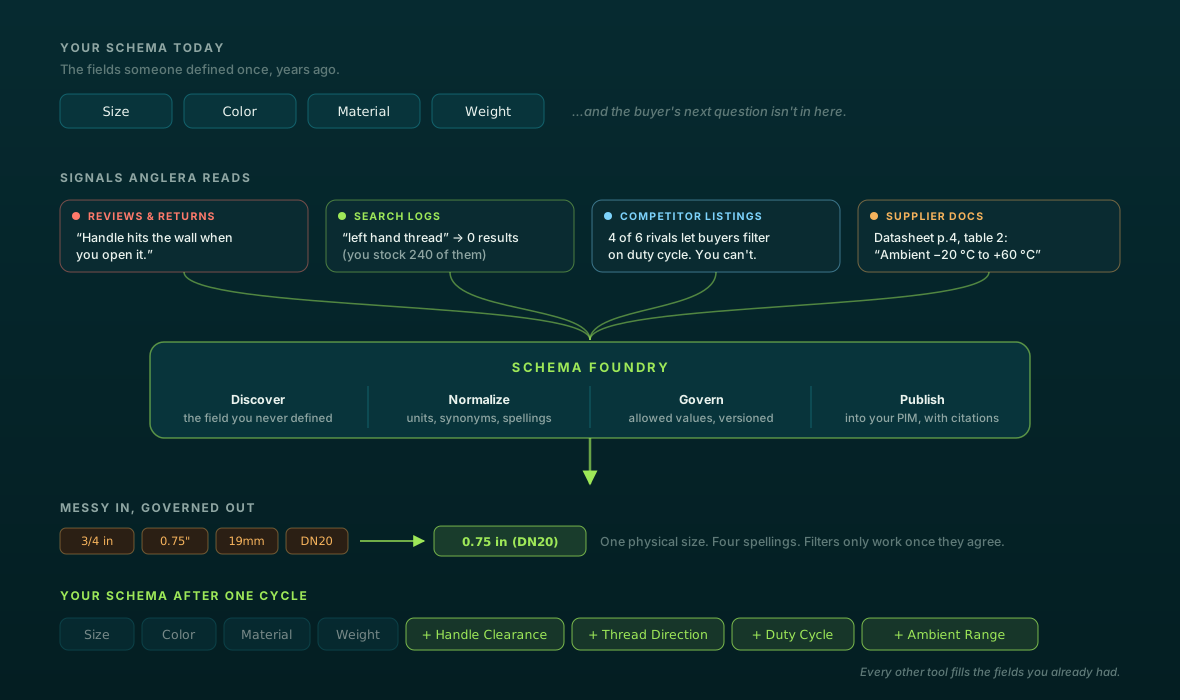
Anglera is the layer that does that work — regardless of which platform you pick. It connects to your Pimcore instance or your Syndigo environment via API, reads your existing SKUs, enriches every attribute and description against buyer signals — how your customers actually search, compare, and filter — and writes the improved content back to the source of truth. What Pimcore then governs and distributes through its integrations, or what Syndigo validates and syndicates to 2,500+ recipients, is buyer-ready from the start rather than just well-organized or schema-compliant. Implementation is roughly 30 days with no platform migration required.
Frequently asked questions
What is the main difference between Pimcore and Syndigo?
Pimcore is an open-source PIM, DAM, MDM, and DXP platform — a developer-extensible system of record for organizations that want maximum control over how product data, digital assets, and master data are stored and governed. Syndigo is a Product Experience Cloud built around content syndication — its core value is network access to 2,500+ retail and GDSN recipients, with automated validation against tens of thousands of retailer-specific content requirements. Both can serve as a PIM, but Pimcore is primarily a data platform and Syndigo is primarily a distribution network with a PIM attached.
Is Pimcore actually free?
The Community Edition is free for non-commercial use and gives access to the full open-source codebase. For commercial deployments, Professional starts at $9,900/year and Enterprise at $29,900/year. The PaaS offering (managed hosting with enterprise support) starts at $39,900/year. Organizations running Pimcore in production commercially will also need to factor in engineering time for implementation and ongoing customization, since the platform is highly extensible but not a no-code setup.
What is GDSN and does Pimcore support it?
GDSN (Global Data Synchronization Network) is the GS1-governed standard for distributing structured product data to trading partners — primarily used by brands and manufacturers supplying grocery chains, mass retailers, and foodservice distributors. Pimcore does not natively support GDSN syndication; connecting to the network requires custom integration work or a third-party GDSN data pool. Syndigo, following its acquisition of 1WorldSync, operates one of the largest GDSN data pools in the US and treats GDSN compliance as a core product feature.
How does Anglera work with Pimcore or Syndigo?
Anglera connects to your existing platform via API, reads your current SKUs, runs enrichment against buyer signals — how your customers actually search, compare, and filter — and writes the improved attributes, descriptions, and copy back to the same record. No migration is required. If you are on Pimcore, the enriched content goes back into your Pimcore repository. If you are on Syndigo, the enriched content returns to the Syndigo record before syndication. Either way, what flows through your platform is buyer-ready rather than just organized or validated. Implementation takes roughly 30 days.
Do I need a separate enrichment tool if I already have Pimcore or Syndigo?
For most B2B distributors, manufacturers, and brands, yes. Pimcore stores and governs data but does not improve it — content quality depends entirely on what suppliers and internal teams provide. Syndigo validates content against retailer schemas and identifies gaps, but it does not autonomously research buyer intent or generate attribute-level enrichment based on how real buyers search. Both tell you what is missing or misformatted; neither fills the gap with buyer-signal-driven content. Anglera does that work and writes the results back to whichever platform is your source of truth.