Plytix vs Sales Layer: Which PIM Is the Right Fit for Your Business?
Plytix and Sales Layer are both cloud PIM platforms that centralize product content and push it to channels. But they were built for different buyers, and the gap between them shows up quickly once you look past the surface-level overlap.
Plytix is designed for small and mid-sized businesses that want a single tool — PIM, DAM, AI content generation, and feed syndication — without seat-count limits or enterprise implementation timelines. The model is deliberately approachable: a freemium entry point, unlimited users on every plan, and enough built-in AI to generate and translate descriptions without a separate content tool. If your team is lean and your biggest problem is getting product content out to ecommerce channels without paying for an enterprise PIM you will not fully use, Plytix is built for that situation.
Sales Layer targets manufacturers, distributors, and retailers managing B2B product data at a higher level of operational complexity. Its Supplier Portal is a genuine B2B differentiator — it lets external suppliers submit and maintain their own product data inside your PIM rather than requiring your team to wrangle incoming specs manually. The "agentic PIM" positioning and six-week onboarding claim are aimed at companies that have been burned by long implementation cycles. Neither platform, however, solves the upstream problem both share: the product data flowing in from suppliers is rarely buyer-ready to begin with.
| Plytix | Sales Layer | Anglera | |
|---|---|---|---|
| Target buyer and market size | Built for SMBs — small and mid-sized ecommerce and retail teams that need a full-featured PIM without enterprise pricing or seat limits; the self-described '#1 PIM for SMBs' | Built for mid-market and enterprise manufacturers, distributors, and retailers managing B2B product data across suppliers, channels, and internal teams | Enrichment layer — works alongside either platform regardless of company size; connects to the PIM via API, enriches SKUs against buyer signals, and writes results back |
| Pricing and seat model | Freemium entry point; paid plans from ~$733/month; catalog-size-based tiers; unlimited users on all plans; AI credits and extra distribution channels available as add-ons | Starts at ~$1,000/month; most plans require a custom quote; tiered by team size and feature set (Core through Enterprise); 30-day free trial available; no self-serve pricing at higher tiers | Priced per SKU enriched — layers onto your existing PIM investment rather than replacing it |
| Supplier and B2B onboarding | No dedicated supplier portal; suppliers send data to your team through standard import workflows; focused on outbound channel distribution rather than inbound supplier collaboration | Supplier Portal is a core differentiator — external suppliers can log in, submit, and update their own product data directly inside the PIM, reducing the manual data-wrangling burden on your team | Does not replace the Supplier Portal — enriches the raw supplier content that arrives through either platform's intake process, then writes clean, complete records back to the PIM |
| AI and content generation | Built-in AI generates and translates product descriptions from existing data; AI credits are sold as an add-on; AI works on whatever content you have loaded — output quality depends on input quality | Positioned as an 'agentic PIM' with AI-assisted validation and workflow automation; content generation capabilities present but less central to the product narrative than the workflow and governance angle | Autonomous enrichment driven by buyer signals — how real buyers search, compare, and decide — not reformatted supplier copy; writes results back to the PIM without a copywriter in the loop |
| Syndication and channel reach | Built-in feed syndication to ecommerce channels and marketplaces; distribution is core to the platform — Plytix positions 'build once, publish everywhere' as its primary value proposition | Multi-channel syndication to channels, marketplaces, and retailer portals; B2B-focused distribution with an emphasis on manufacturer-to-retailer and distributor content flows | Does not syndicate — enriches the content that Plytix or Sales Layer then distributes; works upstream of both platforms |
| Implementation speed | Self-serve onboarding with a freemium tier that lets teams start without a sales conversation; implementation timelines vary by catalog complexity but the product is designed to reduce setup friction for SMB teams | Claims a six-week onboarding timeline as a direct competitive differentiator; sales-led process with a 30-day free trial; faster than many enterprise PIM competitors but still requires a vendor-guided implementation | ~30 days from kickoff to enriched SKUs written back to the PIM; no platform migration required |
| DAM and digital assets | Native DAM included in the platform — teams manage product images and assets alongside product data in the same interface; a meaningful all-in-one benefit for lean SMB teams | Digital asset management capabilities included; supports asset storage and distribution alongside product data, with B2B-oriented workflows for managing assets across supplier and channel relationships | Does not manage digital assets — enriches the product data attributes, descriptions, and copy stored alongside those assets in the PIM |
How to choose between Plytix and Sales Layer
Choose Plytix if you run a small or mid-sized ecommerce or retail operation and want one tool that covers PIM, DAM, AI content generation, and channel syndication without paying per seat or navigating an enterprise sales process. Plytix's unlimited-user model is a genuine advantage for growing teams where headcount is unpredictable. The freemium entry point and self-serve onboarding let you get hands on the product before committing. If your primary workflow is building product content once and pushing it to multiple ecommerce channels — and your team does not need a dedicated supplier portal or complex B2B data governance — Plytix is purpose-built for that motion.
Choose Sales Layer if you are a manufacturer, distributor, or retailer managing product data that flows through external suppliers before it reaches your channels. The Supplier Portal is the feature that makes Sales Layer distinctly suited to B2B operations: instead of your team manually cleaning and entering spec sheets submitted by dozens of suppliers, suppliers submit directly into the PIM. If you are also dealing with the specific pain of slow enterprise PIM implementations, the six-week onboarding claim is worth taking seriously in your evaluation. Sales Layer's B2B orientation — including its channel distribution to retailer portals, not just ecommerce feeds — suits companies operating deeper in the supply chain.
A few signals that clarify the choice:
- If your team has more than a handful of users and seat-based pricing is a concern, Plytix's unlimited-user model removes that friction entirely.
- If external suppliers are the source of most of your product data and you need them to own their own updates, Sales Layer's Supplier Portal is a meaningful operational advantage that Plytix does not match.
- If you are an SMB with a primarily DTC or ecommerce-channel distribution model, Plytix's "build once, publish everywhere" design aligns directly with that workflow.
- If you need B2B channel distribution to retailer portals — not just ecommerce feeds — Sales Layer's distribution network is the more appropriate fit.
- At the price tier where both tools compete, the free trial and freemium options (Plytix) versus the 30-day trial (Sales Layer) mean you can test both before committing.
Whichever you pick, the data still has to get done
Both Plytix and Sales Layer assume your product data is already enriched — complete attributes, buyer-ready descriptions, and titles written for how shoppers actually search. In practice, that assumption is almost never true. Data arrives from suppliers as raw spec sheets, inconsistent field names, factory-floor copy, and half-empty attribute rows. Plytix's AI generates descriptions from whatever you feed it; if the underlying data is thin, the output is too. Sales Layer's Supplier Portal makes it easier for suppliers to submit their data — but does not change the quality of what they submit.
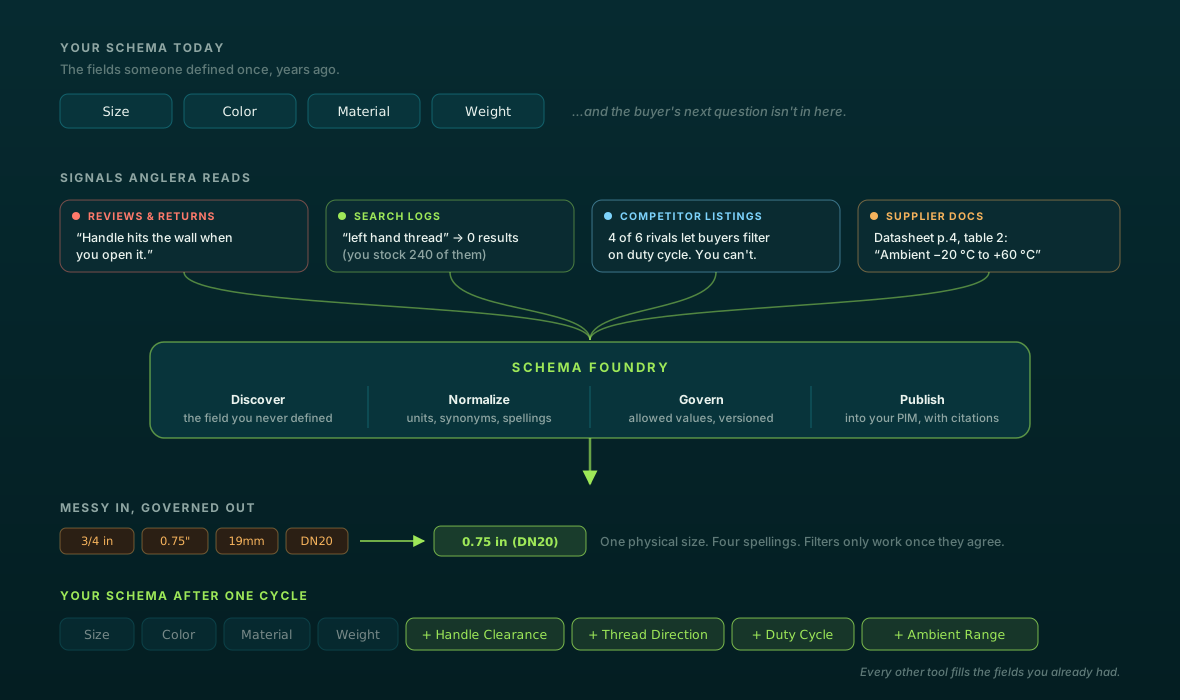
Anglera is the layer that addresses content quality directly. It connects to your Plytix or Sales Layer instance via API, reads your existing SKUs, enriches every attribute and description against buyer signals — how your actual customers search, compare, and filter products — and writes the improved content back to the same PIM record. Your system of record stays in place. No migration, no platform switch. The enrichment quality lifts across the catalog, and the content Plytix or Sales Layer then governs and distributes is buyer-ready from the start rather than just better-organized. Implementation is approximately 30 days. Whichever PIM you choose, Anglera does the enrichment work that platform assumes already happened.
Frequently asked questions
What is the main difference between Plytix and Sales Layer?
Plytix is an all-in-one PIM built for small and mid-sized businesses — unlimited users, a freemium entry point, built-in DAM and AI content generation, and ecommerce-focused syndication. Sales Layer is a B2B-oriented PIM aimed at manufacturers, distributors, and retailers that need a Supplier Portal for inbound data from external partners, multi-channel distribution to retailer portals, and a guided six-week implementation. Both centralize and distribute product content; the difference is target market size, the Supplier Portal capability, and where each platform's syndication network is strongest.
Does Plytix work for B2B distributors and manufacturers?
Plytix can work for B2B companies, particularly smaller ones, but it lacks a dedicated Supplier Portal for managing inbound data from external suppliers. If your core operational challenge is wrangling spec sheets submitted by dozens of suppliers, Sales Layer's Supplier Portal addresses that more directly. If your B2B operation is primarily about centralizing data internally and syndicating it outward, Plytix's all-in-one model may still be sufficient.
Is Sales Layer worth the higher price compared to Plytix?
It depends on what you need. Sales Layer's starting price of ~$1,000/month is higher than Plytix's ~$733/month entry point, and Sales Layer's plans scale by team size where Plytix includes unlimited users. If you need the Supplier Portal, B2B retailer portal distribution, or a more structured implementation for a complex catalog, Sales Layer's higher cost may be justified. If you are an SMB with a lean team and primarily ecommerce distribution needs, Plytix's pricing model is likely more favorable.
How does Anglera work with Plytix or Sales Layer?
Anglera connects to your PIM via API, reads your existing SKUs, runs enrichment against buyer signals — how your customers actually search, compare, and filter — and writes the improved attributes and copy back to the same PIM record. No migration is required. Anglera works alongside whichever platform you choose in roughly 30 days. Your system of record stays unchanged; the content inside it gets better.
Do I still need an enrichment tool if I use Plytix's built-in AI?
Plytix's AI generates and translates descriptions from data you have already loaded — it reformats and expands existing content. If the underlying attributes are thin, incomplete, or copied from supplier spec sheets, the AI output reflects those gaps. Anglera enriches upstream of that step: it researches what buyers search for, identifies which attributes are missing, writes copy aligned to purchase signals, and writes complete records back into Plytix before the AI works with them — or replaces that step entirely. The result is richer input and richer output across the catalog.