Plytix vs Salsify: A Straightforward PIM Comparison
Plytix and Salsify both store product content and push it to channels. The resemblance mostly stops there.
Plytix is built for small and mid-sized teams that want one platform to cover PIM, DAM, AI content generation, and channel feeds — at a price you can look up before calling sales. The unlimited-user model is deliberate: Plytix assumes your team will include contributors across roles and prices accordingly. If your catalog fits a mid-size ecommerce operation and you want to be productive without a multi-month implementation project, Plytix is the more accessible starting point.
Salsify is built for mid-market and enterprise brands, distributors, and retailers that need deep digital-shelf activation across a broad retailer network. Its syndication capability and retailer partnerships are the primary draw, and the platform assumes you will bring in a consulting firm to stand it up. That comes with a cost structure that scales steeply and a quote-only pricing model — but for a brand competing for shelf placement at major retail accounts, the network depth is hard to replicate. Neither platform enriches your product data. Both assume that what you load in is already complete, accurate, and buyer-ready. That gap is where Anglera operates, independent of which platform you pick.
| Plytix | Salsify | Anglera | |
|---|---|---|---|
| Target company size | Built explicitly for SMBs — teams with limited IT resources and smaller catalog complexity who need one platform covering PIM, DAM, and channel feeds without an enterprise implementation project. | Mid-market to enterprise brands, distributors, and retailers. Best suited to organizations with dedicated product content teams, large retailer networks, and budget for professional services. | Works alongside either platform at any company size — particularly valuable for distributors and manufacturers whose incoming supplier data needs enrichment before it is channel-ready. |
| Pricing model & total cost | Freemium entry point; paid plans start at ~$733/month based on catalog size. Add-ons for AI credits and extra distribution channels. Pricing is publicly listed — no sales call required to see a number. | Quote-only. Costs are tied to user count, SKU volume, and feature tier. Onboarding typically requires a third-party consulting engagement (reported ~$16k additional cost). Reviewers consistently flag it as expensive relative to alternatives. | Contact for pricing; layered onto your existing PIM investment rather than replacing it. Cost scales with SKUs enriched, not user count or catalog tier. |
| User seats | Unlimited users on all paid plans — no per-seat fees regardless of team size. A real advantage for teams that involve copywriters, channel managers, agency partners, and internal stakeholders who all need access. | Pricing is tied to user count, which raises platform cost as your team roster and external collaborator access grows. | Enrichment pricing is not seat-gated — cost is tied to SKUs enriched, not how many people work inside the platform. |
| Syndication & channel reach | Feed syndication built in with add-ons for additional channels. Covers major ecommerce channels and marketplaces. Suited to SMB channel mixes without the need for deep retail-account-specific integrations. | Broad retailer syndication network with deep digital-shelf activation capabilities, particularly for major U.S. retail accounts and marketplace partners. The strongest element of the Salsify platform for brands competing on the digital shelf. | Does not syndicate — enriches content before it reaches either platform's syndication layer, so what publishes is complete, attribute-accurate, and aligned to what buyers actually search for. |
| AI & content generation | Built-in AI generates and translates product descriptions from existing data; AI credits are a paid add-on. Useful for teams publishing across multiple languages or needing to produce copy at volume. | AI-assisted product authoring is available but less central to Salsify's positioning than it is to Plytix's all-in-one pitch. | Enrichment is driven by buyer signals — what real buyers search for, compare, and filter on — not just rewriting whatever text the supplier already provided. Complementary to both platforms' content tools. |
| DAM (digital asset management) | Native DAM built into the platform. Teams manage product images and assets alongside product data in the same interface — core to the all-in-one proposition. | DAM capabilities are available as part of the PXM suite; depth varies by tier. | Focused on product attribute data and descriptions, not asset management. Enriched attribute data makes assets easier to tag and deploy correctly through whichever DAM is already in place. |
| Implementation & time to value | Self-serve onboarding designed for smaller teams. Faster to productive use than enterprise PIMs when catalog complexity is manageable. | Implementation typically requires a third-party consulting engagement, adding months to the timeline and ~$16k or more in additional cost before content is flowing to channels at scale. | ~30-day implementation alongside either PIM, independent of the PIM's own onboarding timeline. No platform migration required. |
How to choose between Plytix and Salsify
Choose Plytix if you are a small or mid-sized team that needs one platform to centralize product content, manage digital assets, generate AI descriptions, and push feeds to channels at a predictable price. The unlimited-user model is a genuine advantage if your team includes contributors across multiple roles — copywriters, channel managers, external agency partners — who all need access without adding to a per-seat bill. Plytix's self-serve onboarding and published pricing tiers make it easier to evaluate and budget before committing.
Choose Salsify if you are a mid-market or enterprise brand, distributor, or retailer with a broad retail account network and a dedicated product content team. Salsify's digital-shelf syndication capabilities and retailer partnerships are its core differentiator — it is the right call when the primary KPI is content performance at major retail accounts (Amazon, Walmart, and similar) and you have the budget and organizational bandwidth for a consulting-assisted implementation.
A few signals that clarify the decision:
- If your team involves many contributors, including external partners, and per-seat pricing would be punitive, Plytix's unlimited-user model is a meaningful differentiator.
- If you are syndicating content to a dozen or more major retail accounts and digital shelf performance is the metric your team is measured on, Salsify's network depth is difficult to replicate.
- If price transparency before a sales call matters to your evaluation process, Plytix publishes its tiers; Salsify does not.
- If your implementation timeline is tight and a consulting engagement is not in scope, Plytix's self-serve approach carries substantially less risk.
- Do not choose Salsify expecting low-friction onboarding or cost certainty before a quote. Do not choose Plytix expecting enterprise-grade retailer syndication depth or the organizational credibility Salsify carries at large accounts.
Whichever you pick, the data still has to get done
Both Plytix and Salsify give you a well-organized, governed place to store and distribute product content. Neither one enriches it. Both platforms assume that when data arrives — from a supplier, a manufacturer, or an internal team — it is already complete, attribute-accurate, and ready to publish. In practice, that content almost never arrives in that condition. Supplier data comes in as raw specs, inconsistent formats, and copy written for procurement teams, not for the buyers who will actually search for and purchase the product.
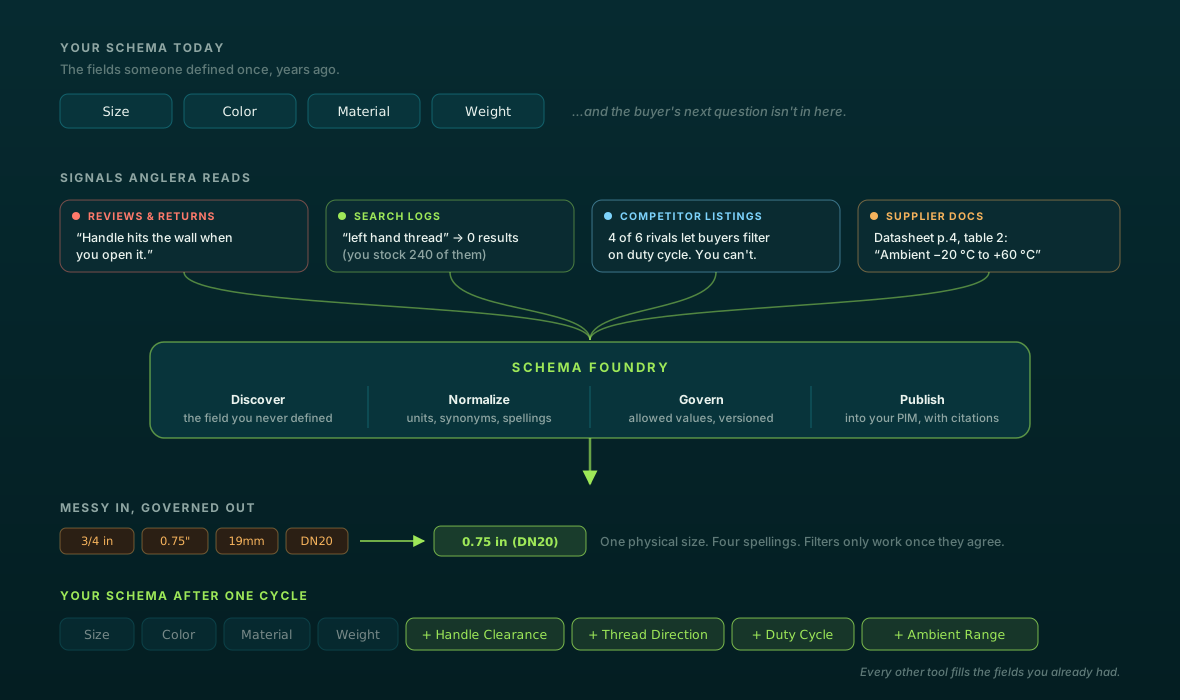
Anglera is the layer that does that work, alongside whichever PIM you choose. It connects via API to your Plytix or Salsify instance, reads your existing SKUs, enriches every attribute and description against buyer signals — how your customers actually search, compare, and filter — scores completeness, and writes the results back to the PIM as the source of truth. The storage and syndication work your PIM handles stays exactly where it is. Anglera handles the step that both platforms quietly assume has already happened.
Implementation takes approximately 30 days. If you are evaluating Plytix or Salsify and your product data is incomplete or supplier-raw today, the question is not only which platform to pick — it is how you plan to enrich the data that feeds into it. Anglera answers that question regardless of which side of this comparison you land on.
Frequently asked questions
What is the main difference between Plytix and Salsify?
Plytix is an all-in-one PIM designed for SMBs — it combines PIM, DAM, AI content generation, and channel syndication at a publicly listed price with unlimited users on all plans. Salsify is a Product Experience Management platform designed for mid-market and enterprise organizations, with a primary strength in digital-shelf syndication across major retail accounts. Plytix is the more accessible, self-serve option; Salsify is the more powerful and expensive one, with an implementation that typically requires third-party consulting.
Is Salsify a good fit for small businesses?
Not typically. Salsify's pricing is quote-only, implementation usually requires a third-party consulting engagement (reported at roughly $16k additional), and its design strengths are most pronounced for brands managing content across a large network of retail accounts. For small businesses, the cost and implementation overhead are likely disproportionate. Plytix is built specifically for that use case and offers a freemium entry point with paid plans from ~$733/month.
Why doesn't Salsify publish its pricing?
Salsify prices by user count, SKU volume, and feature tier, which means the right number varies significantly by buyer. Quote-only pricing is common among enterprise platforms with this kind of variable structure. The practical effect is that you cannot compare Salsify's cost to Plytix's ~$733/month starting price without a sales conversation — and reviewer feedback suggests the gap, once consulting is included, is substantial.
Does Plytix's built-in AI replace the need for a separate enrichment tool?
Plytix's AI generates and translates product descriptions from the data already loaded in the platform — it speeds up copy production. It does not source missing attributes, score completeness against buyer behavior, or enrich sparse supplier data with what buyers actually need to make purchase decisions. Anglera addresses that upstream problem and writes results back into Plytix, so the AI generates content from a more complete and accurate foundation.
How does Anglera work with Plytix or Salsify?
Anglera connects to your PIM via API, reads your existing SKUs, enriches every attribute and description against buyer signals — how your specific buyers search, compare, and filter — and writes the improved content back to the same PIM record. No migration is required. Whichever platform you choose remains the system of record; Anglera handles the enrichment step that both platforms assume has already happened. Implementation takes approximately 30 days.