Plytix vs Stibo Systems: SMB PIM vs Enterprise MDM
These two platforms share a category label — PIM — but address almost entirely different problems for entirely different organizations. Plytix is built from the ground up for small and mid-sized businesses that need a practical, affordable system to centralize product content, manage digital assets, generate copy with AI, and push feeds to ecommerce channels. Stibo Systems builds STEP, an enterprise Master Data Management platform where PIM is one domain inside a larger data governance architecture used by complex, global organizations managing product, customer, supplier, and asset data under one roof.
The buyer profiles rarely overlap. A 50-person distribution company managing 10,000 SKUs across a few ecommerce channels is the Plytix buyer. A Fortune 500 manufacturer governing product and supplier data across business units and geographies — often alongside an SAP or Oracle ERP stack — is the Stibo buyer. If you are genuinely choosing between these two, the first question is not "which has better features" but "which tier of data problem am I actually solving."
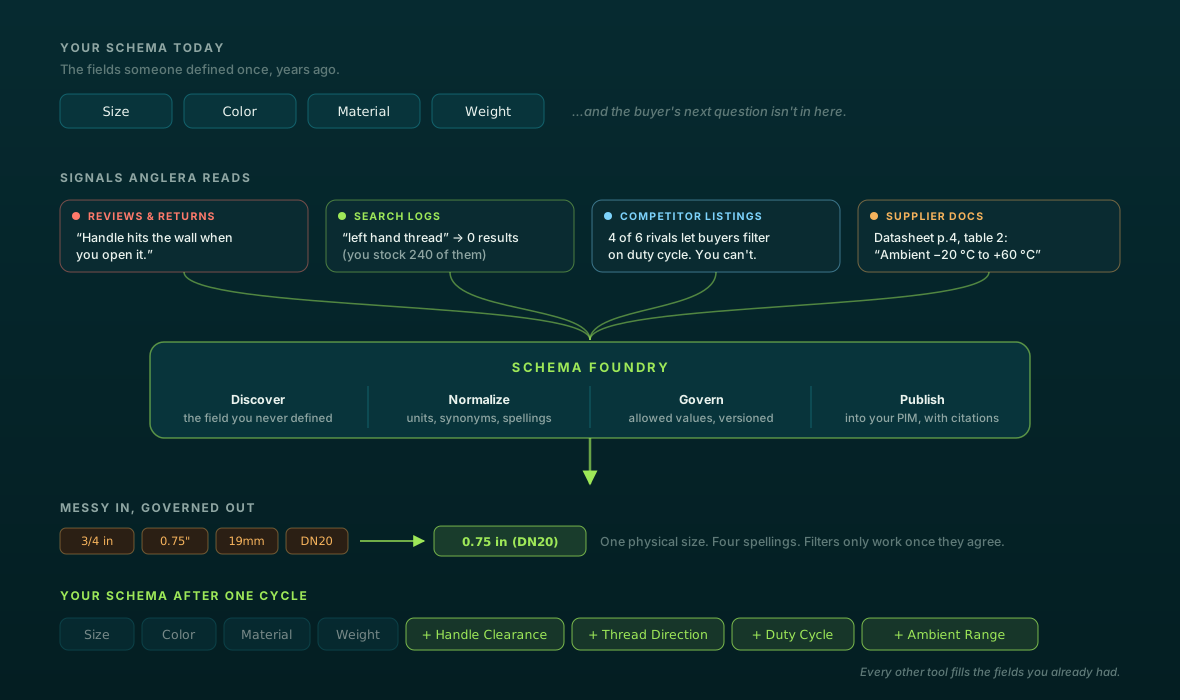
What neither platform resolves automatically is the upstream data quality gap. Product content arrives from suppliers as raw specs, incomplete attribute sets, and copy written for procurement rather than for a buyer comparing options online. Both platforms give you a well-organized place to store, govern, and distribute that content. Neither automatically enriches it to match how buyers search and decide.
| Plytix | Stibo Systems | Anglera | |
|---|---|---|---|
| Target buyer | Small and mid-sized businesses — teams that need one tool covering PIM, DAM, AI content generation, and channel feed syndication without enterprise pricing or a long implementation project | Large enterprises with complex, multi-domain data environments — companies that need a single system of record for product, supplier, customer, and asset master data across business units and geographies | Works with either — connects via API to the PIM or MDM you already run, enriches SKU content against buyer signals, and writes results back to the same system of record |
| Platform scope | PIM + DAM + AI content generation + channel feed syndication in a single product; deliberately all-in-one for SMB teams that cannot manage multiple specialized tools or enterprise licensing | Enterprise MDM platform (STEP) where PIM is one domain among several — also governs customer, supplier, and asset master data; suited to organizations that need a single governance layer across all data domains, not product data alone | Not a PIM or MDM — an enrichment layer that reads from and writes back to whatever platform manages the catalog; no platform scope to overlap with |
| Implementation complexity | Cloud-hosted; designed for relatively fast onboarding; SMB teams can configure and launch without a dedicated systems integrator | Implementation typically takes months; large enterprise deployments commonly require a systems integrator; configuration complexity reflects the multi-domain MDM scope and the need to model governance workflows across data domains | ~30 days from kickoff to enriched SKUs written back to the PIM; no platform migration, no SI engagement required |
| Pricing | Freemium entry tier; paid plans from approximately $733/month; catalog-size-based tiers; add-ons for AI credits and additional distribution channels; unlimited users on all plans | Custom enterprise pricing only; no public rates; scoped by users, data volume, and licensed modules; total cost of ownership includes licensing, multi-month implementation, and typically ongoing SI support | Per-SKU enrichment pricing; layers onto the existing PIM or MDM investment rather than replacing it |
| AI and content enrichment | Built-in AI to generate and translate product descriptions; AI credit add-ons available; focused on authoring efficiency for SMB content teams who need to produce copy at catalog scale | Enterprise governance and workflow automation are STEP's core strengths; AI enrichment tooling is not the primary positioning — the platform is built around data integrity and multi-domain governance rather than content generation | Autonomous enrichment driven by buyer signals — how customers search, compare, and filter — not reformatted supplier copy; writes results back to the PIM without requiring manual review or copywriter involvement |
| Data governance and modeling | Structured for SMB catalog management; configurable attribute templates and channel-ready data models without the complexity overhead of enterprise MDM governance workflows | Deep governance capabilities: data quality rules, approval workflows, role-based access, and data modeling that spans multiple master data domains; a Gartner Magic Quadrant Leader for MDM reflecting enterprise governance strength | PIM-agnostic — adapts to whichever schema Plytix or STEP defines; no data model changes required on either platform |
| Syndication and channel reach | Built-in channel feed syndication; publish product content to ecommerce platforms and marketplaces from within the same subscription, with add-ons for additional channels depending on tier | Enterprise-grade distribution and syndication workflows built into STEP; suited to large organizations pushing governed product data across many internal systems and external channel endpoints | Does not syndicate — enriches the content that Plytix or STEP then distributes; works upstream of both platforms |
How to choose between Plytix and Stibo Systems
Choose Plytix if you are a small or mid-sized business that needs a practical, affordable, all-in-one product content platform and wants to be live quickly. Plytix's combination of PIM, DAM, AI content tools, and channel syndication in a single product — with unlimited users and pricing starting around $733/month — is purpose-built for teams that cannot justify enterprise licensing or a multi-month implementation. If your problem is "we need to centralize our catalog, manage digital assets, generate descriptions, and push feeds to ecommerce channels without a dedicated IT project," Plytix covers all of that in one subscription.
Choose Stibo Systems (STEP) if your organization is a large enterprise with multi-domain data governance requirements that extend well beyond product data. STEP earns its Gartner Magic Quadrant Leader standing in MDM by governing product, customer, supplier, and asset data from a single system of record — with the workflows, data modeling, and governance controls that complex, global organizations need. This is the right choice when the problem is not just catalog management but master data integrity across business units, ERP integrations, and multiple geographies. Budget for a multi-month implementation and a systems integrator.
A few signals that clarify the decision:
- If you have under a few hundred employees, no current MDM infrastructure, and need to get a product content operation running within weeks, Plytix wins on speed and economics.
- If your organization runs SAP, Oracle, or similar enterprise ERP systems and needs a single source of truth for data that spans product, supplier, and customer domains, Stibo is built for that environment.
- If you are mid-market and trying to decide between these two specifically, Plytix is almost certainly the better fit — STEP's pricing, implementation scope, and governance complexity are calibrated for enterprise scale that most mid-market companies do not yet need.
Whichever you pick, the data still has to get done
Plytix and Stibo Systems both assume that the product data stored in them is already good. In practice, it rarely is. Supplier content arrives as raw specs, inconsistent attribute sets, and descriptions written for a procurement document rather than for a buyer comparing options. Both platforms give you a well-organized, governed place to store and distribute that content. Neither automatically makes it buyer-ready.
That gap is where Anglera fits, regardless of which platform you choose. Anglera connects to your Plytix account or your STEP instance via API, pulls your existing SKUs, enriches every attribute and description against buyer signals — how your customers actually search, compare, and filter — and writes the improved content back to the same system of record. Your PIM or MDM stays in place. The content it governs and distributes becomes richer without a manual copywriting effort on your side.
Whether you are an SMB team on Plytix pushing feeds to ecommerce channels, or an enterprise team on STEP managing product data at scale, the upstream enrichment problem is the same. Anglera does that work in roughly 30 days, with no platform migration required and no change to the system of record you have already built.
Frequently asked questions
What is the main difference between Plytix and Stibo Systems?
Plytix is a cloud PIM built for small and mid-sized businesses — an all-in-one platform covering PIM, DAM, AI content generation, and channel syndication, starting at around $733/month. Stibo Systems builds STEP, an enterprise Master Data Management platform where PIM is one domain inside a broader governance architecture that also covers customer, supplier, and asset data. The buyer profiles almost never overlap: Plytix serves SMB teams that need to get organized quickly and affordably; Stibo serves large enterprises governing complex, multi-domain data at scale.
Can a mid-market company use Stibo Systems?
STEP can technically serve mid-market companies, but it is designed and priced for enterprise scale. Custom pricing, multi-month implementation timelines, and systems integrator involvement are the norm. Mid-market companies that do not need multi-domain MDM governance — and most do not — typically find that platforms like Plytix, Akeneo, or similar mid-market PIMs are faster to implement and more cost-effective for the catalog management problem they are actually solving.
Does Plytix include syndication, or is that a separate tool?
Syndication is built into Plytix. The platform lets you centralize product content once and publish it to ecommerce channels and marketplaces from within the same subscription. Additional distribution channels may require add-ons depending on your plan tier, but the core syndication capability is included rather than sold separately.
How does Anglera work alongside Plytix or Stibo Systems?
Anglera connects to your PIM or MDM via API, reads your existing SKUs, enriches attributes and descriptions against buyer signals — how your customers search, compare, and filter — and writes the improved content back to the same system of record. No migration is required. Anglera works alongside whichever platform you choose; implementation is typically around 30 days.
Is Plytix really free to start?
Plytix has a freemium entry tier that lets small teams get started at no cost, with limitations on catalog size, AI credits, and distribution channels. Paid plans begin at approximately $733/month and scale based on catalog size, with add-ons available for AI content generation credits and additional channel integrations. Unlimited users are included on all plans, which is a meaningful cost difference from user-seat-based competitors.