Productsup vs Rithum (ChannelAdvisor / CommerceHub): A Fair 2026 Comparison
Productsup and Rithum (the 2023 merger of CommerceHub, ChannelAdvisor, and Dsco) both help brands and retailers get products in front of buyers across dozens or hundreds of channels. But they come at the problem from different angles, and picking the wrong one creates expensive rework.
Productsup is fundamentally a content engine: its job is to ingest product data from suppliers and internal systems, apply rule-based transformations, and push channel-ready feeds to 2,500+ destinations — marketplaces, retail data pools, paid media platforms. Rithum is a commerce operations platform: it handles listing and feed management too, but its deeper strength is the end-to-end operation of marketplace selling, including drop-ship fulfillment, order routing, and supplier connectivity inherited from CommerceHub and ChannelAdvisor. The right choice depends on whether your bottleneck is content distribution complexity or commerce operations complexity — and in many organizations, those are genuinely different problems.
One thing both platforms share: neither enriches the product data they distribute. They move what you give them. If your attributes are incomplete, your titles are generic, or your content hasn't been scored against buyer demand, Productsup and Rithum faithfully syndicate that weakness everywhere you sell.
| Productsup | Rithum (ChannelAdvisor / CommerceHub) | Anglera | |
|---|---|---|---|
| Primary job | Transform and syndicate product content to 2,500+ channels — a feed management and content distribution engine for brands and manufacturers. | List, fulfill, and manage orders across 420+ marketplace and retail channels — content syndication plus commerce operations including drop-ship and order routing. | Enriches product data upstream in your PIM — filling gaps, cleaning attributes, and scoring content against buyer signals — before either platform distributes it. |
| Channel reach | 2,500+ connectors spanning marketplaces, retail data pools, paid media (Amazon, Google, Meta), and retailer-specific formats. | 420+ marketplace and retail channels with particular depth in North American marketplace operations (Amazon, Walmart, Target) and drop-ship networks. | Channel-agnostic; enriched data flows to whichever syndication or distribution layer you already run. |
| Data transformation | Rule-based transformation is the core product. Sophisticated mapping, normalization, and reformatting for each channel's exact schema requirements. | Feed management and transformation included, but the transformation layer is less deep than Productsup — channel operations is the primary differentiator. | Works upstream of transformation: generates and validates the attribute values themselves, so the content entering Productsup or Rithum is already complete and accurate. |
| Order and fulfillment management | Not a commerce operations platform. Focused on product content distribution; does not handle order routing, drop-ship, or inventory sync. | Strong drop-ship and order routing capabilities from CommerceHub heritage. Connects supplier catalogs to retailer channels and automates fulfillment workflows at scale. | Not an order or fulfillment tool. Anglera operates on the product record upstream, before any transaction occurs. |
| Target customer profile | Enterprise brands, manufacturers, and global retailers needing sophisticated content transformation across many channel formats, especially in European markets and retail data pools. | Brands and retailers with heavy marketplace volume, drop-ship supplier networks, or multi-channel fulfillment complexity — particularly in North American commerce. | B2B distributors, manufacturers, and specialty retailers where SKU-level data accuracy directly affects margin, search placement, and buyer confidence. |
| Pricing model | Custom enterprise pricing only. No public tiers; quote required via sales. | Custom enterprise pricing based on GMV and channel usage. No public tiers. | Priced by SKU volume and enrichment scope. Typical implementation runs approximately 30 days. |
| Scale and track record | Processes over 2 trillion products per month. Clients include L'Oréal, ALDI, and PUMA. | Serves 40,000+ brands and retailers across marketplace and retail channels globally. | Focused on quality over throughput — enrichment depth per SKU, not raw feed volume. |
How to choose between Productsup and Rithum (ChannelAdvisor / CommerceHub)
Choose Productsup if content distribution complexity is your primary bottleneck.
Productsup earns its place when you need to take messy or inconsistent supplier content and reshape it into dozens of precise channel formats at scale. It is especially well suited for global brands and manufacturers that distribute through retail data pools, European markets, or a wide mix of paid media and marketplace formats. If your team spends significant time writing and maintaining data transformation rules, Productsup is built for that work.
Choose Rithum if commerce operations complexity is your primary bottleneck.
Rithum is the stronger fit when your challenge is not just getting listings up, but managing the ongoing commerce operation around them — drop-ship supplier networks, order routing, marketplace policy compliance, and inventory sync across hundreds of channels. The CommerceHub heritage gives Rithum capabilities that Productsup simply does not have on the fulfillment side. If you are a retailer connecting supplier catalogs to marketplaces, or a brand managing drop-ship programs at scale, Rithum addresses problems Productsup does not.
If you are weighing both, it is worth being honest about which constraint is actually limiting revenue: content quality and channel reach, or fulfillment operations and marketplace management. Some larger organizations run both platforms for different parts of their stack, though that adds integration overhead worth evaluating before committing.
Whichever you pick, the data still has to get done
Both Productsup and Rithum are distribution platforms. They move product data — they do not improve it.
When a brand onboards with either tool, the assumption is that the product content coming in is complete, accurate, and optimized. In practice it rarely is: attributes are missing, titles are pulled from a supplier sheet, and nobody has checked whether the content matches what buyers actually search for. Productsup and Rithum faithfully replicate that gap across every channel they touch.
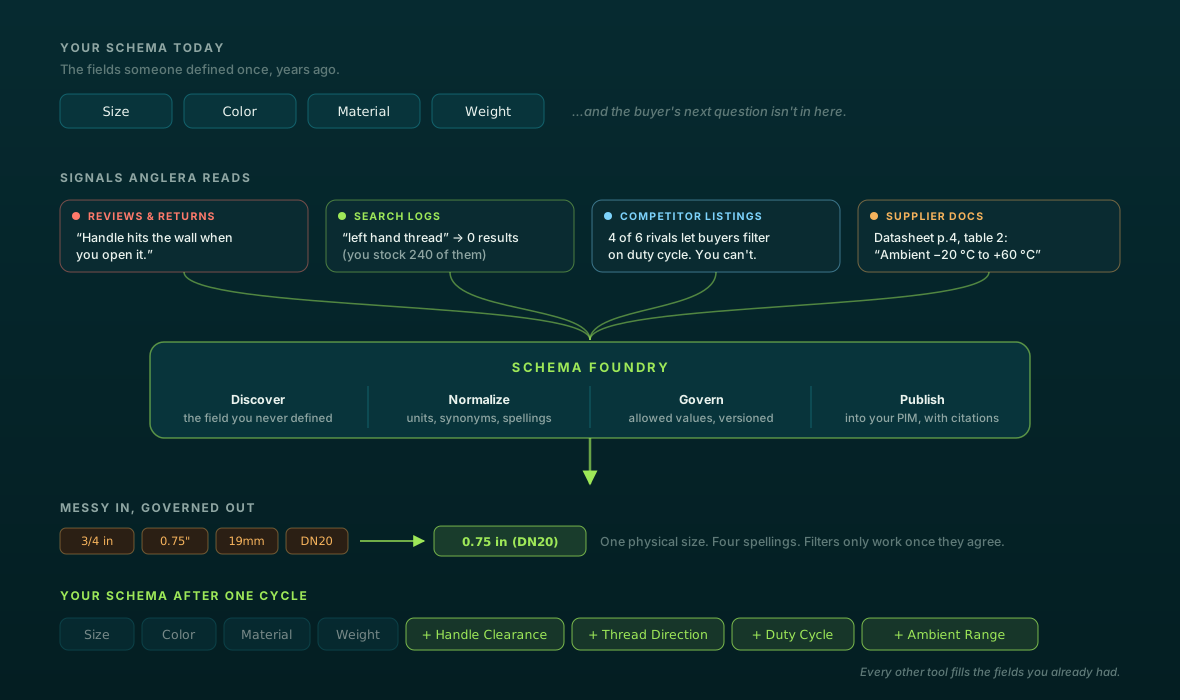
Anglera is the layer that runs before syndication. It connects to your PIM — the source of truth — pulls every SKU, identifies what is missing or weak against buyer signals and category standards, generates and verifies the missing attributes, and writes the enriched data back to the PIM. By the time Productsup or Rithum picks up that record, it is ready.
This is not a replacement for either platform. It is what makes them work better. Whichever tool you choose for distribution, Anglera handles the enrichment work that platform assumes already happened. Implementation typically runs about 30 days, and the enriched content lives in your PIM permanently — not locked inside the syndication layer.
Frequently asked questions
What is the core difference between Productsup and Rithum?
Productsup is primarily a content transformation and feed distribution engine — its strength is reshaping product data into the exact format each channel requires, across 2,500+ connectors. Rithum is a commerce operations platform that covers feed management but adds meaningful drop-ship, order routing, and marketplace operations capabilities inherited from CommerceHub and ChannelAdvisor. If your problem is content distribution complexity, Productsup is the more focused tool. If your problem includes fulfillment and marketplace operations, Rithum covers more ground.
Do Productsup or Rithum enrich product data?
Neither platform is designed for enrichment. Both assume you are bringing reasonably complete, accurate product content and focus their capabilities on transforming and distributing that content to channels. If your product data has gaps — missing attributes, weak titles, uncategorized SKUs — those gaps will be distributed at scale. Enrichment needs to happen upstream, in or alongside your PIM, before syndication runs.
Can I use Productsup and Rithum together?
Technically yes, though it adds integration complexity and cost. In practice, most organizations evaluate which platform addresses their primary constraint and choose one. Some larger enterprises use Productsup for content-heavy brand distribution and Rithum for drop-ship or marketplace operations, treating them as separate tools for separate problems. That only makes sense if both problems are genuinely present and large enough to justify the overhead.
Where does Anglera fit if I already use one of these platforms?
Anglera connects to your PIM — not to your syndication platform. It reads your product records, identifies gaps and quality issues, enriches and scores the data against buyer signals, and writes the improved content back to your PIM. The next time Productsup or Rithum pulls from that PIM, it picks up better data. There is no change to your existing syndication workflow; the enrichment layer runs upstream of it.
Which platform is better for marketplace sellers?
Rithum has a stronger marketplace operations track record, particularly in North American channels such as Amazon, Walmart, and Target, and it handles the operational side of marketplace selling — order management, drop-ship, inventory — that Productsup does not cover. Productsup has broader channel connector breadth and deeper transformation capabilities, which matters more for brands distributing content to many different retailer and media formats simultaneously. For a marketplace-first seller focused on operations, Rithum is typically the better fit.