Productsup vs Unilog CX1 / CIMM2: Which Platform Fits Your Stack?
Productsup and Unilog CX1 / CIMM2 are often mentioned in the same B2B digital commerce conversation, but they solve fundamentally different problems. Productsup is a channel syndication and feed management platform built to push product content across 2,500+ retail, marketplace, and advertising channels at enterprise scale. Unilog CX1 is an all-in-one platform purpose-built for mid-market B2B distributors — bundling a storefront, a PIM, a CMS, site search, and ERP integration under one subscription, with an optional managed content library of 10M+ vendor SKUs.
That difference matters before you issue an RFP. A brand or manufacturer whose main challenge is distributing data across many channels simultaneously will find Unilog's B2B-storefront focus too narrow. A mid-market electrical or HVAC distributor who wants eCommerce without assembling a best-of-breed stack will find Productsup's lack of a storefront or PIM a significant gap. The sections below walk through the dimensions that separate the two so you can match the tool to the actual problem you are solving.
| Productsup | Unilog CX1 / CIMM2 | Anglera | |
|---|---|---|---|
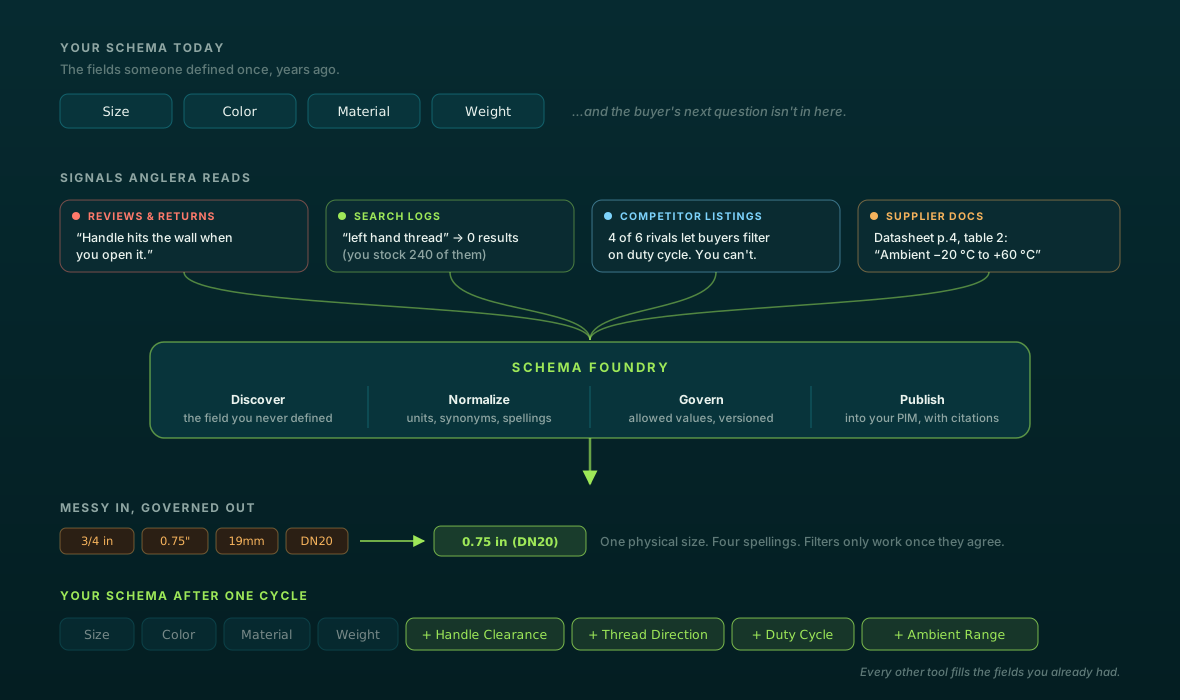
| What it does | Ingests product data from any source, applies transformation and normalization rules, and syndicates channel-ready feeds to 2,500+ retail, marketplace, and advertising destinations — including Amazon, Google, Meta, and retail data pools. | Bundles a B2B eCommerce storefront, built-in PIM, CMS, site search, and ERP/POS integration layer (CX1 Connect) in one platform. Separately sells a managed content library of 10M+ SKUs from ~2,000 manufacturers plus custom enrichment services. | Neither syndicates feeds nor runs a storefront. Anglera enriches the product data upstream — gathering, cleaning, attributing, and scoring every SKU against buyer signals — so what flows into either platform is already complete and accurate. |
| Best-fit buyer | Enterprise brands, manufacturers, and large retailers that need to push high-volume product content across many digital channels simultaneously. Clients include L'Oréal, ALDI, and PUMA — companies with complex, multi-channel distribution requirements. | Mid-market B2B distributors, wholesalers, and manufacturers — especially in electrical, industrial, plumbing, and HVAC — that want a single-vendor platform covering storefront, PIM, and ERP integration without building a best-of-breed stack. Commonly adopted among AD member distributors. | Any distributor, manufacturer, or retailer whose catalog has attribute gaps, inconsistent data, or missing specs — regardless of which commerce or syndication platform sits downstream. |
| Channel reach | 2,500+ pre-built channel connectors is the core value proposition. Handles Amazon, Google Shopping, Meta, regional marketplaces, and retail data pools from a single feed management workflow. | One high-quality B2B storefront channel plus ERP/POS integration via CX1 Connect. Not designed for multi-channel retail or marketplace syndication — the platform's goal is a clean B2B buying experience, not breadth of outbound channels. | Channel-agnostic. Once attributes are complete and buyer-signal-scored, they travel cleanly to whichever destinations Productsup or CX1 pushes them — no connector work required on Anglera's side. |
| Product content and enrichment | Applies rule-based transformation and normalization in transit. Does not supply missing attribute values, generate descriptions, or fill taxonomy gaps — it expects data to arrive structured and ready before the feed runs. | Offers a managed content library (10M+ SKUs, ~2,000 manufacturers) plus custom enrichment, taxonomy normalization, and gap-fill sold as content subscriptions and managed-services engagements. Coverage is strongest in its core verticals. | Automatically gathers, cleans, enriches, and scores every SKU using buyer signals, then writes results back to your PIM or data source. Not bounded by a pre-indexed library — works on any SKU in your catalog, including long-tail and proprietary items. |
| PIM and data ownership | No native PIM. Assumes a separate PIM, ERP, or structured data source is feeding it. Works alongside tools like Akeneo, Salsify, and similar platforms. | Built-in PIM bundled with the storefront — a practical advantage for distributors who do not want a separate PIM license. The trade-off: product master data lives inside the commerce platform, which can complicate future migrations. | Not a PIM. Reads from and writes back to your existing PIM, ERP, or data layer — including Unilog CX1 itself — keeping your source of truth authoritative without displacing it. |
| Implementation scope | Enterprise-grade deployment with dedicated onboarding. Timeline scales with integration complexity, number of channels, and data transformation requirements. Custom scoping required. | Multi-month implementation covering storefront configuration, PIM data migration, ERP integration, and content onboarding. Unilog provides managed implementation services to accelerate the project. | Approximately 30 days. Integrates at the data layer alongside either platform without requiring changes to your storefront, syndication setup, or channel configurations. |
| Pricing | Custom enterprise pricing only. No public tiers; quote required via sales. | Subscription SaaS, quote-based. Third-party sources cite entry pricing in the low hundreds per month, but real deployments scale with catalog size, active modules, and content services scope. | Usage-based pricing scaled to SKU volume. No multi-year platform contracts or implementation fees bundled into the base price. |
How to choose between Productsup and Unilog CX1 / CIMM2
Choose Productsup if your primary challenge is distributing product content at scale across a large number of retail, marketplace, or advertising channels — and your data is already well-structured when it leaves your PIM. It is the right call for enterprise brands and manufacturers whose operational bottleneck is reach and speed-to-channel, not content creation or data quality. If you are publishing to 20+ channels and need consistent, transformation-ready feeds with enterprise SLAs, Productsup was built for that problem.
Choose Unilog CX1 / CIMM2 if you are a mid-market B2B distributor — particularly in electrical, industrial, plumbing, or HVAC — who needs to launch or modernize an eCommerce storefront without assembling a best-of-breed technology stack. The bundled PIM, managed content library, and ERP connectors reduce integration overhead and shorten time-to-launch. It is especially compelling if your catalog overlaps with the 10M+ SKUs already in Unilog's content library, or if you operate within the AD member network where Unilog has deep implementation experience.
Neither tool is the right first purchase if your primary problem is incomplete or inconsistent product data. Productsup has no enrichment capability — it can reshape data that arrives well-formed, but it cannot supply missing attributes. Unilog's managed library helps within its covered verticals, but custom enrichment is a professional-services engagement rather than a continuous automated process. If your catalog has significant gaps, addressing enrichment before (or alongside) either platform will produce better outcomes faster.
Whichever you pick, the data still has to get done
Both Productsup and Unilog CX1 share the same unstated assumption: that product data is ready before it enters the platform. Productsup's transformation rules can reformat and normalize data in transit, but they cannot invent missing specifications, generate accurate descriptions, or score attributes against what buyers actually search for. Unilog's managed content library covers that gap within its indexed catalog — but it is bounded by the roughly 2,000 manufacturers it has onboarded, and anything outside that set, or any proprietary or long-tail SKU, still arrives incomplete.
Anglera fills that gap regardless of which platform you choose. It connects to your PIM, ERP, or Unilog's own data layer, automatically enriches every SKU using buyer signals and sourced attribute data, and writes the complete, scored results back to your source of truth. By the time Productsup reads the outbound feed, the attributes are already channel-ready. By the time Unilog serves the product detail page, the specs are already populated. The enrichment work that both platforms assume has already happened — Anglera does it, in about 30 days, without replacing any platform in your existing stack.
Frequently asked questions
Does Productsup replace a PIM?
No. Productsup is a channel syndication and feed management platform. It ingests data from an existing PIM or structured data source and distributes it outbound. It does not store or manage your product master data, and it does not enrich or fill attribute gaps.
Is Unilog CX1 the same as CIMM2?
CX1 is Unilog's current platform branding; CIMM2 was the legacy product name. They share the same vendor and are often referenced interchangeably in mid-market distribution circles, particularly among companies that implemented the platform before the rebrand.
Can Productsup and Unilog CX1 be used together?
It is uncommon but architecturally possible. A distributor could use Unilog CX1 as its B2B storefront and PIM, then feed data to Productsup for syndication to additional retail or marketplace channels. In practice, most Unilog customers use CX1 as their primary commerce channel and rely on CX1 Connect for ERP integration rather than adding a separate syndication layer on top.
Where does Anglera fit if I already have a managed content library like Unilog's?
Managed content libraries provide good breadth for indexed manufacturers but limited depth for every SKU — especially long-tail items, proprietary products, or SKUs outside core verticals. Anglera enriches the specific attributes your catalog is missing, including buyer-signal scoring, competitor cross-references, and custom taxonomy alignment, and it works alongside rather than replacing your existing content subscriptions.
How long does it take to implement Anglera alongside Productsup or Unilog CX1?
Approximately 30 days. Anglera integrates at the data layer, so it does not require changes to your storefront configuration, syndication setup, or existing channel connections. Both platforms continue operating exactly as before — the difference is that the product data flowing through them is more complete.