Rithum vs Salsify: Channel Operations or Digital Shelf Content?
Rithum and Salsify are not really head-to-head competitors — they solve different problems. If you are evaluating both, the first question to answer is which problem is actually blocking you.\n\nRithum (the 2023 merger of CommerceHub, ChannelAdvisor, and Dsco) is a commerce operations platform. Its job is getting products listed and fulfilled across 420+ marketplace and retail channels at scale — feed management, order routing, drop-ship automation, inventory sync. It does not care much about the quality of what is on the listing; its job is making sure the listing exists everywhere it needs to be, and that orders flow correctly. Salsify is a Product Experience Management platform — a PIM and digital shelf tool built around brand-side content authoring, retailer content requirements, and syndicating the right product content to the right retail accounts. Salsify cares deeply about what is on the listing; it cares less about fulfillment operations downstream.\n\nA buyer who needs both is often a mid-market or enterprise operator running a content stack alongside a channel operations stack — which is common. But if budget forces a choice, the right platform depends entirely on which bottleneck is costing you more: listing coverage and operational efficiency, or content quality and digital shelf performance. Neither platform solves the problem they share upstream: the product data going in is rarely buyer-ready to begin with.
| Rithum (ChannelAdvisor / CommerceHub) | Salsify | Anglera | |
|---|---|---|---|
| Primary job to be done | Channel operations — automating feed management, marketplace listings, order routing, and inventory sync across 420+ channels; the core job is getting products listed and fulfilled everywhere at scale | Product content management — a centralized PIM/PXM for authoring, governing, and syndicating product content to the digital shelf; the core job is making sure the right content reaches the right retail accounts | Enrichment layer — reads your existing product catalog (wherever it lives), enriches every SKU against buyer signals, and writes results back; not a channel ops tool or a PIM |
| Channel reach and feed automation | 420+ marketplace and retail channels including Amazon, Walmart, Target, and major drop-ship networks; deep per-channel feed automation, listing rules, and order/inventory workflows built from the CommerceHub, ChannelAdvisor, and Dsco merger | Broad syndication network built for brand-to-retailer digital shelf activation; strong with major US retail accounts and direct-to-retailer content requirements; not optimized for marketplace feed operations or drop-ship order routing | Does not syndicate — enriches the product content that Rithum or Salsify then distributes; works upstream of both platforms |
| Product content authoring and enrichment | Feed management and basic listing optimization; focused on getting listings live and accurate across channels, not on deepening product attributes or writing buyer-facing copy; content quality depends on what you send in | Purpose-built for brand-side content authoring, digital shelf analytics, and meeting retailer-specific content requirements; AI-assisted copywriting and completeness scoring built in; teams write or review final copy | Autonomous enrichment against buyer signals — how real buyers search, compare, and filter — written back as complete, buyer-ready attributes; no copywriter required in the loop |
| Order and inventory operations | Core strength: drop-ship automation, order routing, inventory sync, and fulfillment network management — the combined operational layer from CommerceHub and Dsco serves 40,000+ brands and retailers | Not an order or inventory platform; Salsify is focused entirely on product content, not on fulfillment or operational workflows downstream of the listing | Not an operations platform; focused entirely on improving the quality of product content before it is listed or fulfilled anywhere |
| Pricing and total cost | Custom enterprise pricing based on GMV and channel usage; no public pricing; costs scale with transaction volume and channel mix | Quote-based only; no public pricing; tied to user count, SKU volume, and feature tier; onboarding typically requires a third-party consulting engagement adding ~$16,000 or more; reviewers consistently flag it as expensive relative to alternatives | Priced per SKU enriched — layers onto your existing investment in Rithum or Salsify rather than replacing either |
| Implementation timeline | Varies by channel mix and operational scope; connecting 10+ channels with full feed automation and order workflows typically takes months; complex drop-ship integrations add time | Typically requires a consulting engagement alongside vendor onboarding before content goes live; the ~$16,000 consulting add-on reflects real implementation effort, not optional services | ~30 days from kickoff to enriched SKUs written back to your catalog; no platform migration required |
| Best fit | Brands, retailers, and marketplace sellers whose primary challenge is channel operations at scale — feed management, drop-ship automation, and order/inventory workflows across many channels simultaneously | Brands and manufacturers whose primary challenge is digital shelf performance — authoring product content centrally, meeting retailer content requirements, and measuring performance at key accounts | Any B2B distributor, retailer, or manufacturer who needs buyer-ready product content without switching their existing channel ops or content platform |
How to choose between Rithum (ChannelAdvisor / CommerceHub) and Salsify
Choose Rithum if your primary pain is operational: products are not listed everywhere they should be, feeds drift out of sync, drop-ship orders are routing inefficiently, or your team is manually managing inventory across dozens of channels. Rithum's 420+ channel integrations — built from three acquisitions that each specialized in a different layer of the commerce operations stack — are designed for this problem at scale. Content quality is not its focus; channel coverage and operational automation are.\n\nChoose Salsify if your primary pain is content: your product data is siloed across systems, your brand teams cannot maintain consistent copy across retail accounts, or your digital shelf scores at major retailers are dragging down conversion. Salsify's PXM model — centralized authoring, retailer content requirement mapping, and digital shelf analytics — is purpose-built for the brand or manufacturer trying to own the digital shelf with better content, not just wider distribution.\n\nA few signals that sharpen the decision:\n- If you need drop-ship automation, order routing, or inventory sync, Rithum has the capability and Salsify does not.\n- If you need a content system of record for brand authoring and retailer syndication, Salsify is the more natural fit.\n- If you need both channel operations and content governance, many mid-market and enterprise operators run both — a content platform (Salsify or another PIM) alongside a channel operations tool (Rithum or similar).\n- If your catalog is primarily B2B with deep attribute complexity and industrial SKUs, neither platform is a natural fit — both are more optimized for consumer-facing retail and brand-to-retailer workflows.\n- If budget forces a choice and your conversion problem is tied to thin or inaccurate content, fix the content first: bad listings distributed across 420 channels are still bad listings.
Whichever you pick, the data still has to get done
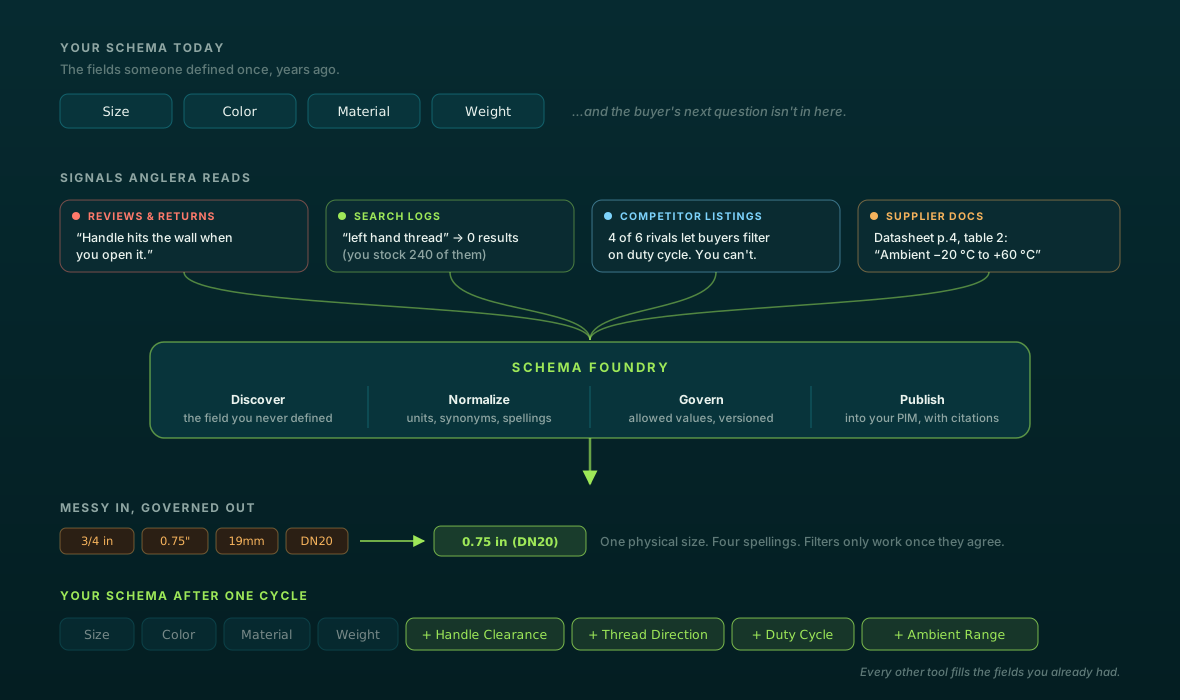
Both Rithum and Salsify assume your product data is already buyer-ready. Rithum automates the mechanics of getting listings live across channels; Salsify organizes and governs the content that goes to those listings. Neither platform automatically makes the underlying product data more complete, more accurate, or more aligned with how buyers actually search and compare — that work still has to happen before distribution.\n\nAnglera is the layer that does that work. It connects to your existing product catalog — whether it lives in Salsify, another PIM, an ERP, or a spreadsheet — pulls every SKU, enriches attributes and descriptions against real buyer signals, scores completeness, and writes the improved content back to the source. What Rithum then syndicates across 420 channels, or what Salsify then governs and distributes to retail accounts, is content built to convert — not just formatted for compliance.\n\nIf you pick Rithum, Anglera enriches before distribution. If you pick Salsify, Anglera enriches before the authoring review cycle. Either way, the PIM or operations platform stores the data; Anglera does the work. Implementation is ~30 days with no platform migration required.
Frequently asked questions
What is the main difference between Rithum and Salsify?
Rithum is a channel operations platform — its job is getting products listed, orders routed, and inventory synced across 420+ marketplaces and retail channels. Salsify is a Product Experience Management platform — its job is organizing, authoring, and syndicating product content so that what buyers see on the digital shelf is accurate and complete. Rithum focuses on operational reach and fulfillment; Salsify focuses on content quality and digital shelf performance. They are not direct competitors — they solve different problems, and many operators run both.
Does Rithum replace a PIM like Salsify?
No. Rithum manages the distribution and operational layer — feeds, orders, inventory, and channel integrations. It does not provide the content authoring, attribute governance, or digital shelf analytics that a PIM like Salsify does. Rithum consumes the product content your PIM produces; it does not produce or govern it. Companies that use Rithum typically still need a separate PIM or content management tool to author and maintain what Rithum distributes.
Can Salsify handle marketplace feed management the way Rithum does?
Salsify has syndication capabilities and a broad network for brand-to-retailer content activation, but it is not purpose-built for the operational depth Rithum offers at the marketplace level — real-time feed automation, drop-ship order routing, inventory sync, and the breadth of 420+ channel integrations. If marketplace operations and fulfillment automation are the primary requirement, Rithum's capabilities in that area are significantly deeper.
How does Anglera work alongside Rithum or Salsify?
Anglera connects to your existing product catalog via API — whether that catalog lives in Salsify, another PIM, or another system. It pulls your SKUs, runs enrichment against buyer signals (how your customers actually search, compare, and filter), and writes the improved attributes and copy back to the same source. If Rithum is your distribution layer, it then distributes richer content across channels. If Salsify is your content layer, it governs and syndicates content that is already buyer-ready. Implementation takes roughly 30 days with no platform migration.
Which platform is better for a B2B distributor?
It depends on where the bottleneck is. If a B2B distributor's main challenge is channel coverage — getting SKUs live across multiple portals, marketplaces, or retailer feeds — Rithum's channel operations tooling is relevant. If the main challenge is content quality — thin attributes, inconsistent descriptions, and missing specifications that make buyers go elsewhere — Salsify's PXM capabilities address that more directly. Many B2B distributors with complex industrial catalogs find neither platform ideal out of the box, since both are more optimized for consumer brand-to-retailer workflows. Anglera addresses the content quality problem regardless of which platform a distributor already uses.