Rithum (ChannelAdvisor / CommerceHub) vs Stibo Systems: Commerce Operations or Master Data Governance?
Rithum and Stibo Systems are not really fighting for the same job. Rithum (the 2023 merger of CommerceHub, ChannelAdvisor, and Dsco) is a commerce operations platform — its core job is getting products listed, fulfilled, and optimized across 420+ marketplace and retail channels at scale. Stibo Systems makes STEP, an enterprise Master Data Management (MDM) and PIM platform whose job is being the authoritative system of record for product, customer, supplier, and asset data across a large organization. One distributes; the other governs.
If you are comparing them, you are likely asking a foundational question about where to invest first: do you need your data governed and centralized before you push it anywhere, or do you need your channel operations sorted out while data quality catches up? Many large enterprises run both — Stibo as the system of record, Rithum as the distribution engine — but the budget and implementation bandwidth to stand up both simultaneously is substantial. Most buyers have to pick a lane.
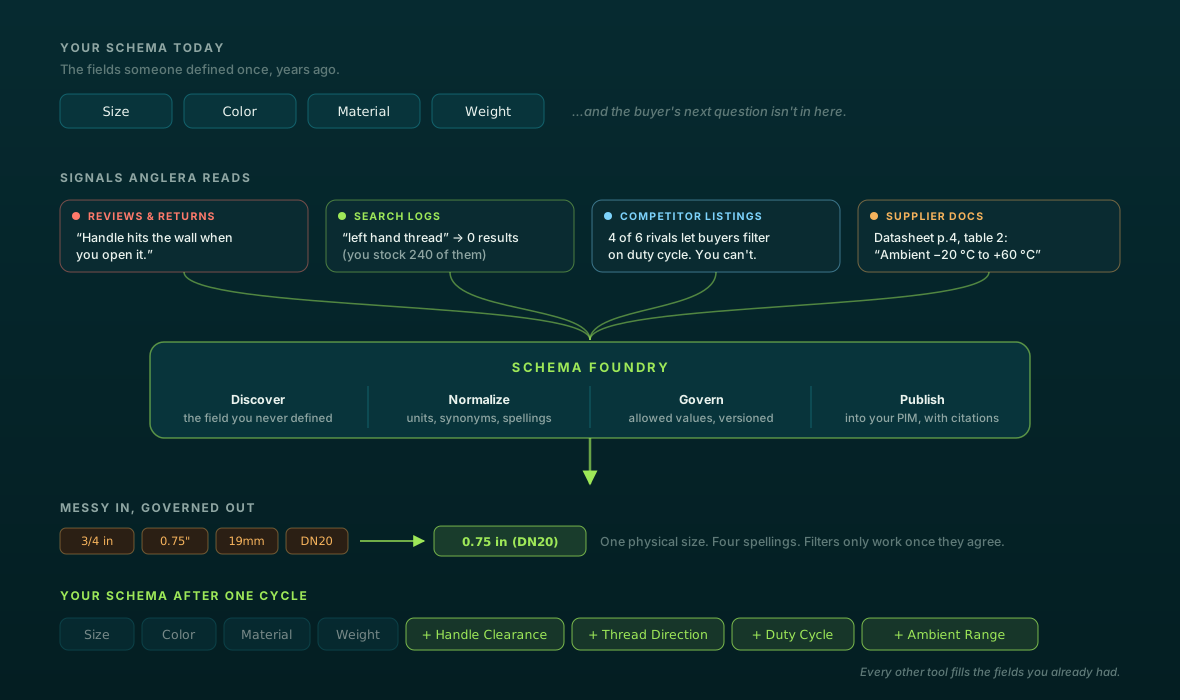
What neither platform does is enrich the product data itself. Stibo gives you a well-governed place to store and distribute whatever content arrives from suppliers. Rithum maps and transforms feeds for channel compliance. But the hard work of making a product description win a buyer — complete attributes, titles that match how people actually search, content that converts — still falls on the people behind the keyboard unless something else handles it.
| Rithum (ChannelAdvisor / CommerceHub) | Stibo Systems | Anglera | |
|---|---|---|---|
| Primary function | Commerce operations platform — syndicates product listings, automates feeds, and manages order and inventory workflows across 420+ marketplace and retail channels for brands and retailers | Enterprise MDM and PIM — the authoritative system of record for product, customer, supplier, and asset data; governs data quality and distribution at the master-data level across the organization | Enrichment layer — not a syndicator or MDM; reads SKUs from the system of record, enriches every attribute and description against buyer signals, and writes results back before distribution |
| Data governance and MDM | Not an MDM; minimal data governance — designed to push listings out across channels, not to serve as a system of record or enforce data quality rules across domains | Full enterprise MDM with Gartner Magic Quadrant Leader recognition; multi-domain governance covering product, customer, supplier, and asset data; workflow-driven stewardship and data modeling at scale | PIM-agnostic enrichment that works within whatever governance structure Stibo defines; improves the quality of what STEP governs without changing the data model |
| Channel reach and marketplace operations | 420+ pre-built channel connections including Amazon, Walmart, Target, and global retail partners; strong drop-ship, marketplace operations, and order routing capabilities built for GMV at scale | Has outbound syndication capabilities, but channel breadth and marketplace operations are not STEP's primary design strength — governance and data modeling are | Does not syndicate — works upstream of both platforms to ensure the data Rithum distributes or Stibo syndicates is buyer-ready before it reaches any channel |
| Product data enrichment | Feed transformation and mapping for channel compliance; does not enrich raw product attributes, generate missing content, or score descriptions against buyer behavior | Workflow tools for data stewards to manually enrich data; no AI-generated attribute enrichment at scale; enrichment quality depends on the people and processes running inside STEP | Automated enrichment at SKU scale — fills missing attributes, generates buyer-signal-optimized copy, and scores completeness; writes results back to the source of record without a copywriter in the loop |
| Implementation complexity | Weeks to months for channel onboarding depending on feed complexity and channel count; faster to value than a full MDM deployment but complex at scale | Months to well over a year for a full STEP deployment; typically requires a certified systems integrator for data modeling, workflow configuration, and integration work; substantial upfront investment before any data flows | ~30 days from kickoff to enriched SKUs written back to the system of record; no platform migration or SI required |
| Best-fit company profile | Brands and retailers with high-volume multi-channel selling operations — particularly those managing marketplace listings, drop-ship programs, and order routing across many retail partners simultaneously | Large enterprises (typically Fortune 1000) running complex, multi-domain data environments with governance, compliance, or regulatory requirements where a single authoritative source of product and master data is a strategic priority | Any B2B distributor, retailer, or manufacturer with existing product data — regardless of which platform governs or distributes it — who needs richer, buyer-ready content without switching platforms |
| Pricing model | Custom enterprise pricing; typically GMV-based plus per-channel fees; no public pricing — requires a sales conversation | Custom enterprise subscription scoped by users, data volume, and modules; no public pricing; SI costs routinely add significant cost on top of licensing; total cost of ownership is high | Priced per SKU enriched — adds on top of your existing platform investment rather than replacing it |
How to choose between Rithum (ChannelAdvisor / CommerceHub) and Stibo Systems
Choose Rithum if your most urgent problem is channel operations — getting products listed, fulfilled, and optimized across a large number of marketplace and retail accounts. Rithum's strength is breadth of channel connections (420+), feed automation at GMV scale, and drop-ship and order routing capabilities that no MDM platform is built to match. If you are a brand or retailer whose products are already reasonably well described but struggle to keep listings accurate, compliant, and live across dozens of channels simultaneously, Rithum's commerce operations focus is a natural fit. It is not the right investment if your first problem is data chaos inside the organization — Rithum assumes the data exists and routes it; it does not govern it.
Choose Stibo Systems STEP if your first problem is that you do not have a reliable, governed system of record for product and master data — and that gap is creating downstream problems across channels, business units, or regions. STEP is built for enterprises that need to manage product, customer, supplier, and asset data with workflow-driven governance, version control, and multi-domain relationships at the scale of a large organization. If your catalog has thousands of SKUs managed by multiple teams with no single source of truth, STEP's MDM architecture addresses the root problem. Be prepared for a substantial implementation: most STEP deployments take months, require a certified systems integrator, and involve meaningful data modeling work before anything goes live.
A few signals that clarify the choice:
- If your data is already reasonably well-governed and your pain is channel reach and operational complexity across many retail partners, Rithum wins.
- If your data is fragmented across spreadsheets, ERPs, and supplier portals with no authoritative source, STEP addresses the foundation before distribution even makes sense.
- If you are a large enterprise with multi-domain governance requirements — managing product, customer, and supplier data in one governed environment — STEP's MDM breadth has no equivalent in Rithum's feature set.
- If you need a faster path to value, Rithum's channel onboarding is meaningfully quicker than a full MDM deployment.
- In many large enterprise stacks, the answer is eventually both: STEP as the governed source of truth, Rithum as the distribution engine. The question is which gap is more painful right now.
Whichever you pick, the data still has to get done
Rithum and Stibo Systems solve the distribution and governance layers of a commerce stack. What neither solves is the enrichment layer — and that gap shows up the same way regardless of which platform you choose.
Supplier data arrives as raw specs, partial attribute sets, and copy written for procurement, not for the buyers who compare products online. Stibo's STEP gives you a governed, authoritative place to store that content and push it downstream. Rithum maps and transforms it for channel compliance. But the content itself — the descriptions, attributes, titles, and specifications that make a buyer choose your product over a competitor's — still arrives thin and stays thin unless someone enriches it.
Anglera is the layer that does that work. It connects to your system of record via API — whether that is STEP, a PIM inside your stack, or a flat data export — reads your existing SKUs, enriches every attribute and description against buyer signals (how your customers actually search, compare, and decide), and writes the improved content back to the source of truth. Whatever Rithum then distributes or STEP then governs is buyer-ready from the start, not just well-organized and reliably routed. Implementation is ~30 days with no platform migration required. Whichever platform you choose first, Anglera fits into the layer upstream of both.
Frequently asked questions
Are Rithum and Stibo Systems direct competitors, or do they solve different problems?
They largely solve different problems. Rithum is a commerce operations and channel syndication platform — its job is getting products listed and fulfilled across 420+ marketplace and retail channels. Stibo Systems STEP is an enterprise MDM and PIM — its job is being the authoritative system of record for product, customer, and supplier data with governance workflows. Many large enterprises run both: STEP as the source of truth, Rithum as the distribution engine. Buyers comparing them are usually deciding which layer to invest in first, not choosing one over the other as a permanent substitute.
How long does it take to implement Stibo Systems STEP versus Rithum?
Stibo STEP implementations typically take months to well over a year for full deployment, and almost always require a certified systems integrator for data modeling, workflow configuration, and integration work. Rithum onboarding varies by channel count and feed complexity but is generally faster to initial value — weeks to months for core channel connections. Neither is a quick win at enterprise scale, but the gap in implementation complexity is meaningful.
Can Rithum replace a PIM or MDM like Stibo?
No. Rithum is not a PIM or MDM — it is a commerce operations platform designed to syndicate and distribute product data, not to serve as a governed system of record. It does feed transformation and channel mapping well, but it does not provide the data modeling, workflow governance, multi-domain relationships, or master data stewardship that STEP is built around. If your organization needs a governed source of truth for product and master data, Rithum does not fill that role.
Does Stibo Systems STEP have built-in channel syndication like Rithum?
STEP has outbound syndication capabilities, but channel breadth and marketplace operations are not its primary design strength — enterprise MDM and data governance are. For high-volume marketplace and retail syndication across dozens of channels with order routing and drop-ship operations, Rithum's 420+ channel connections and commerce operations tooling significantly outpace what STEP's syndication layer provides.
Where does Anglera fit if I already have Rithum or Stibo?
Anglera works upstream of both. It connects to your system of record via API, enriches product attributes and descriptions against buyer signals — how your customers actually search and compare — and writes the improved content back before it reaches Rithum for distribution or lives inside STEP's governance workflows. You do not switch platforms; you get better content inside whichever system you already run, in roughly 30 days.