Rithum vs Syndigo: Commerce Operations or Content Supply Chain?
Rithum and Syndigo are often mentioned in the same conversation about getting products to retail channels, but they solve fundamentally different problems. Comparing them head-to-head is useful only once you understand which layer of that challenge you actually need to fix.\n\nRithum — the 2023 merger of CommerceHub, ChannelAdvisor, and Dsco — is a commerce operations platform. Its job is getting products listed, fulfilled, and managed across 420+ marketplace and retail channels at scale. Feed automation, drop-ship routing, order management, and marketplace compliance are where Rithum concentrates its design energy. It is not a content platform; it assumes you already have the product content and moves it efficiently to wherever it needs to go.\n\nSyndigo, following its acquisition of 1WorldSync, is one of the largest product content networks in the world. It combines PIM, content syndication, digital asset management, and MDM to help brands store, validate, and distribute product content to 2,500+ retail and GDSN recipients globally. Its job is the content supply chain — ensuring the right attributes, assets, and compliance data reach every trading partner in the right format. Neither platform solves the upstream problem they share: product data still arrives from suppliers as raw specs, and neither Rithum nor Syndigo enriches that content before it flows downstream.
| Rithum (ChannelAdvisor / CommerceHub) | Syndigo | Anglera | |
|---|---|---|---|
| Core job | Commerce operations — feed automation, marketplace listing management, drop-ship order routing, and inventory synchronization across 420+ channels | Content supply chain — storing, validating, and distributing product content to 2,500+ retail and GDSN recipients globally from a central PIM/DAM/MDM hub | Enrichment layer — neither stores nor syndicates; reads raw product data from wherever it lives, enriches every SKU against buyer signals, and writes results back before distribution |
| Channel and network reach | 420+ marketplace and retail channels including Amazon, Walmart, Target, and major global platforms; strongest for marketplace-style listing and fulfillment flows | 2,500+ retail and GDSN recipients globally, with deep coverage in grocery, convenience, specialty retail, and regulated CPG categories; broadest content network available | Channel-agnostic; enriches your product data upstream of any channel or recipient network so that richer content flows into whichever distribution path you use |
| PIM and content management | Minimal content management — feed templates and channel-specific attribute mapping, but no central product content repository, DAM, or MDM layer | Full PIM + DAM + MDM hub; brands store the master content record, manage digital assets, and push validated versions to each trading partner from a single system | Reads from and writes back to your existing PIM or Syndigo content hub; does not replace the content store — enriches what is already there |
| Order, inventory, and fulfillment | Core strength — drop-ship automation, marketplace order management, inventory synchronization, and 3PL/DSP integrations are central to the platform | Out of scope — Syndigo manages product content and syndication; order routing, drop-ship, and inventory flows are not part of the platform | Out of scope — Anglera focuses solely on product data quality, not order or fulfillment workflows |
| Data validation and compliance | Feed mapping and channel-specific attribute validation to meet marketplace listing requirements; solid for marketplace compliance, less suited to GDSN or grocery-sector regulatory requirements | 10,000 data validations across 23,000 unique retailer requirements, plus GDSN certification; deepest compliance coverage in the market for CPG and regulated product categories | Scores each SKU for completeness and relevance against buyer signals before distribution; flags attribute gaps early so content passes downstream validation on the first attempt |
| Pricing | Custom enterprise pricing based on GMV and channel usage; not publicly listed | Custom subscription pricing by data volume, users, and feature tier; third-party estimates place TCO $10,000–$30,000 above smaller PIM alternatives for mid-market buyers; no public pricing tiers | Priced per SKU enriched — a separate enrichment layer that sits on top of either platform investment, not a replacement for it; ~30-day implementation |
| Ideal buyer profile | Brands and retailers running high-volume marketplace and drop-ship operations who need feed automation, order management, and broad channel reach — and who already have product content handled | Manufacturers and CPG brands with complex content requirements, GDSN obligations, or a need to centralize and validate product content before distributing it to hundreds of retail trading partners | Any distributor, retailer, or manufacturer using either platform whose product data is still incomplete, inconsistent, or not optimized for how buyers actually search and compare |
How to choose between Rithum (ChannelAdvisor / CommerceHub) and Syndigo
Choose Rithum if your primary bottleneck is operational — getting products listed and fulfilled across many marketplaces and retail channels at speed and scale. Rithum is the right choice when feed automation, drop-ship routing, marketplace compliance, and order management across dozens of channels are consuming your team's bandwidth. It is particularly strong for brands and retailers with high SKU velocity across Amazon, Walmart, and similar platforms who need a single engine to manage listing, inventory, and order flows without manual intervention. If content management is already solved and the problem is channel operations, Rithum is built for that.
Choose Syndigo if your primary problem is managing and distributing product content — especially if GDSN compliance, grocery retail, or regulated CPG categories are in play. Syndigo is the right choice when you need a governed, validated master content record that flows cleanly to hundreds of trading partners, each with different attribute requirements. Its 2,500+ recipient network and 10,000+ validation rules make it the most defensible choice for manufacturers who cannot afford compliance failures at retail. If your team is still manually managing content per retailer and spending disproportionate effort on attribute formatting, Syndigo's centralized content supply chain solves that at scale.
A few signals that clarify the choice:
- If drop-ship, marketplace order management, or GMV-at-scale is the business problem, Rithum. If GDSN certification, grocery compliance, or brand-side content governance is the problem, Syndigo.
- If you sell on Amazon and Walmart primarily, Rithum's 420+ channel network is the stronger operational fit. If you sell through major grocery chains and need GS1-structured data flowing to trading partners, Syndigo's network depth wins.
- Some large manufacturers run both — Syndigo manages the master content record and GDSN distribution while Rithum handles marketplace listing and order flows. They operate at different layers of the commerce stack and do not directly compete for the same job.
Whichever you pick, the data still has to get done
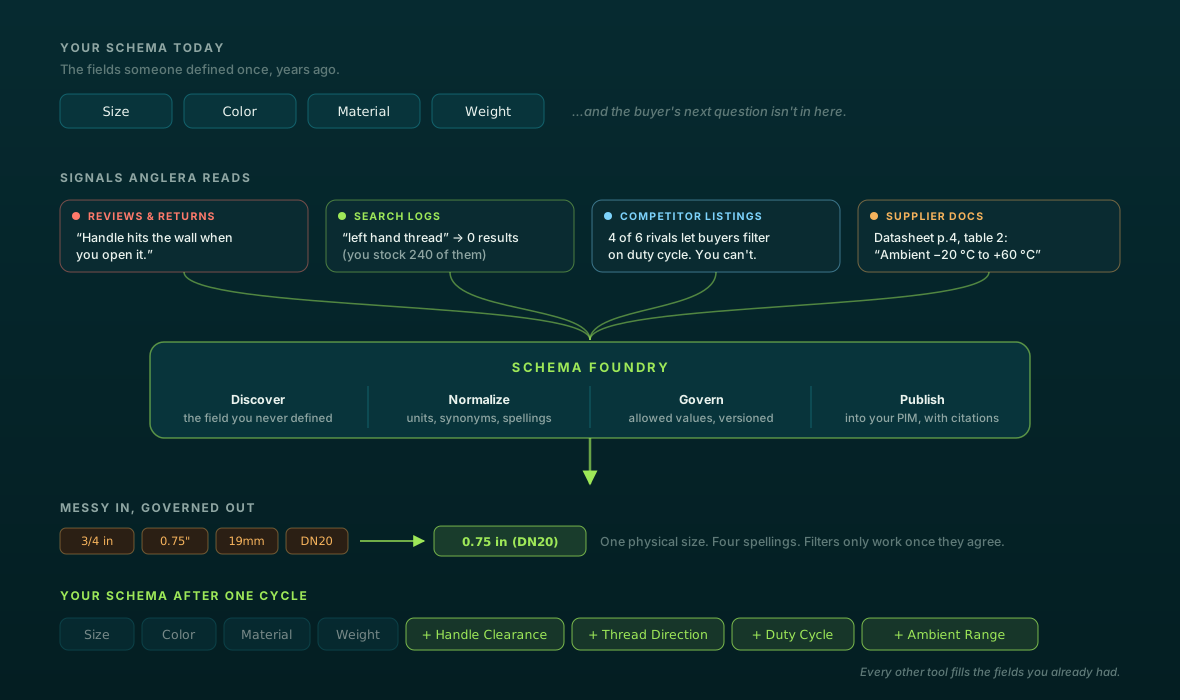
Both Rithum and Syndigo assume your product data is already complete and buyer-ready. Rithum takes that data and moves it through feed automation and order workflows. Syndigo validates it against retailer schemas and distributes it to trading partners. Neither platform goes back to the source and makes the underlying content better — richer attributes, more accurate descriptions, titles written around how buyers actually search, not how suppliers wrote the spec sheet.\n\nThat is exactly what Anglera does, and it works regardless of which platform you choose. Anglera connects to your existing data source — your PIM, Syndigo's content hub, or wherever the master record lives — reads every SKU, enriches each one against real buyer signals, fills attribute gaps, and writes the improved content back before it ever enters Rithum's feed engine or Syndigo's distribution network. The output is the same system of record, but with content that was built around how buyers compare, filter, and decide — not just what the supplier provided.\n\nWhichever platform you pick to move that content, Anglera makes sure what goes in is worth distributing. Implementation is approximately 30 days, with no platform migration required on either side.
Frequently asked questions
Can Rithum replace a PIM?
No. Rithum handles feed mapping and channel-specific attribute requirements but does not provide a central content repository, DAM, or MDM layer. Most brands running Rithum maintain a separate PIM or ERP as the master record and push content into Rithum for channel distribution.
Does Syndigo handle marketplace order management or drop-ship?
No. Syndigo manages product content and syndication to trading partners. Order routing, drop-ship automation, and inventory synchronization are outside its scope. That is where platforms like Rithum specialize. The two tools address different layers of the commerce stack.
Can I run Rithum and Syndigo together?
Yes, and some larger manufacturers do. Syndigo manages the master content record and handles GDSN distribution to grocery and specialty retail; Rithum handles marketplace listing operations and order flows to Amazon, Walmart, and similar channels. Because they serve different functions, they do not duplicate each other when used together.
Where does Anglera fit if I already have Syndigo?
Syndigo stores and distributes your content accurately — but it does not enrich it. Anglera reads from your Syndigo content hub (or from your upstream PIM), identifies which attributes are thin or missing, scores each SKU against buyer signals, and writes the improved content back before it gets distributed. Better input going into Syndigo's network means better shelf placement and conversion at every recipient.
How long does Anglera take to implement alongside either platform?
Approximately 30 days, regardless of which platform you pair it with. Anglera connects to your existing data source via API, runs enrichment against buyer signals, and writes results back without a platform migration or a lengthy professional-services engagement.