Sales Layer vs Unilog CX1 / CIMM2: Dedicated PIM or All-in-One Commerce Suite?
Sales Layer and Unilog CX1 are both built for B2B product data, but they solve different problems for different buyers. Sales Layer is a dedicated cloud PIM — its job is to centralize product content, validate it, manage supplier onboarding, and syndicate it across channels and trading partners. Unilog CX1 (the current branding for what was CIMM2) is an all-in-one B2B commerce suite that bundles its own PIM inside a platform that also includes a storefront, CMS, site search, and ERP integration layer — plus a managed library of 10M+ SKUs from roughly 2,000 manufacturers that customers can subscribe to as a content service. These are genuinely different value propositions.
The decision often comes down to one question: do you already have (or plan to build) your own eCommerce presence, or do you need a single vendor to hand you the entire stack? If you need a best-of-breed PIM with fast setup and flexible syndication that connects to your existing website, ERP, and channel ecosystem, Sales Layer is the more flexible choice. If you are a mid-market distributor in electrical, industrial, plumbing, or HVAC who wants one vendor to handle storefront, content, and ERP integration — and whose catalog overlaps heavily with Unilog's manufacturer network — Unilog CX1 is designed for exactly that scenario.
Both platforms share an important assumption: that the product data entering the system is already reasonably complete and accurate. Sales Layer validates and syndicates what you put in; Unilog's managed content library covers many catalog SKUs from its partner manufacturers but still leaves long-tail SKUs, proprietary items, and supplier categories outside the network to your team. The gap between raw supplier data and distribution-ready content is where enrichment happens — and neither platform closes it automatically at catalog scale.
| Sales Layer | Unilog CX1 / CIMM2 | Anglera | |
|---|---|---|---|
| Platform type | Dedicated cloud PIM: centralizes, validates, and syndicates product content; no native B2B storefront or commerce engine | All-in-one B2B commerce suite bundling a PIM, storefront, CMS, site search, and ERP integration layer under one roof | Enrichment layer that sits between raw supplier data and your system of record — works alongside either platform without replacing it |
| Best-fit buyer | Manufacturers, distributors, and retailers who need a fast-setup, channel-agnostic PIM with supplier onboarding and multi-channel syndication — and who manage (or plan to manage) their own eCommerce layer separately | Mid-market distributors in industrial, electrical, plumbing, HVAC, and adjacent verticals who want one vendor for storefront, PIM, content, and ERP — especially AD Network member companies | B2B distributors and manufacturers receiving incomplete supplier feeds; enriches the catalog against buyer signals regardless of which platform stores the data |
| Implementation timeline | ~6-week onboarding for the PIM layer; Supplier Portal setup adds time depending on supplier count and data quality | Multi-month implementation; scope covers storefront configuration, PIM data migration, ERP integration, and content subscription onboarding — budget accordingly | ~30 days; connects to your existing system of record without replacing it — no rip-and-replace, no parallel platform to maintain |
| Product content & enrichment | You bring your own content; the platform validates structure and completeness, flags gaps, and lets suppliers self-submit data via the Supplier Portal — no managed content library | Managed library of 10M+ SKUs from ~2,000 manufacturers; subscription includes taxonomy, gap-fill, normalization, and custom enrichment services — strongest where your suppliers are already in the network | Automatically researches and fills missing attributes from supplier sites and buyer signals, normalizes values, scores every SKU for completeness, and writes enriched records back to your PIM — covers long-tail and proprietary SKUs the managed library does not include |
| eCommerce & channel reach | Syndicates to marketplaces, retailer portals, and channels via connectors; no native B2B storefront — designed to pair with your existing commerce platform | Native B2B storefront with CMS, site search, customer-specific pricing, and customer portal built in; the commerce layer is core to the product, not an add-on | Not a commerce platform; enriched product data flows downstream through your existing integrations, improving site search relevance and conversion on whichever storefront you run |
| ERP & system integration | API-first; connects to ERPs, marketplaces, and eCommerce platforms via native connectors and custom integrations; flexible but you configure the connections | CX1 Connect is purpose-built for ERP and POS systems common in distribution (Eclipse, Epicor, SAP, Prophet 21); pre-built for the distribution ERP stack | Reads from and writes back to your existing PIM or ERP as the system of record; adds to the stack you have without requiring new infrastructure |
| Pricing model | Starts ~$1,000/month; tiered plans (Core to Enterprise) by team size and feature set; 30-day free trial available — lower barrier to evaluate | Quote-based SaaS; priced by platform modules plus optional content subscriptions and managed enrichment services; no self-serve pricing and real costs vary significantly by catalog size and scope | Priced per SKU enriched, not a platform fee or per-seat license — designed to sit alongside your existing PIM investment rather than compete with it |
How to choose between Sales Layer and Unilog CX1 / CIMM2
Choose Sales Layer if you need a dedicated, channel-agnostic PIM with fast onboarding and flexible syndication. It is the right fit when your team already manages — or plans to manage — your B2B or eCommerce storefront separately through a platform like Shopify, Magento, or a custom build. The Supplier Portal is a genuine advantage if you have a network of suppliers who can be invited to submit data directly. The 30-day trial makes it lower-risk to evaluate before committing. If your catalog spans multiple channels not served by Unilog's pre-built connector set, Sales Layer's API-first approach gives you more flexibility.
Choose Unilog CX1 if you are a mid-market distributor — particularly in electrical, industrial, plumbing, HVAC, or adjacent categories — who wants a single vendor to handle your B2B storefront, PIM, managed product content, and ERP integration. The bundled SKU content library is a genuine time-to-market advantage when your catalog overlaps heavily with Unilog's ~2,000 manufacturer partners: content arrives pre-built rather than waiting on supplier cooperation. It is also worth prioritizing if your ERP is common in distribution (Eclipse, Epicor, Prophet 21) and you want pre-built connectors over custom API work. Budget for a multi-month implementation and scope the content subscription carefully — coverage varies by supplier category, and long-tail SKUs outside the network still require manual or automated enrichment work.
The short version: Sales Layer is the better choice when you want a best-of-breed PIM that integrates with the rest of your stack. Unilog CX1 is the better choice when you want one vendor to cover the full storefront-to-content-to-ERP stack and your vertical matches their strongest categories.
Whichever you pick, the data still has to get done
Whichever platform you choose, the data still needs to be enriched before it is genuinely distribution-ready — and neither platform closes that gap automatically.
Sales Layer validates and syndicates what you put in. If attributes are thin, inconsistent, or missing — because a supplier sent a flat file with half the fields blank — they ship thin. The Supplier Portal helps collect data from willing suppliers, but it does not research or fill what suppliers do not provide.
Unilog's managed content library is a real head start for SKUs covered by its ~2,000 manufacturer partners. But a typical distributor's catalog includes long-tail items, proprietary products, private-label SKUs, and supplier categories outside the network. Those items still arrive as raw, incomplete data — and someone still has to fill the gaps manually or leave them unfilled.
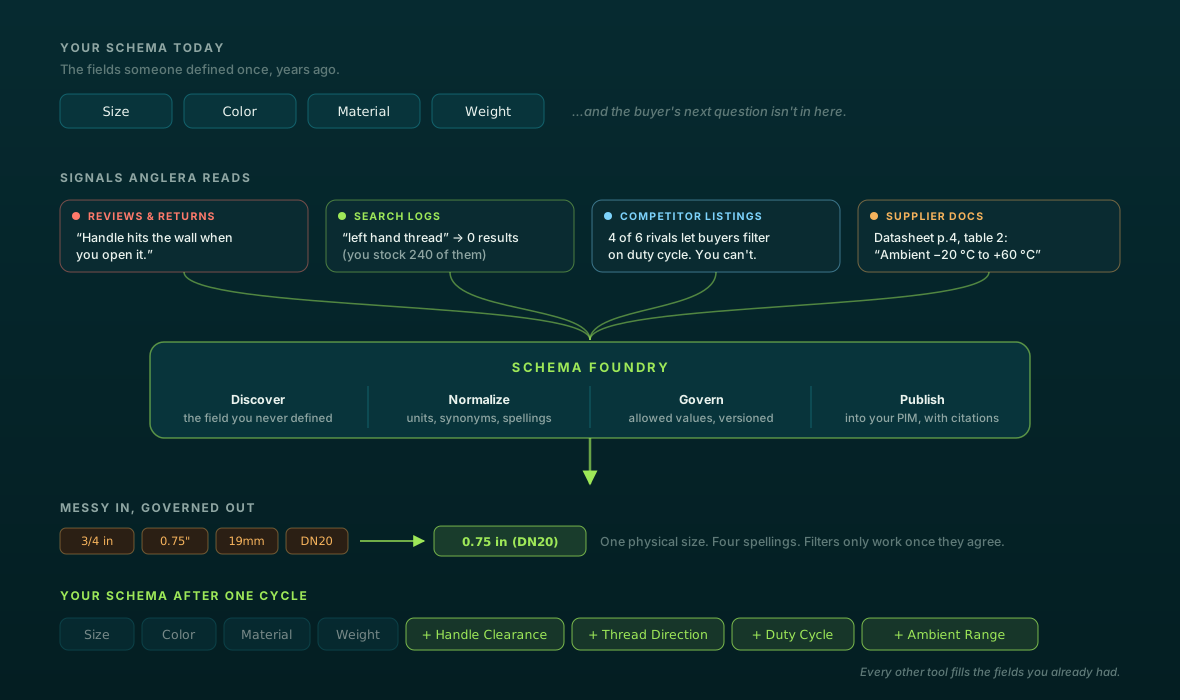
Anglera works upstream of both. It ingests your catalog however it arrives — supplier flat files, EDI feeds, web crawls — researches missing attributes from manufacturer sites and buyer signals, normalizes units and values, scores every SKU against your attribute model, and writes the enriched record back to your PIM (Sales Layer or Unilog's built-in PIM) as the system of record. By the time data reaches either platform's validation or storefront layer, it is already complete.
The integration takes roughly 30 days and connects to your existing system without replacing it. Whichever platform you pick, Anglera makes the data that flows through it better — and keeps it better as your catalog grows and supplier feeds change.
Frequently asked questions
Can Sales Layer replace Unilog CX1 for a mid-market distributor?
Only partially. Sales Layer handles the PIM and syndication layer well, but it does not include a B2B storefront, CMS, site search, or ERP connectors purpose-built for distribution. If you already have a separate eCommerce platform and ERP integration in place, Sales Layer covers the product data layer cleanly. If you need all of those capabilities from one vendor — or want access to a managed SKU content library for common distribution categories — Unilog CX1 covers scope that Sales Layer does not.
Does Unilog's managed content library eliminate the need for separate enrichment?
For SKUs well-represented among Unilog's ~2,000 manufacturer partners, the library significantly reduces manual enrichment work. But it does not cover every SKU in a typical distributor's catalog — long-tail items, proprietary products, private-label SKUs, and suppliers outside the network still arrive as incomplete data. Enrichment gaps remain; they are smaller for well-covered catalog segments and larger for everything else.
How does Sales Layer's Supplier Portal compare to Unilog's managed content approach?
They solve the same supplier data problem differently. Sales Layer's Supplier Portal invites suppliers to submit content directly into the PIM — it is a self-service collection tool that works well when suppliers are willing to participate. Unilog's managed library is a pre-built dataset that does not require supplier participation — content is syndicated from manufacturers already in the network. Sales Layer's approach is more flexible and works for any supplier; Unilog's is more turnkey but limited to covered manufacturers.
Where does Anglera fit if I am already using Unilog CX1's content subscriptions?
Anglera complements rather than replaces Unilog's managed content subscriptions. Where Unilog's library covers a SKU, you get the benefit of that pre-built content. Where it does not — long-tail items, proprietary products, suppliers outside the network — Anglera researches and fills the gaps automatically, then writes the enriched data back to the PIM layer. The two work in sequence, not in competition.
My suppliers send incomplete flat files. Which platform handles that better?
Neither platform was designed to research and fill missing data. Sales Layer will store and flag the incomplete record; the gap stays until someone fills it or the supplier resubmits. Unilog's content subscription may pre-fill some attributes for covered SKUs, but raw supplier flat files for uncovered items still arrive incomplete. Anglera is purpose-built for this scenario: it takes incomplete supplier inputs, researches and fills missing attributes from external sources, and writes complete records back to your system of record before they reach either platform's catalog.