Salsify vs Unilog CX1 / CIMM2: Digital Shelf Activation or All-in-One B2B Commerce?
Salsify and Unilog CX1 are both described as "product data platforms," but they solve different problems for different buyers at different points in the commerce stack. Putting them side by side without that context makes the comparison misleading. Salsify is a Product Experience Management (PXM) system — a content hub and syndication network for brands and distributors that need to push rich product content to retail trading partners and digital channels. Unilog CX1 (the rebranding of CIMM2) is an all-in-one B2B commerce suite: storefront, built-in PIM, CMS, site search, and ERP integration sold as a single platform for mid-market distributors and manufacturers. One is primarily outbound content syndication; the other is primarily a customer-facing eCommerce business.
The buyers who genuinely face this decision tend to be mid-market B2B distributors evaluating whether to anchor their digital strategy around a best-of-breed PXM (Salsify, plus a separate storefront) or an integrated commerce suite (Unilog, which bundles the storefront and basic PIM in one contract). A smaller number of buyers — those who also act as suppliers to retail chains — may need to think about both. But for most distributors, this is a genuine either/or.
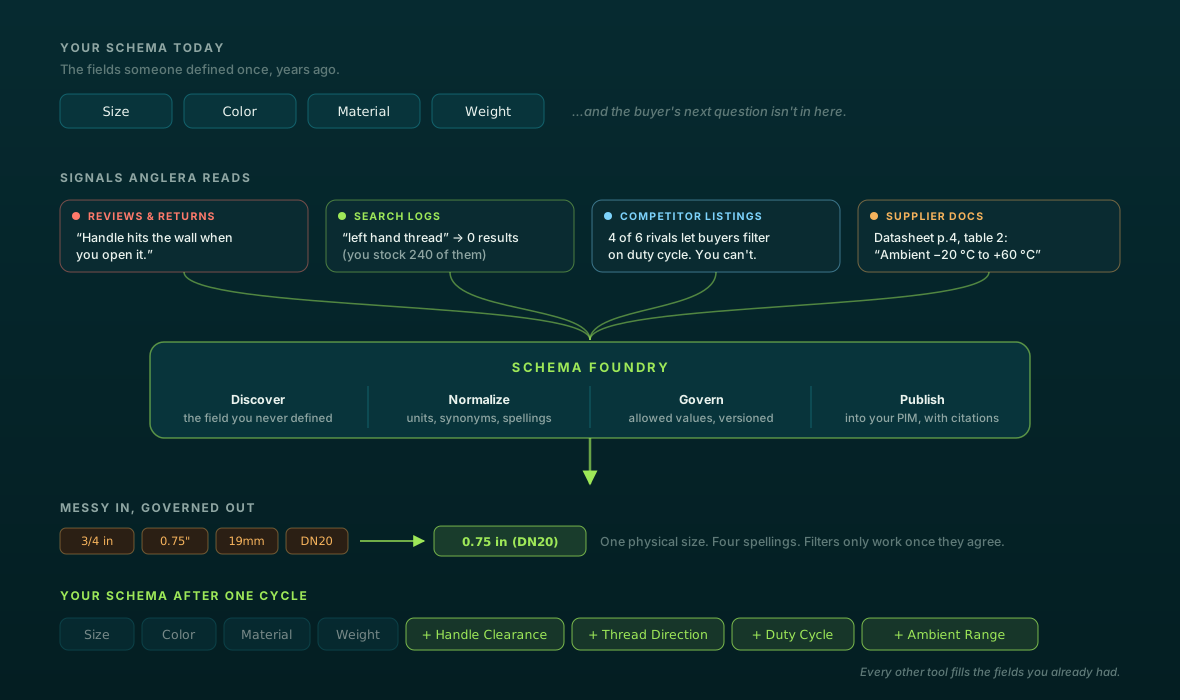
What both platforms share is an assumption: that the product data you bring them is reasonably complete and well-structured. Salsify's syndication network underperforms on thin content; trading partners reject or deprioritize incomplete records. Unilog's storefront and managed SKU library fill some gaps, but distributor-specific attribute normalization, buyer-signal scoring, and enrichment across a heterogeneous supplier base remain unsolved at the platform level. That upstream gap — between raw supplier data and channel-ready product content — is where Anglera works, regardless of which platform you choose.
| Salsify | Unilog CX1 / CIMM2 | Anglera | |
|---|---|---|---|
| Platform scope | Product Experience Management (PXM) — a centralized content hub for authoring, organizing, and syndicating product content to retail trading partners and digital channels. Includes workflow tools, digital asset management, and a broad syndication network. No eCommerce storefront. | An all-in-one B2B commerce suite: eCommerce storefront, built-in PIM, CMS/site builder, site search, and the CX1 Connect ERP integration layer — sold as a single platform for mid-market distributors. Optional product-content subscriptions backed by a managed SKU library are sold alongside. | Sits at the content layer regardless of platform scope. Enriches SKUs in your system of record before they power Salsify's syndication flows or populate Unilog's storefront. |
| Built-in eCommerce storefront | None. Salsify is a content management and syndication system; the customer-facing storefront, order management, and commerce experience live in a separate platform (Shopify, Salesforce Commerce, etc.) that you must select, integrate, and maintain. | Yes — a B2B eCommerce storefront is bundled into CX1, with a site builder, CMS, faceted search, and buyer-facing features (account pricing, order history, branch locator) purpose-built for distributor and wholesaler workflows. | Not a storefront. Enriched product data flows into whichever commerce layer is in place — whether Unilog's built-in store or a standalone platform connected to Salsify's content feeds. |
| Target buyer and vertical fit | Best known for brands and CPG manufacturers pushing content to retail trading partners — Home Depot, Amazon, Walmart, specialty retailers. Also used by larger retailers managing their own digital shelf. Less purpose-built for the mid-market distributor who needs a B2B storefront connected to an ERP. | Built specifically for mid-market B2B distributors, manufacturers, and wholesalers — especially in electrical, industrial, plumbing, and HVAC distribution (50+ AD member companies use it). Less relevant for brand-side digital-shelf activation or CPG retail syndication. | Serves B2B distributors, retailers, and manufacturers across both contexts — enriches and scores SKUs against buyer signals, then writes back to whichever platform holds the catalog. |
| Managed content library and SKU enrichment services | No proprietary content library. You author and own all product content; quality depends entirely on what brands and suppliers bring. Salsify provides tools for managing and syndicating that content — not for researching or filling missing attributes at scale. | Yes — a managed library of 10M+ vendor SKUs from ~2,000 manufacturers, with ongoing content subscriptions, taxonomy normalization, attribute gap-fill, and managed enrichment services sold alongside the platform. Particularly strong in electrical, plumbing, and HVAC verticals. | Adds automated, AI-driven enrichment on top of whatever is already in the PIM — researching missing attributes from supplier sites and external sources, normalizing inconsistent values, and scoring completeness against your specific channel and buyer requirements. |
| Channel syndication | Core differentiator — a broad network connecting product content to hundreds of retail trading partners (major US chains, Amazon, specialty channels). The digital-shelf activation capability Salsify is best known for. | Not a syndication platform. Content stays within the CX1 ecosystem — your B2B storefront and connected ERP. Not designed for pushing product content to third-party retail or marketplace trading partners. | Not a syndication layer. Enriches the product data that flows through Salsify's syndication network or populates Unilog's storefront, so content meets channel requirements before it reaches any downstream destination. |
| ERP and B2B integration | Has an API and a partner integration ecosystem, but is not natively designed around ERP bi-directional sync for B2B distribution workflows. Pricing tiers, inventory availability, and order data typically live in a separate system outside Salsify. | CX1 Connect provides purpose-built ERP/POS integration for B2B distributors — syncing account pricing, inventory, and order data with systems common in distribution (Infor, Eclipse, Epicor, and others). A core part of the value proposition for the distribution buyer. | Sits upstream of both — enriches product data in the PIM before it flows to ERP, storefront, or syndication channels, so every downstream system receives complete, clean records from the start. |
| Pricing and implementation | Quote-based only; widely reported as expensive relative to alternatives. Third-party consulting typically required for onboarding (~$16k additional cost reported). SKU volume, user count, and feature tier all drive cost. Complex implementations with variable timelines. | Quote-based, not self-serve; third-party sources cite entry pricing in the low hundreds per month, but real deployments scale with catalog size, modules selected, content subscriptions, and managed services. Multi-month implementation given the storefront, ERP, and content setup involved. | ~30-day implementation alongside whichever platform is in place. No rip-and-replace — connects to your existing system of record and enriches in bulk, then keeps pace with catalog changes. |
How to choose between Salsify and Unilog CX1 / CIMM2
Choose Salsify if digital-shelf activation and retail syndication are your primary goals. If you are a brand or manufacturer — or a distributor acting as a supplier to major retail chains — that needs to push rich, structured product content to retail trading partners, Salsify is purpose-built for that workflow. The broad syndication network and the system-of-record positioning for the digital shelf are genuine strengths. Understand going in that Salsify is not a B2B commerce platform: there is no customer-facing storefront, no ERP integration layer, and no managed SKU library. You will need a separate eCommerce stack alongside it, and implementation typically requires outside consulting help.
Choose Unilog CX1 if you are a mid-market B2B distributor, manufacturer, or wholesaler that wants to launch or grow an eCommerce presence while keeping a tight connection to your ERP and supplier catalog. The all-in-one model — storefront, PIM, CMS, search, and ERP sync in one subscription — reduces vendor count and integration complexity, and the vertical depth in electrical, industrial, plumbing, and HVAC distribution is a real advantage. If your product catalog falls within or near those categories, Unilog's managed SKU library may also accelerate content setup. If you also need to push content to retail trading partners as a supplier, Unilog does not solve that problem.
Consider both only if your business genuinely spans both use cases: a distributor that is simultaneously a supplier to major retail chains, needing a B2B storefront for your direct customers and a syndication feed to retail trading partners. That profile is uncommon. Most buyers are choosing between these two tools, not layering them — and the choice usually follows from whether your primary distribution motion is B2B digital commerce or retail-partner syndication.
Whichever you pick, the data still has to get done
Both platforms share the same upstream assumption: that the product data flowing through them is already reasonably complete and accurately structured. Salsify's syndication network underperforms on thin content — retail trading partners reject or deprioritize records with missing required attributes, and the manual rework lands back on your team. Unilog's managed SKU library covers a strong baseline for common distribution verticals, but the library reflects manufacturer-provided attributes, not buyer-signal-optimized content; and for distributors with broad, heterogeneous supplier catalogs, gaps remain that the library does not close.
Anglera works upstream of both. It takes incomplete supplier inputs — flat files, thin catalog exports, PDFs — researches missing attributes from supplier sites and external sources, normalizes values across inconsistent supplier formats, scores every SKU against buyer signals, and writes the enriched records back to your PIM or ERP. By the time your data reaches Salsify's syndication layer or Unilog's storefront, it is already complete and channel-ready.
The workflow is additive. Anglera connects to your existing system of record in roughly 30 days without replacing it — no parallel system to maintain, no rip-and-replace project. Your Salsify subscription gets better content to syndicate; your Unilog storefront gets complete product pages from launch. Whichever platform you choose, the data that flows through it gets better — and stays better as your catalog grows or supplier feeds change.
Frequently asked questions
Can Unilog CX1 replace Salsify for retail syndication to trading partners?
No. Unilog CX1 is a B2B commerce platform, not a retail syndication network. Its content layer serves your own storefront and ERP-connected catalog — it does not connect to retail trading partners (Walmart, Home Depot, Amazon, specialty chains) the way Salsify does. If pushing structured product content to retail trading partners is a business requirement, you need a PXM or syndication platform; Unilog CX1 does not fill that role.
Can Salsify serve as the all-in-one platform for a B2B distributor — storefront included?
No. Salsify is a content management and syndication system. It does not include a customer-facing B2B storefront, site search, CMS, or ERP integration layer. A B2B distributor using Salsify still needs a separate commerce platform, integration middleware, and ERP connector. Salsify can be one part of that stack — typically the content-management and syndication layer — but it is not the whole stack.
Does Unilog's managed SKU library eliminate the need for a separate enrichment tool?
Partly. The library of 10M+ SKUs from ~2,000 manufacturers provides a strong baseline in electrical, plumbing, HVAC, and industrial distribution. But coverage thins outside those categories, the content reflects manufacturer-supplied attributes rather than buyer-signal-optimized data, and custom or proprietary SKUs from your own supplier relationships are not in the library. Distributors with broad, heterogeneous catalogs typically still encounter meaningful attribute gaps.
My catalog has 50,000+ SKUs with inconsistent supplier data. Which platform handles that better?
Unilog's content subscription and managed enrichment services are specifically designed for this scenario in distribution verticals — taxonomy normalization, gap-fill, and attribute structuring at catalog scale are sold as part of the platform offering. Salsify provides tools for managing content once it is reasonably complete, but does not offer a comparable managed enrichment service. Either way, Anglera can handle the upstream research and normalization work, writing clean records back to whichever platform holds your catalog before any manual review is needed.
How does Anglera fit if I'm already using Salsify or Unilog?
Anglera connects to your existing system of record — Salsify's content hub, Unilog's PIM, or an upstream ERP — enriches SKUs with missing or thin attributes, and writes the improved data back. For Salsify users, that means cleaner content entering the syndication network with fewer trading-partner rejections. For Unilog users, it means complete product pages on the storefront from launch, supplementing the managed SKU library for categories or suppliers not yet covered.