Stibo Systems vs Unilog CX1 / CIMM2: A Buyer's Guide (2026)
These two platforms solve related but fundamentally different problems. Stibo Systems STEP is an enterprise Master Data Management platform — the system of record for organizations that need to govern product, customer, supplier, and asset data across a complex, multi-domain environment. Unilog CX1 (formerly CIMM2) is an all-in-one B2B commerce suite built for mid-market distributors who want an eCommerce storefront, a PIM, and a managed content library bundled into one subscription. A buyer rarely compares both at the same time unless they are a growing distributor asking whether to go all-in-one or build a best-of-breed stack anchored on a serious MDM platform.
The honest frame: if you are a Fortune 500 manufacturer or global retailer running multi-domain data complexity, Unilog CX1 likely undershoots your requirements. If you are a regional electrical or HVAC distributor looking to launch B2B eCommerce quickly, Stibo STEP may be significant overkill — and the implementation cost alone could dwarf Unilog's entire annual contract. This guide lays out both tools dimension by dimension so you can make a clear-eyed call.
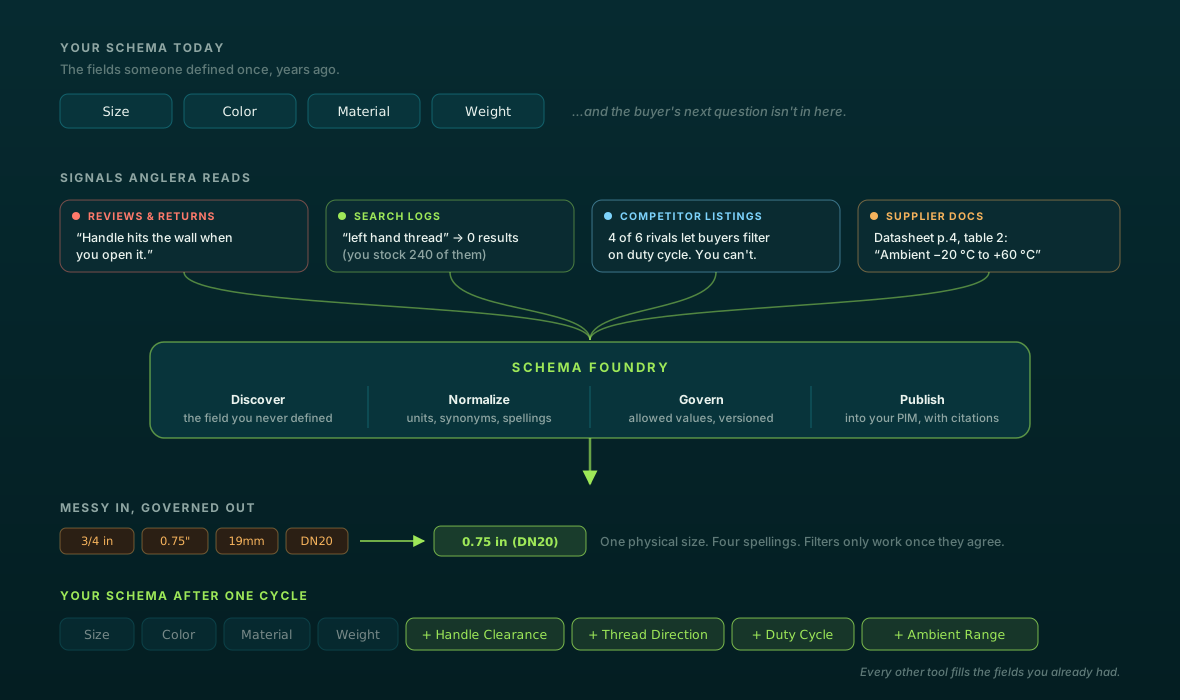
One thing neither platform does out of the box: automatically enrich your proprietary SKUs against buyer signals — normalizing attributes, filling content gaps, scoring completeness, and writing polished data back to your PIM or MDM. That is the gap Anglera fills in roughly 30 days, regardless of which platform you choose.
| Stibo Systems | Unilog CX1 / CIMM2 | Anglera | |
|---|---|---|---|
| Platform scope | Enterprise MDM + PIM. Governs product, customer, supplier, and digital asset data in a unified domain model, with data governance workflows, syndication, and strong data modeling built in. No eCommerce storefront included. | All-in-one B2B commerce suite. Bundles an eCommerce storefront, PIM, CMS/site builder, site search, and ERP integration (CX1 Connect) in a single platform. Purpose-built for mid-market distributors. | Platform-agnostic enrichment layer. Connects to either system as the enrichment engine — gathers raw product data, cleans and normalizes it, enriches attributes against buyer signals, and writes results back to your system of record. |
| Best-fit company profile | Large enterprise — Fortune 1000 manufacturers, retailers, and CPG companies running multi-domain data across business units, regions, or brands that need governance-grade infrastructure. | Mid-market B2B distributors, manufacturers, and wholesalers — especially in electrical, industrial, HVAC, and plumbing. Strong presence among AD member companies (50+). Aimed at companies launching or scaling eCommerce without a best-of-breed stack. | Fits both profiles. Enriches product data at any catalog scale — thousands to millions of SKUs — and integrates into your existing data pipeline without displacing your PIM or MDM. |
| Built-in eCommerce storefront | None. STEP is the system of record; customers connect it to a separate commerce platform of their choice (Salesforce Commerce Cloud, SAP Commerce, and others are common pairings). | Full B2B eCommerce storefront with CMS, site search, and customer-facing product pages. The storefront is one of the primary reasons distributors choose the platform over a standalone PIM. | Enriches the product data that powers the storefront — attributes, descriptions, specs, and completeness scores — regardless of where that storefront lives or which platform serves it. |
| Product content library and enrichment services | None. STEP governs whatever data you load into it. Customers are responsible for sourcing, enriching, and maintaining their own product content before or after it lands in STEP. | Managed library of 10M+ SKUs from approximately 2,000 manufacturers, available as content subscriptions. Also offers custom SKU enrichment, taxonomy, gap-fill, and normalization services for distributor catalogs. | Automates enrichment of your proprietary and long-tail SKUs — the items not covered by any vendor library — using AI against buyer signals, then writes clean, scored data back to your PIM or MDM. |
| Multi-domain MDM capability | Core strength. STEP manages product, customer, supplier, and digital asset data in a unified domain model. Stibo is a Gartner Magic Quadrant Leader for MDM and is used by enterprises that need to govern more than just product data. | Product data focused. CX1 Connect handles ERP and POS integration, but Unilog is not a multi-domain MDM system. Customer and supplier data governance is outside the platform's scope. | Operates on the product domain specifically — attribute enrichment, completeness scoring, and buyer-signal-aligned content generation at the SKU level. Complements MDM governance rather than competing with it. |
| Implementation complexity and timeline | Heavy. Enterprise STEP deployments typically run multiple months and frequently require a certified systems integrator. The platform is highly configurable, which means high setup cost alongside high long-term flexibility. | Multi-month, but more guided and managed by the Unilog team. Less SI dependency than a full MDM platform, though catalog migration, content onboarding, and ERP integration still add time and project management overhead. | Approximately 30-day implementation. Connects to your PIM or MDM, ingests your catalog, and begins enriching SKUs without displacing your existing stack or extending your primary platform timeline. |
| Pricing model | Custom enterprise subscription, no public pricing. Scoped by users, data volume, and modules. Total cost of ownership is significant and typically includes implementation fees and often systems integrator costs on top. | SaaS subscription, quote-based, not self-serve. Third-party sources cite entry pricing in the low hundreds of dollars per month, but real deployments scale with catalog size, content subscriptions, and managed enrichment services. | A subscription enrichment layer priced independently of your PIM or MDM. Additive, not a replacement — so it does not change your platform licensing. Contact Anglera for pricing scoped to your catalog size. |
How to choose between Stibo Systems and Unilog CX1 / CIMM2
Choose Stibo Systems STEP if you are a large enterprise that needs a governance-grade, multi-domain MDM platform as your authoritative system of record. If your data environment spans product lines, business units, brands, or domains — and you need strong data modeling, workflow orchestration, and syndication to match — STEP is built for that complexity. Plan for a multi-month implementation, likely a systems integrator, and an enterprise-tier budget.
Choose Unilog CX1 if you are a mid-market B2B distributor, manufacturer, or wholesaler looking to launch or scale eCommerce without assembling a best-of-breed stack. If you operate in electrical, industrial, HVAC, or plumbing distribution and want a storefront, PIM, and product content library in a single managed subscription, CX1 is purpose-built for your vertical. Unilog's managed content services and AD member network also reduce the cold-start problem for catalog enrichment on major vendor SKUs.
If you are genuinely evaluating both, the deciding question is usually the storefront. If you need an eCommerce storefront and do not already have one, Unilog is the faster, more integrated path. If you already have a commerce platform and need a serious, scalable system of record for multi-domain data governance, Stibo reaches further and grows with enterprise complexity. Mid-market companies on the higher end of the range who want best-of-breed flexibility sometimes choose a standalone PIM or MDM (like Stibo) paired with a separate commerce platform — that is a more expensive and more capable combination than Unilog's all-in-one, and the right call only if the added flexibility justifies the added complexity.
Whichever you pick, the data still has to get done
Here is the honest gap: both platforms assume your product data is already good when it arrives.
Stibo STEP governs and distributes whatever you load into it — garbage in, governed garbage out. The platform has no mechanism to automatically enrich sparse attributes, generate buyer-facing descriptions, or score SKU completeness before data flows downstream to commerce and partners.
Unilog's managed content library covers major manufacturer SKUs from its approximately 2,000 vendor partners. It does not cover your proprietary items, private-label products, or anything outside that library. Your non-catalog SKUs still land in the PIM incomplete.
Anglera fills that gap regardless of which platform you choose. It connects to your PIM or MDM in roughly 30 days, runs automated enrichment across your full catalog against buyer signals, scores attribute completeness at the SKU level, and writes clean data back to your system of record — whether that is Stibo STEP or Unilog CX1. There is no platform migration, no storefront rebuild, and no SI required. Whichever platform wins your evaluation, Anglera is the enrichment engine that makes your product data actually work for your buyers, your storefront, and your search.
Frequently asked questions
Is Stibo Systems a PIM or an MDM?
It is both, and the distinction matters. Stibo STEP is primarily an enterprise MDM platform that includes PIM as one data domain. Unlike standalone PIMs, STEP can govern product, customer, supplier, and digital asset data in a unified model. That breadth is why it is used by large enterprises with complex, multi-domain data environments — and why it is typically overkill for a distributor whose primary need is a product catalog and an eCommerce storefront.
What happened to CIMM2 — is it the same as Unilog CX1?
Yes. CIMM2 was Unilog's earlier product branding. CX1 is the current platform name — the same core stack of eCommerce storefront, PIM, CMS, site search, and ERP integration, with updated branding and continued development investment. If you see CIMM2 referenced in analyst write-ups or peer reviews, it refers to the same vendor and platform.
Can Anglera work with both Stibo STEP and Unilog CX1?
Yes. Anglera is platform-agnostic. It connects to your existing PIM or MDM, enriches your product data, and writes it back. Whether your system of record is Stibo STEP, Unilog CX1, or any other platform, Anglera handles the enrichment work that your platform assumes has already been done before data arrives.
Unilog already offers managed content services — why would I also need Anglera?
Unilog's managed content library covers major manufacturer SKUs from its roughly 2,000 vendor partners. It does not cover your proprietary SKUs, private-label products, or any items outside that catalog. Anglera automates enrichment for those SKUs — filling attribute gaps, normalizing specs, generating buyer-facing content, and scoring completeness — then writes the results back to your PIM. The two are complementary rather than redundant.
How long does Anglera take to implement alongside Stibo or Unilog?
Approximately 30 days. Anglera is an enrichment layer that connects to your existing system of record. There is no platform migration, no storefront change, and no systems integrator required. Your Stibo or Unilog implementation timeline — which is measured in months — is not affected by adding Anglera alongside it.