Syndigo vs Unilog CX1 / CIMM2: Content Supply Chain or B2B Commerce Platform?
Syndigo and Unilog CX1 / CIMM2 both touch product data, but they solve different problems for different buyers — and conflating them leads to expensive mistakes. Syndigo is a Product Experience Cloud (PXM) platform that brands and manufacturers use to push product content outward to 2,500+ retail trading partners. Unilog CX1 is a B2B commerce platform that distributors and wholesalers use to power their own online storefront, with PIM and ERP integration built in. They rarely compete for the same buyer. Understanding the distinction matters before you allocate budget or start an implementation.
Syndigo's pitch is network breadth and compliance coverage: one place to store, validate, and distribute product content to retailers in their exact required formats — 23,000 unique retailer requirements, 10,000 data validations, and GDSN infrastructure inherited from its acquisition of 1WorldSync. The platform is optimized for the content supply chain between manufacturer and retailer. Unilog CX1's pitch is the opposite end of the transaction: it gives mid-market B2B distributors a single vendor for storefront, PIM, CMS, site search, and ERP integration — so they can launch eCommerce and grow online sales without assembling a best-of-breed stack. Unilog also runs a managed content library of 10M+ vendor SKUs, which reduces the initial content burden for common catalog items.
Both platforms share a foundational assumption: that the product data flowing into them is reasonably complete. Syndigo validates records against retailer requirements and returns failures when attributes are missing or wrong — it does not fill the gaps. Unilog's content library covers major manufacturer SKUs but leaves long-tail items, niche suppliers, and fast-changing specs as gaps that still require enrichment. That upstream preparation work — gathering, cleaning, and scoring every SKU before it enters either platform — is where Anglera operates, regardless of which tool you choose.
| Syndigo | Unilog CX1 / CIMM2 | Anglera | |
|---|---|---|---|
| Primary job | Distribute product content from brands and manufacturers to 2,500+ retail and GDSN trading partners in each retailer's exact required format; the content supply chain between manufacturer and shelf | Power a mid-market B2B distributor's own eCommerce storefront, with PIM, CMS, site search, and ERP integration bundled in one platform; the commerce platform you sell through | Enrich and score every SKU against buyer signals before it enters either platform's pipeline — fills the data preparation gap both tools assume is already handled upstream |
| Who it's built for | Brands and manufacturers whose retail buyers (grocery, mass-market, specialty) require product content delivered in retailer-specific formats or GDSN-compliant data; especially strong in CPG and consumer goods | Mid-market B2B distributors, manufacturers, and wholesalers — particularly in electrical, industrial, plumbing, and HVAC distribution — that want a single vendor for storefront, PIM, and ERP integration rather than a best-of-breed stack | B2B distributors and manufacturers receiving incomplete or inconsistent supplier data; works alongside whichever platform you already run or are evaluating |
| Retail / partner syndication network | 2,500+ retail and GDSN recipients; 23,000 unique retailer content requirements; one of the largest product content networks globally following the 1WorldSync acquisition; purpose-built for trading partner compliance | Not a syndication network; CX1 Connect integrates your storefront to ERP and POS systems, not to external retail trading partners; the storefront itself is your buyer-facing distribution point | Not a syndication platform; enriches and validates data upstream so it meets retailer requirements or storefront standards before reaching either platform's distribution or publishing layer |
| B2B eCommerce storefront | None; Syndigo is a content delivery and compliance platform that pushes data to retailers — it does not give you a selling storefront of your own | Full B2B storefront with CMS, site builder, and site search; the storefront is the core of what CX1 is, not an add-on; purpose-built for distributor and wholesaler online selling | Not a storefront; enriched product content flows to your selling channel through your existing PIM or ERP integrations |
| Managed content library and enrichment services | Validates incoming content against 10,000 data checks and 23,000 retailer-specific attribute requirements; flags or rejects records that fail — does not research or fill missing attributes | Managed library of 10M+ vendor SKUs from ~2,000 manufacturers; custom enrichment, taxonomy, gap-fill, and normalization services available as content subscriptions alongside the platform | Automatically gathers missing attributes from supplier sites and external sources, normalizes values, and writes enriched records back to your system of record — covers long-tail SKUs and items outside any vendor library, at scale and without manual intervention |
| Pricing model | Custom-quoted; no public tiers; third-party estimates put TCO $10K–$30K higher per year than smaller mid-market PIM alternatives; scales by data volume, users, and number of recipient trading partners | Quote-based; entry-level listings in the low hundreds per month, but real deployments scope by catalog size, platform modules, and content subscription tiers; managed enrichment services add recurring cost | Priced per SKU enriched; no seat fees or annual platform minimum; designed to layer onto your existing investment rather than replace it |
| Implementation timeline | Complex onboarding; mapping to 23,000+ retailer-specific requirements, GDSN data pool registration, and validation configuration; timeline varies widely by network size and compliance scope; specialized implementation resources commonly required | Multi-month project; involves storefront configuration, ERP integration via CX1 Connect, content onboarding from the managed library, and team training; not a self-serve setup | ~30 days; connects to your existing PIM or data store without replacing it — no rip-and-replace, no parallel system to maintain |
How to choose between Syndigo and Unilog CX1 / CIMM2
Choose Syndigo if you are a brand or manufacturer whose retail buyers require product content delivered in their exact, retailer-specific formats — particularly if you sell through major grocery, mass-market, or specialty retail chains that mandate GDSN-compliant data or proprietary content specifications. Syndigo's value is its network: 2,500+ trading partners, compliance coverage for 23,000 unique retailer requirements, and the GDSN infrastructure inherited from 1WorldSync. If your problem is "getting clean, compliant product content into Walmart, Kroger, or Target's systems at scale," Syndigo is purpose-built for exactly that. Keep in mind that Syndigo is a content distribution platform, not a selling platform — you will still need a PIM to author and maintain content, and you will not get a B2B storefront from it.
Choose Unilog CX1 if you are a mid-market B2B distributor, manufacturer, or wholesaler whose primary need is a selling channel — a B2B eCommerce storefront you control, backed by a PIM and connected to your ERP. CX1 is especially well-matched for buyers in electrical, industrial, plumbing, and HVAC distribution, where it has vertical depth, established AD member relationships, and a managed library of manufacturer SKUs that covers much of the common catalog. If your goal is to launch or modernize a B2B online store without assembling separate commerce, PIM, and integration vendors, CX1 offers a coherent all-in-one path. It is not a syndication platform: if you also need to push content to external retail trading partners in their required formats, you will need a separate tool for that.
A minority of buyers — typically manufacturers that sell through major retail chains and also operate their own B2B channel — could plausibly need both. For most buyers, though, the decision is not between Syndigo and Unilog CX1: it is a decision about which problem to solve first.
Whichever you pick, the data still has to get done
Both platforms share a foundational assumption that tends to create the same downstream problem: the product data coming in is already reasonably complete and accurate. Syndigo runs every incoming record through 10,000 data validations and up to 23,000 retailer-specific attribute requirements — records that fail are flagged or rejected, and the remediation work lands back on your team. Unilog's managed library reduces that burden for the 10M+ SKUs it covers, but custom items, niche suppliers, recently added products, and attributes your business tracks that the library does not will still arrive as gaps. Those gaps show up as thin product pages, failed syndication submissions, and lost search traffic.
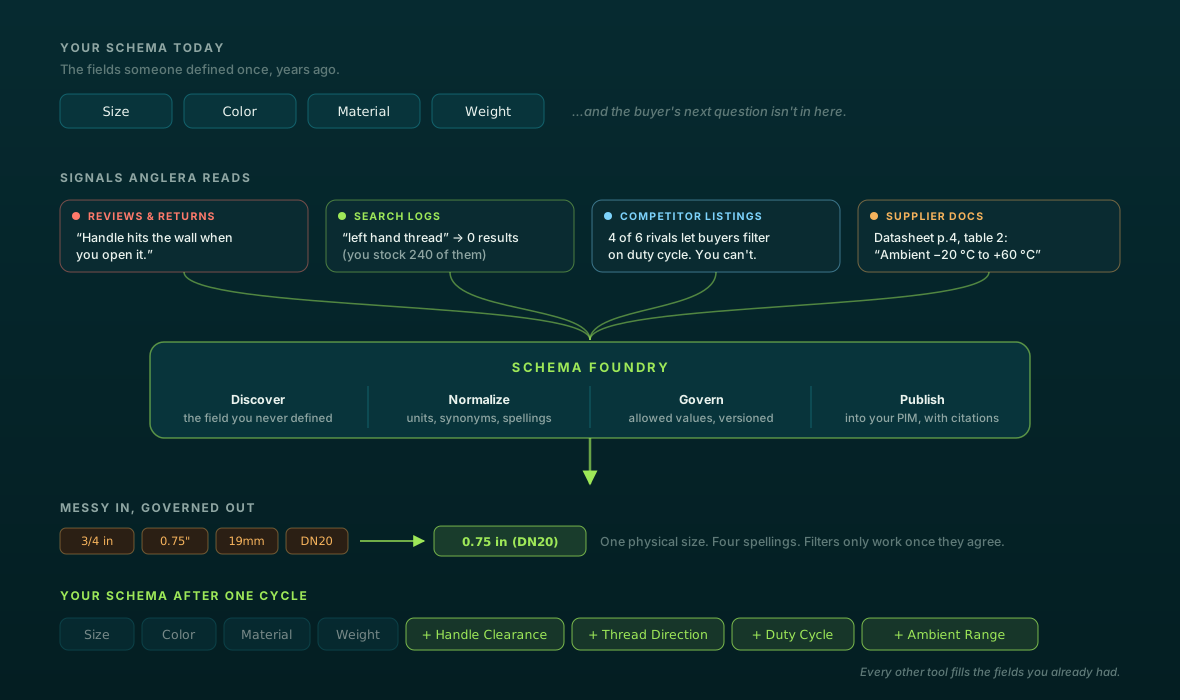
Anglera works upstream of both. It crawls supplier sites, pulls from external sources, normalizes units and values against your attribute model, scores every SKU against buyer signals, and writes enriched records back to wherever you store product data — your Unilog CX1 PIM layer, your ERP, your staging environment before Syndigo distribution. By the time your catalog reaches either platform's validation engine or storefront publishing layer, the data is already complete.
The integration is additive, not disruptive. Anglera connects to your existing system of record in approximately 30 days and enriches in bulk, then keeps pace as your catalog grows or supplier feeds change. You keep the platform you have chosen. The data that flows through it — and the compliance rates, page quality, and conversion metrics that depend on it — improve.
Frequently asked questions
Are Syndigo and Unilog CX1 actually competing for the same buyer?
Rarely. Syndigo is built for brands and manufacturers that push product content outward to retail trading partners. Unilog CX1 is built for distributors and wholesalers that power their own B2B storefront. The overlap is narrow — mostly manufacturers that sell through major retail chains and also operate a direct B2B channel. For most buyers, only one of these tools addresses their actual problem.
Can Unilog CX1 replace Syndigo for content syndication to retail partners?
No. Unilog CX1 is a B2B commerce platform with a built-in PIM; it is not a content syndication network. If your retail buyers require product content in their specific formats, or if GDSN compliance is a requirement, CX1 does not provide that capability. Syndigo — or a similar GDSN-certified data pool — is the appropriate tool for that job.
Does Unilog's managed content library eliminate the need for a dedicated enrichment tool?
It reduces manual work for the SKUs already in the library (10M+ from approximately 2,000 manufacturers). But the library does not cover every item in your catalog, every niche supplier, or every custom attribute your business tracks. Long-tail SKUs, recently added products, and items outside the library still require enrichment — and even library-covered items may lack the specific attribute depth your buyers search by. Anglera handles those gaps automatically, at catalog scale.
What happens in Syndigo when I submit incomplete product data?
Syndigo runs incoming records against 10,000 data checks and retailer-specific attribute requirements. Records with missing or incorrect attributes are flagged or rejected, and the burden of correcting them returns to your team. Syndigo does not research or fill missing attributes. Anglera enriches and validates your data before it enters Syndigo's distribution layer, reducing failure rates and the manual rework they generate.
Is Syndigo's acquisition of 1WorldSync relevant when evaluating these tools?
Yes. Syndigo acquired 1WorldSync and now operates one of the largest product content networks in the world. If you were evaluating 1WorldSync and Syndigo as separate products, that distinction has largely collapsed — the combined entity covers both the GDSN data pool infrastructure and the broader PXM toolset. For buyers evaluating Syndigo today, the network reach is as large as it has ever been, but the platform is also enterprise-oriented in its pricing and implementation complexity.