
84 Lumber: The Family Distributor That Never Sold Out
84 Lumber ranks #8 in building materials on the 2026 MDM Top Distributors list. Here is how a family-owned lumber yard reached $5.9B without a single PE dollar.
Part of Distributor Playbooks — strategy teardowns of every company on the MDM Top Distributors lists.
In 1956, four men pooled $84,000 to buy land and buildings in a Pennsylvania crossroads town called Eighty Four. Seventy years later, the company that took the town's name sits at #8 in building materials on Modern Distribution Management's 2026 Top Distributors list, down two spots from #6 the year before, with $5.9 billion in FY2025 revenue per MDM's report. What makes 84 Lumber worth a closer look isn't the size. It's who owns it, and what they refused to do to get there.
A cash-and-carry bet that outgrew its own model
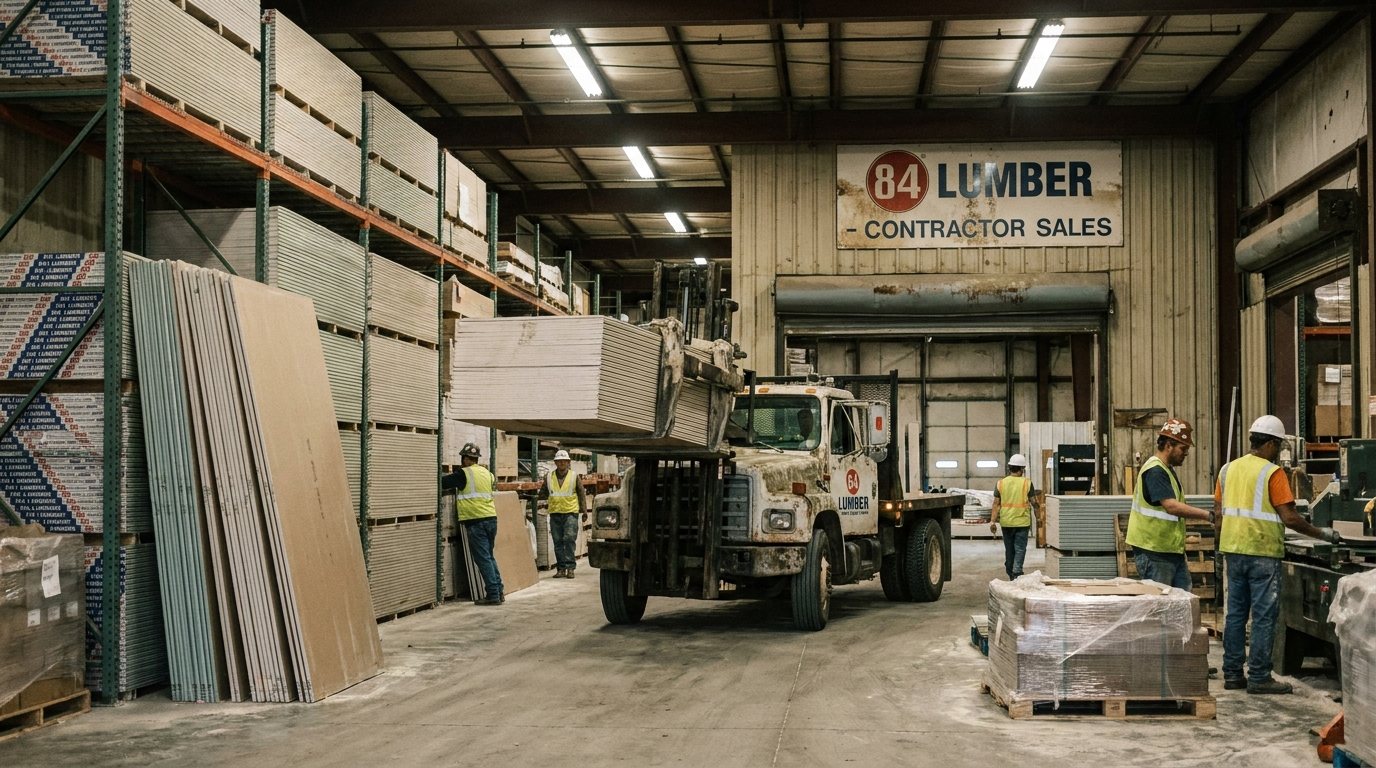
Joseph A. Hardy III founded the company with his brothers Norman and Bob, plus Ed Ryan and Jack Kunkle, on a simple premise: sell lumber wholesale, cash only, no delivery unless you pay for it, no heat in the yard, no frills for a customer who only cared about price and supply. It was a builder's warehouse, not a hardware store, according to the company's Wikipedia history. That stripped-down model scaled fast. By 1981 the company had 339 stores and $478 million in revenue, still stubbornly cash-only, still selling mostly to contractors who didn't need a showroom.
The company didn't grow by buying competitors. It grew by opening its own stores, one at a time, for decades, an approach that stands out precisely because almost nobody else in building-materials distribution does it that way anymore. Builders FirstSource, the sector's revenue leader at roughly $15 billion, got there through more than 40 acquisitions since 1998, including the 2015 ProBuild deal and the 2020 BMC Stock Holdings merger. The rest of the roofing and building-products channel has been consolidating just as hard through public roll-ups and private equity. 84 Lumber took the slower, organic road and still built a $6 billion business without a merger to show for it.
The succession that could have gone wrong
In 1992, after 34 years running the company, Joe Hardy handed control to his daughter Maggie, then 26. Family succession stories in distribution usually get told as smooth transitions. This one had teeth almost immediately: within her first year as owner, the company crossed $1 billion in revenue, proof the business wasn't coasting on inherited momentum. Hardy relaxed the cash-only rule in 1987 to accept credit and modernized stores that had literally gone unheated through Pennsylvania winters, incremental changes that mattered more to the balance sheet than they sound.
The six months that nearly ended it
The defining chapter isn't the founding. It's 2008 and 2009, when the housing collapse gutted every builder 84 Lumber sold to. According to Forbes' 2015 account of the crisis, Hardy's own father urged bankruptcy. Her advisors agreed. She refused, and instead put up her jewelry, her house, and her personal checking account as collateral. The company closed roughly half of its 500 stores and cut nearly two-thirds of its 9,600-person workforce. She took an $195 million loan from Cerberus Capital Management at 18% interest and borrowed another $30 million against the family's Nemacolin resort. For six months, Forbes reported, a $500,000 revenue miss in either direction would have triggered personal bankruptcy alongside the corporate one.
It worked. By 2013, debt was down from $558 million to $200 million, and new divisions in contractor installation services plus a $5.6 million investment in precision computerized saws added $128 million in annual sales and lifted operating profits 48%. Revenue, which had fallen from $3.8 billion pre-recession to a low point, was back to $2.3 billion by 2014 and growing 27% a year. This is the part of the story that belongs in the record: 84 Lumber didn't survive the housing crash because it was big or diversified. It survived because its owner treated the company's solvency as inseparable from her own.
What owning 96% of an S-corp buys you
Hardy still owns roughly 96% of 84 Lumber as a private S-corporation, per Forbes' reporting on her ownership stake. No public filings, no PE sponsor, no board answering to outside capital. That structure is the real strategic asset here, more than any single store format. It is why the company could fund a $500 million renovation of Nemacolin into a luxury resort using lumber-business wealth, a diversification move no PE-backed roll-up peer would tolerate. It is why 84 Lumber could run a 90-second Super Bowl ad in 2017 built around a mother and daughter's journey to the US border, a spot Fox initially rejected for its imagery, without a PR committee softening it first. Joe Hardy died in 2023 according to Wikipedia's entry on Maggie Hardy, leaving her as sole family authority over a business her father built and she rebuilt.
Today the company runs roughly 310 stores across 35 states, per Forbes' profile of Hardy, alongside component plants, door shops, and design studios added in 2020. The MDM #8 building-materials ranking places it well behind the acquisition-fueled giants at the top of that list. But it's the only company in that tier that got there without selling a share of itself to anyone.
The tension worth naming
Staying private and family-run gave 84 Lumber the freedom to make a bet its board-governed rivals couldn't, and the discipline to survive a crisis its lenders didn't expect it to survive. It also means the entire enterprise still rests on one owner's judgment, the same concentration of control that let Hardy save the company in 2009 could just as easily be a single point of failure in a sector where competitors now measure scale in tens of billions and dozens of acquisitions. That trade-off, freedom against fragility, is the story of every family-owned survivor in a consolidating industry, and 84 Lumber has simply run it longer and louder than most.
Every distributor on the MDM list runs on the same unglamorous machinery underneath the branding: a catalog, a yard, a truck, and the data that ties them together.