
Advance Auto Parts: From a Pawned Ring to Aftermarket Giant
How a 1932 three-store gamble in Roanoke, Virginia, became Advance Auto Parts, No. 97 on NRF's 2026 Top 100 Retailers list with $4.30B in U.S. sales.
Part of Retailer Playbooks — history-first profiles of every company on the NRF Top 100 Retailers list.
Advance Auto Parts sits at No. 97 on the NRF Top 100 Retailers 2026 list, the National Retail Federation's annual ranking compiled with Kantar, with $4.30 billion in 2025 U.S. retail sales. The company most people picture as a red-and-white strip-mall fixture actually started as a bailout of a failing three-store chain during the worst year of the Depression, and it grew almost entirely by buying its way past bigger, older rivals.
A three-store gamble in 1932
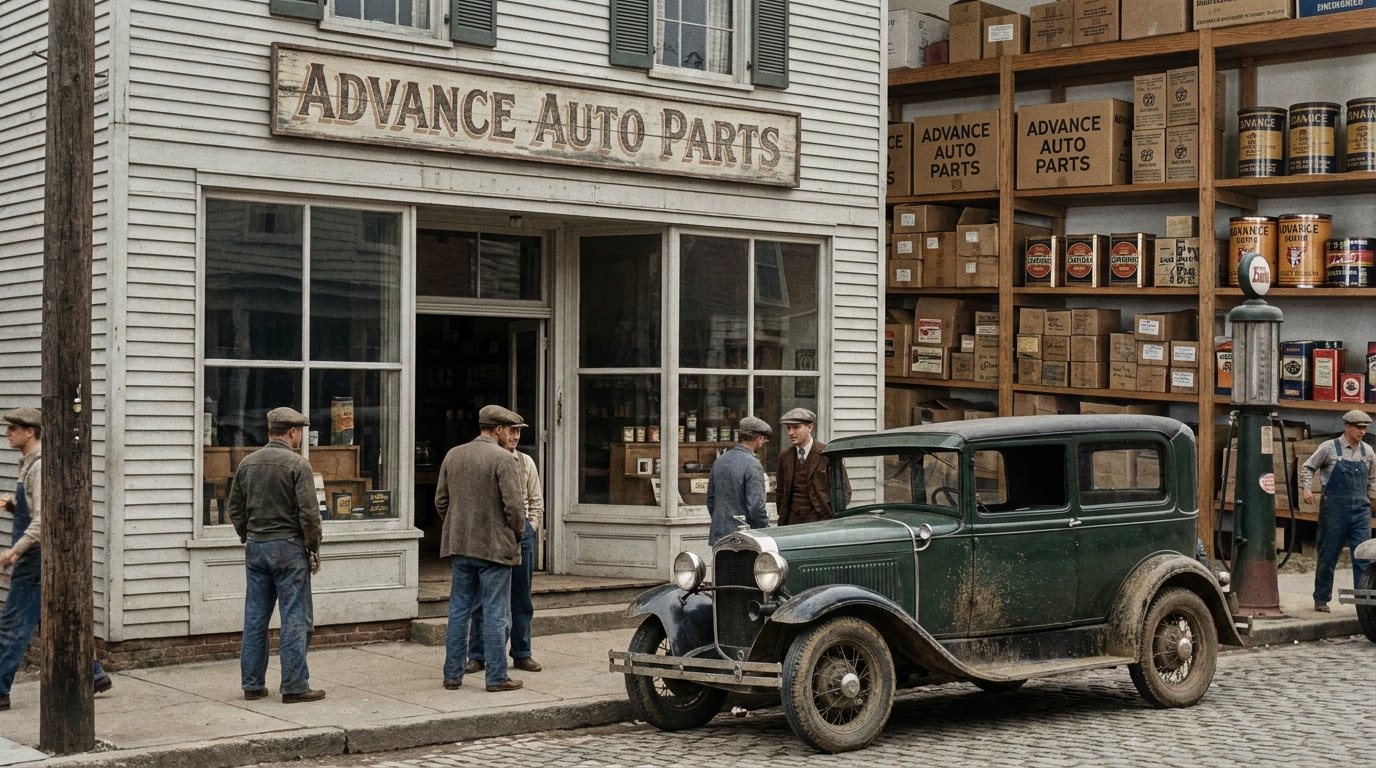
Arthur Taubman was the son of Austro-Hungarian immigrants who quit school at 13 to work in retail, then watched a Pittsburgh chain he'd built with his brother collapse in the Depression. In 1932 he found a struggling three-store auto parts business in Roanoke, Virginia, available for purchase. To scrape together the down payment, his wife Grace pawned her wedding ring alongside his Masonic ring, according to the company history compiled by FundingUniverse. Taubman had only a grade-school education, but he ran the stores on four rules he stated plainly: give customers value, earn a reputation for honesty, keep them coming back with quality and service, and treat employees like family.
The timing worked in his favor. New Deal road-building programs and Depression-era frugality meant people kept their old cars running rather than buying new ones, and Advance grew from 3 stores to 21 within a decade. When wartime rubber shortages choked off auto parts supply in the 1940s, Taubman diversified into housewares and appliances to keep the registers ringing, a pivot that stuck around for decades afterward.
The son who narrowed the aisles
By 1969, when Taubman handed the company to his Wharton-educated son Nicholas, Advance had grown to 54 stores that sold everything from lawn mowers to televisions. Nicholas concluded the company had no real identity. Touring a North Carolina location in the mid-1970s, he realized shoppers could buy the same appliances and toys elsewhere for less. He stripped the stores back down to auto parts, closed the credit and service departments, and in 1978 renamed the chain Advance Auto.
That refocus paid off fast. In 1982 the company introduced its PDQ system, "Parts Delivered Quickly," a same-day and next-day distribution network that initially promised 25,000 parts within 24 hours to any store. It was a logistics bet dressed up as a customer promise, and it became the backbone of how the company competed for the next forty years. By 1985 the chain hit Nicholas's target of 100 stores and took the name Advance Auto Parts.
Buying the way to scale
Between 1985 and 1996, the company under CEO Garnett Smith expanded to more than 500 stores and $808 million in revenue, putting it at No. 2 behind AutoZone. With no heir wanting the job, Nicholas hired Goldman Sachs in 1997 to find a buyer, and in 1998 private equity firm Freeman Spogli & Co. took an 86 percent stake for $351 million.
The acquisitions that followed reshaped the industry. In 1998, Advance bought most of Sears' Western Auto operations for $175 million cash plus a 40 percent equity stake, adding roughly a thousand stores. Western Auto itself was no minor chain: it had been founded in Kansas City in 1909 by George Pepperdine and Don Abnor Davis, according to Wikipedia's history of the company — the same Pepperdine whose auto-parts fortune later endowed Pepperdine University. Advance wound the Western Auto name down for good by 2003, closing out nearly a century of independent history within a company most car owners today have never heard of.
Advance kept buying. It picked up 671-store Discount Auto Parts in 2001 for roughly $520 million in cash and stock, went public on the NYSE that November, and by early 2003 had integrated both chains well enough to crack the Fortune 500 at No. 466. The biggest move came in 2013 and 2014: a $2.04 billion acquisition of General Parts International, owner of Carquest and WorldPac, that made Advance the largest automotive aftermarket parts provider in North America by store count, per Wikipedia.
The correction
Scale bought market position, but it also bought complexity Advance never fully digested. Integrating Carquest's independent-dealer network alongside its own corporate stores strained operations for years, and by 2023 the company was exploring an exit from pieces of the empire it had just finished assembling. New CEO Shane O'Kelly sold the WorldPac business to Carlyle for $1.5 billion in 2024 and announced the closure of 523 corporate stores and 204 independent locations, a retrenchment aimed at fixing a cost structure that had ballooned across decades of acquisitions rather than a single misstep. It is the kind of hard chapter that belongs in the ledger next to the growth years, not apart from it: the same appetite for scale that built the company also built the bloat it later had to cut.
The insight most retellings miss
The through-line in Advance's history is not the parts counter. It is distribution. A pawnshop-funded startup survived the Depression by adapting to what customers could still afford. A son who inherited a cluttered catalog store won by narrowing it to one category and building same-day delivery around it in 1982, decades before "same-day" became a retail expectation. And the company's most storied acquisition target, Western Auto, only exists in Advance's history because a mail-order auto parts business built in 1909 eventually needed a bigger logistics network than it could build alone. Long before algorithms and fulfillment centers, Advance Auto Parts was already a company that competed on how fast the right part could get to the right shelf.
Every retailer on this list has a version of that same unglamorous truth buried in its founding story: the front end is the brand, but the back end, the catalogs, the warehouses, the delivery trucks, is what actually decides who survives.