
O'Reilly Auto Parts: How Two Missourians Built an Empire
O'Reilly Auto Parts ranks #30 on NRF's 2026 Top 100 with $17.07B in U.S. sales. Here's how a father-son jobber grew into a 6,500-store chain.
Part of Retailer Playbooks — history-first profiles of every company on the NRF Top 100 Retailers list.
O'Reilly Auto Parts ranks #30 on the NRF Top 100 Retailers 2026, with $17.07 billion in 2025 U.S. retail sales, compiled annually by the National Retail Federation with Kantar. The chain now runs more than 6,500 stores across the U.S., Mexico, and Canada. It started as one rented building in Springfield, Missouri, staffed by 13 people who had just quit their jobs.
A Father, a Son, and a Bad Transfer Offer
In November 1957, Charles F. O'Reilly and his son Charles H. "Chub" O'Reilly worked at Link Motor Supply, a wholesale auto parts jobber in Springfield. The company was reorganizing, and the plan called for retiring the 72-year-old Charles F. and shipping Chub off to run an office in Kansas City. Chub said no. By his own account, Kansas City was "too big," with too much hustle, bustle, and traffic for his taste, according to FundingUniverse's company history.
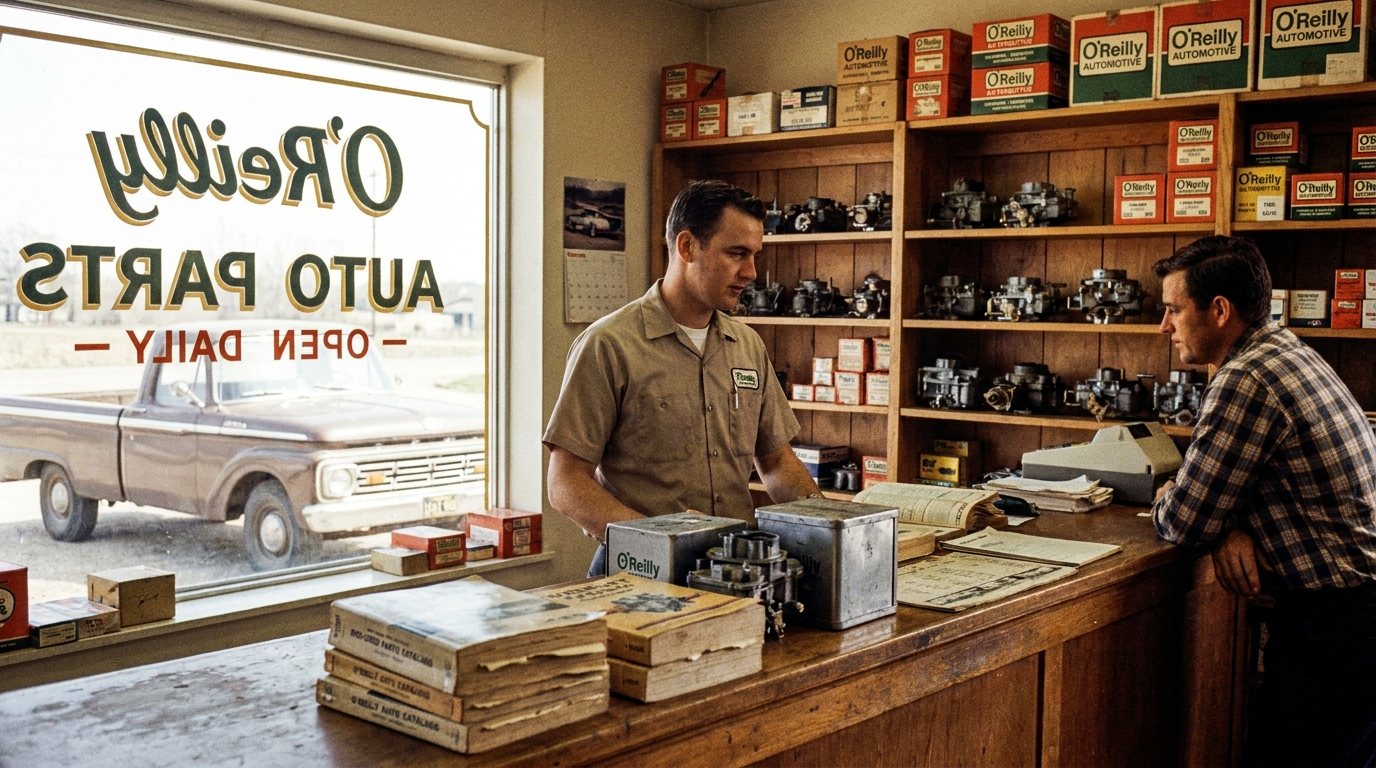
So father and son walked out and started their own shop instead. O'Reilly Automotive opened with 12 to 13 employees in a rented building and did $700,000 in sales its first full year, 1958. Three years later, combined with a jobber subsidiary called Ozark Automotive Distributors, formed in 1960, the operation was doing $1.3 million.
That second entity, Ozark, is easy to skip past, but it set the pattern for everything that followed. From the start, O'Reilly sold to two different customers under one roof: do-it-yourself car owners buying parts over the counter, and professional mechanics and independent jobbers buying wholesale through Ozark. Most of the chain's future rivals picked a lane. AutoZone built its identity on the DIY counter. NAPA and Carquest built theirs on the professional jobber network. O'Reilly refused to choose, and it never sold tires or offered installation labor either, a discipline it has kept for nearly seventy years. That dual-market posture, wholesale and retail running through the same inventory and the same trucks, is the unique insight in O'Reilly's story: it is the reason the company could later absorb chain after chain without ever having to decide which kind of retailer it was.
The Slow Roll, Then the Big Swing
Growth stayed regional and patient for decades. Nine stores by 1975, all in southwestern Missouri. Family control passed to the next generation, with Chub's four children, Charles, Lawrence, David, and Rosalie O'Reilly Wooten, running operations by 1980. The company went public on NASDAQ under the ticker ORLY on April 23, 1993, and used the capital to accelerate a strategy of buying regional competitors rather than building stores from scratch one at a time.
| Year | Move | Why it mattered |
|---|---|---|
| 1998 | Acquired Hi/LO Auto Supply, 182 stores in Texas and Louisiana | First major acquisition; brought a Houston distribution center and entry into a new region |
| 2001 | Acquired Mid-State Automotive Distributors, 82 stores | Extended reach across seven states |
| 2008 | Acquired CSK Auto, 1,273 stores in 12 states | Largest deal in company history, done in the shadow of a rival's accounting scandal |
| 2019 | Acquired Mayasa Auto Parts | First entry into Mexico |
| 2023 | Acquired Groupe Del Vasto (Vast-Auto) | First entry into Canada |
The CSK deal deserves the closest look. CSK Auto had been assembled in 1987 as Northern Automotive, a roll-up of three older West Coast chains: Checker Auto Parts (founded 1969), Schuck's Auto Supply (founded 1917), and Kragen Auto Parts (founded 1947). CSK grew aggressively through the late 1990s and early 2000s, swallowing Trak Auto, Big Wheel, Al's, Grand Auto Supply, and Murray's along the way, and by 2006 it ran 1,273 stores. That same year, CSK dismissed its chief operating officer and chief administrative officer after an internal investigation turned up accounting irregularities; the SEC would later file civil charges against four former executives over fraud dating to 2002-2004, according to Wikipedia's account of CSK Auto.
O'Reilly signed the agreement to buy CSK in April 2008, for roughly a billion dollars including assumed debt, and closed the deal that July. It was a bet that a disciplined operator could fix a chain a scandal had weakened, and it worked: O'Reilly rebranded every CSK store under its own banner by 2011, and the acquisition nearly doubled its footprint in one stroke, a scale jump the company had spent fifty years building toward one region at a time.
What the Discipline Bought
The payoff of running both channels through one network shows up in the plumbing. By the late 1990s, O'Reilly stores were linked by computer to regional distribution centers stocking more than 100,000 SKUs, with a policy the company called Right Part, Right Price, Right Now: if a store didn't have one of roughly 15,000 commonly requested parts on hand, the customer got a 5% discount and next-day delivery from another store or warehouse, per Wikipedia's history of O'Reilly Automotive. That redundancy, more than any single acquisition, is what let O'Reilly keep absorbing regional chains without breaking its promise to either kind of customer.
Today the company runs from a 117,000-square-foot Springfield headquarters, employs more than 93,000 people, and sits in both the S&P 500 and the NASDAQ-100. It stayed nonunion and family-influenced through generations of leadership, and under current CEO Brad Beckham it has kept extending the same playbook into Mexico and Canada rather than inventing a new one.
O'Reilly's whole history is really a case study in supply chains built to move a $4 alternator as reliably as a $400 one, one warehouse, one truck route, one acquisition at a time. That kind of unglamorous infrastructure work, done consistently for seven decades, is what this series keeps finding at the bottom of retail's biggest names.