
AutoZone: How a Grocer's Side Bet Built an Auto-Parts Giant
AutoZone ranks #31 on the NRF Top 100 with $15.94B in 2025 sales. Its history reveals a discipline most retailers avoid: negative shareholder equity.
Part of Retailer Playbooks — history-first profiles of every company on the NRF Top 100 Retailers list.
AutoZone ranks #31 on the NRF Top 100 Retailers 2026, with $15.94 billion in 2025 U.S. retail sales. It is also, by one measure, one of the strangest balance sheets in American retail: a company with more debt than assets, run that way on purpose for two decades. To understand why, you have to start in a grocery warehouse in Memphis.
A wholesaler's side bet
AutoZone did not begin as a car-parts idea. It began inside Malone & Hyde, a Memphis wholesale grocery distributor, where Joseph R. "Pitt" Hyde III ran operations. Hyde noticed something obvious in hindsight: the same high-volume, low-margin distribution logic that moved groceries could move auto parts, if someone built the stores and warehouses to match. On July 4, 1979, that idea opened its doors in Forrest City, Arkansas, as Auto Shack. First-day sales were $300, according to the company's Wikipedia history, a number small enough that almost nothing about the launch signaled what would follow.
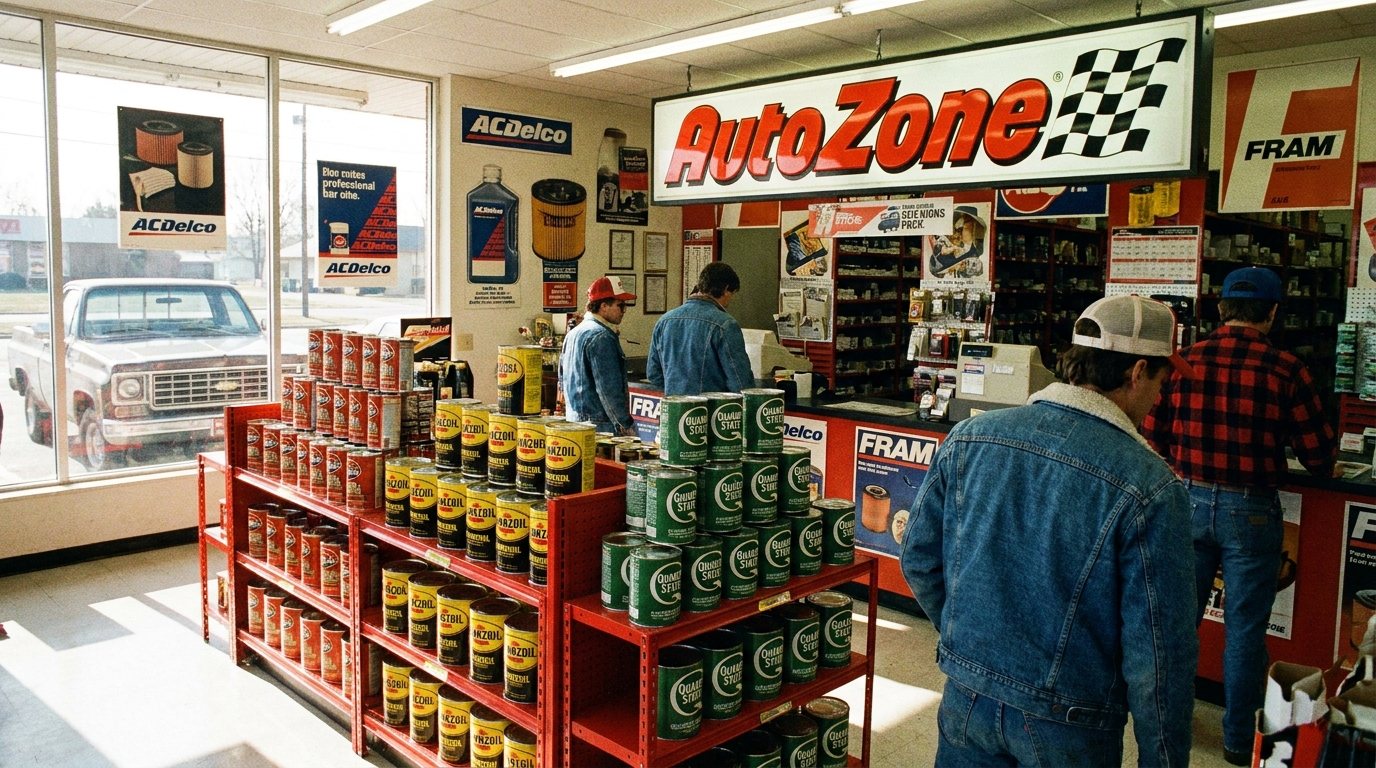
What followed was a Walmart-style rollout applied to a category nobody had modernized. Most auto parts stores in 1979 were dim counters run by mechanics for mechanics, stocked from behind the register and staffed by people who assumed you already knew what you needed. Auto Shack, as FundingUniverse's company history describes it, bet on clean, well-lit stores, centralized distribution, and clerks trained to help a do-it-yourselfer who did not know a caliper from a carburetor. The company opened roughly one store a week through its first decade, targeting lower- and middle-income men aged 18 to 49 who maintained their own cars out of necessity rather than hobby. Eight stores by 1980. Twenty by 1981. A hundred by 1983. Nearly 200 across thirteen states by 1984.
The rename nobody chose voluntarily
Here is the detail most customers never learn: AutoZone was not the original name, and the switch wasn't a branding refresh. It was a legal retreat. RadioShack sued over trademark infringement, arguing "Auto Shack" traded too closely on its own name. Rather than fight it out, Hyde's company rebranded to AutoZone in 1987, the same year Hyde separated the chain entirely from the Malone & Hyde grocery business it had grown up inside.
The forced rename turned out to be a gift. "AutoZone" read as a destination category name rather than a knockoff of an electronics retailer, and it arrived at exactly the moment the company was scaling past its regional roots. A 1984 management buyout with KKR had already put the company on a path toward independence; the 1987 name change completed the separation. By 1989, AutoZone was the third-largest auto parts retailer in the country. It went public on the NYSE in April 1991 under the ticker AZO, with KKR retaining a controlling stake as debt came down.
Building the parts, not just selling them
Most retailers resell what manufacturers make. AutoZone went further, building Duralast, its private-label parts brand, starting in 1986 and expanding it through 1988. Pairing that with an Express Parts Service model and lifetime warranties on tens of thousands of parts, AutoZone stopped competing purely on price and location and started competing on trust in its own name on the box. Vertical integration cut out distributor markups. It also gave AutoZone a lever competitors selling only national brands didn't have: the ability to price, warranty, and market a part exactly the way it wanted to.
The 1990s brought the acquisitions that filled out the map: Auto Palace, Chief Auto Parts, and TruckPro in 1998, plus entry into Mexico that same window. ALLDATA, a repair-information software company, joined in 1996 for $56 million, quietly building a data asset that would matter more as cars grew more complex. By fiscal 1999, sales had reached $4.1 billion. Store count crossed 1,000 in 1995, in Louisville, Kentucky, and kept climbing.
The pivot to the garage, not just the driveway
The clearest strategic shift in AutoZone's more recent history is the one least visible to a walk-in customer: the move into commercial sales, the parts sold to repair shops and mechanics rather than weekend DIYers. Industry shorthand calls this DIFM, "do it for me," as opposed to DIY. AutoZone built a "hub, feeder, and satellite" distribution network starting in 2002 specifically to get obscure parts to commercial customers within hours, then layered "mega hub" superstores on top of that model, crossing 100 mega hubs by 2024. The bet: as cars get more complex and fewer owners do their own brake jobs, the money migrates to the shops doing the work, and whoever gets parts to those shops fastest wins the account.
The insight the About page won't tell you
Here is the fact that best explains how AutoZone actually operates. As of its most recent fiscal year, the company reported total assets of roughly $19.4 billion against total shareholder equity of negative $3.4 billion. That is not a typo and not distress. AutoZone has spent decades funneling free cash flow into share buybacks rather than dividends, buying back stock aggressively enough, year after year, to run the accounting equity line permanently underwater while the business keeps generating cash and paying down debt on schedule. Most public companies treat negative equity as an emergency signal. AutoZone treats it as a capital-allocation strategy, and Wall Street has largely agreed with the bet for over twenty years running.
Today AutoZone operates 7,657 stores across the United States, Mexico, Brazil, Puerto Rico, and the U.S. Virgin Islands, all corporately owned with no franchise model, employing roughly 130,000 AutoZoners. It is a long way from a wholesale grocer's warehouse in Memphis, and further still from a $300 first day in Forrest City.
Every part on that shelf exists because someone, decades ago, decided a car owner without grease under their fingernails deserved a well-lit store and a clerk who could explain what a caliper does. That is the quieter infrastructure retail runs on: not just the stores, but the catalogs, warehouses, and data behind them.