
AFC Industries: Same Playbook, Three Different Owners
AFC Industries ranks #7 in Fasteners on MDM's 2026 Top Distributors list. Three private equity owners later, its buy-and-build model has only sped up.
Part of Distributor Playbooks — strategy teardowns of every company on the MDM Top Distributors lists.
AFC Industries lands at #7 in Fasteners and #28 in Industrial Supply on Modern Distribution Management's 2026 Top Distributors list, with 2024 revenue of roughly $700 million. What makes AFC unusual isn't the ranking. It's that the company has been sold twice in the last decade, by one private equity firm to another, and each new owner made the acquisition machine run faster rather than pausing to catch its breath.
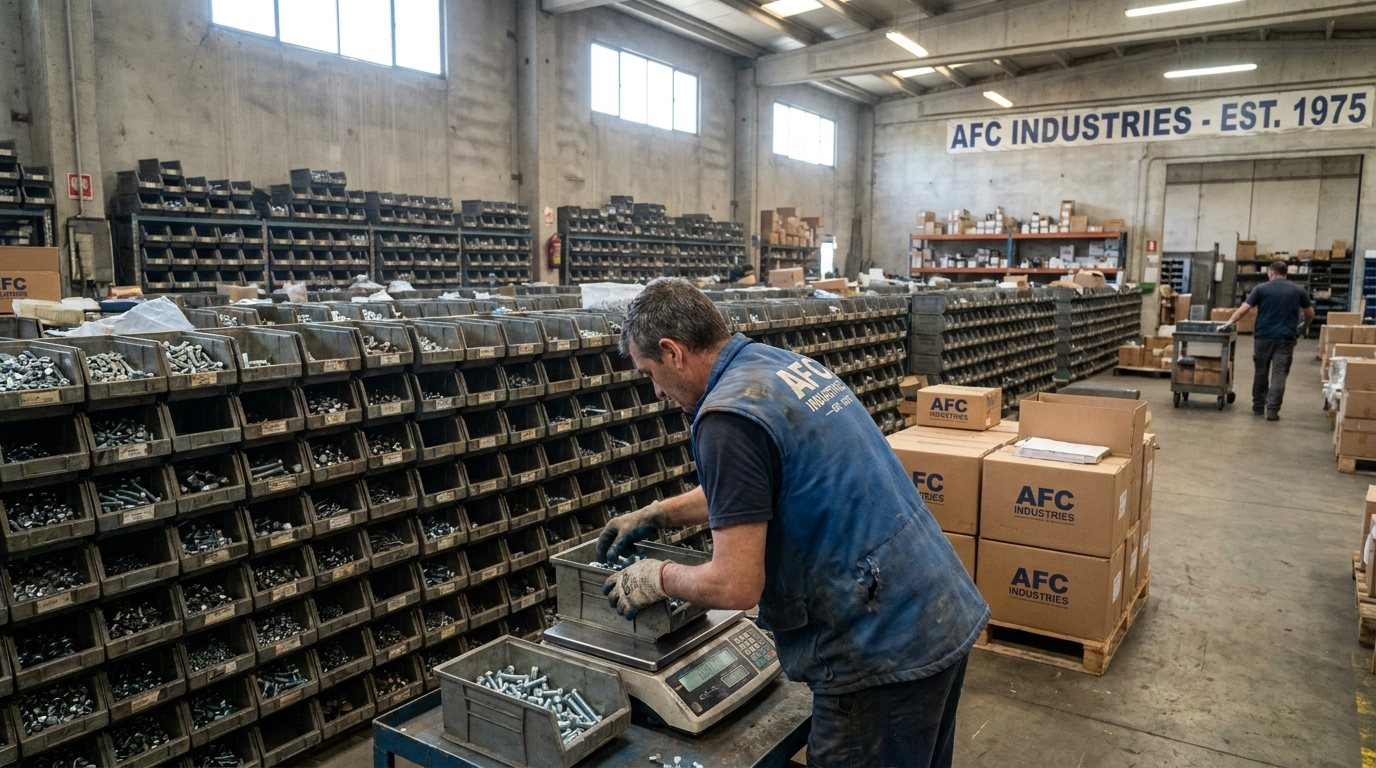
A fastener shop in Fairfield, Ohio
AFC was founded in 1987 in Fairfield, Ohio, as a regional distributor of fasteners and the small hardware category the industry calls C-parts: screws, pins, clips, the unglamorous parts that keep an assembly line moving. For 25 years it stayed a founder-run business serving Ohio and Indiana manufacturers, the kind of company MDM's list is full of but that rarely gets written about.
That changed in February 2012, when Cleveland-based Rockwood Equity recapitalized the company with its founders, replaced the existing management, and went shopping. The 2014 purchase of Pennsylvania-based Dell Fastener pushed AFC's footprint from two states to six: Pennsylvania, Georgia, Michigan, Oregon, California. By March 2015, Rockwood had sold AFC to Incline Equity Partners, a three-year hold that turned a regional fastener house into a multi-region platform.
The relay race
That sale to Incline is where the pattern starts. Under Incline, AFC added roughly a dozen more acquisitions and tripled in size. In April 2021, Incline sold AFC again, this time to Bertram Capital, a lower-middle-market firm that runs a "buy and build" thesis across fragmented industries. At the time of that sale, AFC operated 22 stocking locations across North America and into Mexico, with customer relationships averaging more than 20 years. Bertram Partner Kevin Yamashita called it a company that had "established itself as a real partner to customers through its high-touch and value-added distribution model."
Bertram didn't slow the pace either. AFC closed 11 acquisitions in its first 24 months under Bertram, including six in a single year, 2023. Revenue that MDM's own reporting put at around $520 million in 2022 reached the $700 million mark used in the 2026 ranking two years later, growth that is mostly bolt-on, not organic same-store lift.
| Ownership era | Span | Acquisition pace |
|---|---|---|
| Founder-owned | 1987–2012 | Organic growth, Ohio/Indiana |
| Rockwood Equity | 2012–2015 | 1 major deal (Dell Fastener), footprint tripled to 6 states |
| Incline Equity Partners | 2015–2021 | ~12 acquisitions, company size tripled |
| Bertram Capital | 2021–present | 11 deals in first 24 months, 6 in 2023 alone |
The insight worth naming plainly: most roll-ups either get flipped once for a quick multiple or stall out under new ownership as integration debt piles up. AFC has now changed hands three times without the acquisition engine ever cooling. Each sponsor inherited a company mid-sprint and chose to run it harder, which says something about how replicable the underlying playbook is: find a fragmented C-parts distributor, add vendor-managed inventory and vending, keep the acquired brand's local relationships intact, and repeat.
From scale to specialization
The more recent moves suggest the playbook is evolving, not just repeating. Where earlier acquisitions were mostly about adding stocking locations and customer lists, the 2024–2026 deals read differently: CH Peters (tooling, November 2024), Irwin Industrial (Canadian expansion into aerospace and defense, January 2025), Cavanaugh Government Group (Chicago-based defense sourcing, July 2025), and Allied Inventory Systems (aerospace and defense, March 2026). In October 2025, AFC formally split into two branded units, AFC Tooling and AFC Aerospace & Defense, followed by the March 2026 launch of a custom tooling line under the Cline Tool Customs name.
That's a distributor moving from horizontal scale, more branches and more SKUs, toward vertical depth in categories that carry real compliance overhead: AS9100/AS9120B and ITAR credentials aren't something a buyer bolts on overnight, and they're a moat competitors without that paperwork can't easily cross. It also means AFC now looks less like a single fastener distributor and more like a holding structure for several specialized ones, some of the older acquisitions, like Oregon Bolt and QFC Fasteners, still keep their own pages on AFC's site rather than being folded into a single brand.
The tension underneath the growth
Buying a company every few months for over a decade is a demonstrated strength, but it is also a dependency. AFC's growth curve assumes there is always a next distributor willing to sell and always a next sponsor willing to buy the platform when the current owner exits. That has held for three ownership cycles running. Whether the newer aerospace and defense specialization changes the exit math, a differentiated platform is worth more to a strategic acquirer than to another financial sponsor running the same playbook, is the open question for whoever eventually buys AFC from Bertram.
Distribution rankings like MDM's measure revenue and scale, but underneath every fastener SKU that ships on time is a catalog, a branch, and a data record that has to be right. That's the unglamorous machinery this series keeps coming back to.