
Apple Retail: How a Rejected Idea Built a Store Empire
Apple ranks #11 on the NRF Top 100 with $75.9B in 2025 U.S. retail sales. Here's how a store idea the press mocked in 2001 became a retail model everyone now copies.
Part of Retailer Playbooks — history-first profiles of every company on the NRF Top 100 Retailers list.
Apple lands at #11 on the NRF Top 100 Retailers 2026 list, with $75.90 billion in 2025 U.S. retail sales, the National Retail Federation and Kantar report. That number belongs to a store division that did not exist until May 2001, and that the trade press greeted, at launch, with open scorn. The story of how it went from a punchline to a top-tier American retailer in two decades says something about the company that founding-myth retellings usually skip.
A garage, then a near-death
Apple's origin is well worn but worth the specifics. Steve Jobs, Steve Wozniak, and Ronald Wayne formed a partnership on April 1, 1976, to sell Wozniak's Apple I board. Jobs sold his Volkswagen van and Wozniak sold his HP-65 calculator to raise the first $1,300. Wayne, uneasy about personal liability, sold his stake back for $800 twelve days later. Investor Mike Markkula's $250,000 and operating discipline turned the partnership into a real company in January 1977, per Wikipedia's Apple Inc. history.
Two decades later, Apple was nearly gone. By the mid-1990s it had bled market share to cheaper Windows PCs and couldn't ship a modern operating system. Apple bought NeXT, the company Jobs founded after his 1985 ouster, for roughly $427 million in early 1997, and Jobs quietly returned as an advisor. When boardroom turmoil followed, Jobs was named interim CEO that September. He cut Apple's product line by about 70 percent, according to the same Apple Inc. history, betting the company's survival on doing far less, far better.
A Target executive builds a store nobody asked for
The retail chapter starts in that same rebuilding period, and it starts with an unlikely hire. In January 2000, Apple recruited Ron Johnson, then a senior merchandising executive at Target, to run retail operations, according to Wikipedia's profile of Johnson. Apple had already failed once at retail, through store-within-a-store partnerships that never gave it control of the customer experience. This time, instead of leasing floor space in someone else's building, Johnson's team and a group led by Disney veteran Allen Moyer built full-scale mockups of a prospective Apple Store inside a warehouse near Cupertino, testing layout and flow in private for months before a single customer saw it.
That caution looked justified when the concept leaked. Retail and business press greeted the idea of a computer maker opening its own stores with open skepticism. Chains like CompUSA and Egghead were already showing that computer retail was a brutal, thin-margin business, and Apple was a company that had just survived near-collapse. Betting scarce cash on real estate and store staff, rather than concentrating on products alone, read to outside observers as a distraction Apple could not afford.
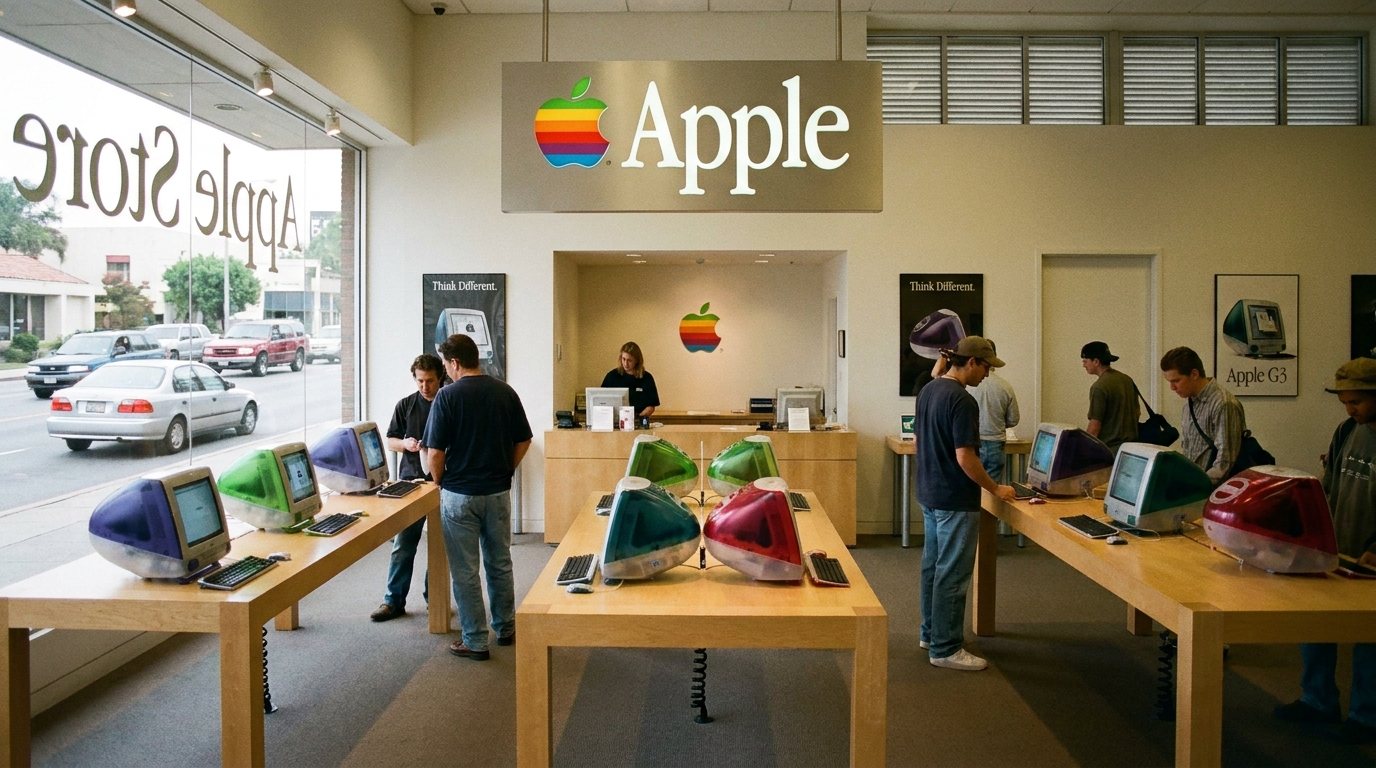
Apple opened its first two stores anyway, in Tysons Corner, Virginia, and Glendale, California, on May 19, 2001. More than 7,700 people showed up and spent roughly $599,000 across the two locations that weekend, per Wikipedia's Apple Store history.
Faster than any retailer, on record
The doubts didn't survive contact with the sales floor. Apple's retail division reached $1 billion in annual sales in 2004, described by that same Wikipedia history as the fastest any retailer had ever hit that mark, and grew to $1 billion in quarterly sales by 2006. By 2011, global retail revenue topped $16 billion, and Apple's U.S. stores were generating an average of $473,000 in revenue per employee, a figure that made Apple's small-footprint mall stores among the most productive retail real estate in the country.
The stores also became architectural statements. The best known, the glass-cube Apple Fifth Avenue in Manhattan, was shaped with input from architect Peter Bohlin, and the company later patented both the cube's design and its glass staircase. Most stores were designed by Bohlin Cywinski Jackson or Foster + Partners, an unusual level of design investment for a retail chain selling consumer electronics rather than luxury goods. By the time the format had matured, Apple was operating more than 500 stores across 27 countries and regions, a footprint most of which is far smaller in square footage than a typical department store anchor.
The unusual bet: a store built to sell you less
Every Apple Store carries a Genius Bar, the in-store repair and support counter Johnson's team is credited with inventing, alongside free "Today at Apple" sessions that teach photography, music, and coding rather than pushing a cash register. That is the detail worth sitting with. Apple's hardware margin is locked in before a customer ever walks through the door, so the store itself was never built to be the profit center. It was built to be the reason someone trusts the brand enough to pay full price for the next device, and the place they go when something breaks instead of a repair shop or a return counter. Most electronics retailers of that era were optimized for the register. Apple optimized its stores for time spent not buying anything, and treated that as the investment.
That inversion did not travel well when its architect tried to export it. Johnson left Apple in 2011 after roughly seven and a half years to become CEO of JCPenney, where he attempted a similar experience-first overhaul on a struggling department-store chain and was pushed out within eighteen months, per the same Wikipedia profile. The Apple Store model, it turned out, depended on a hardware business that could subsidize the experiment. A legacy retailer selling apparel on thin margins couldn't absorb the same bet.
Apple's store business is barely older than a generation, built on the back of a company that had nearly vanished a few years earlier. What it proves is less about computers than about patience: the willingness to mock up a format in a warehouse for months, ignore the press coverage calling it a mistake, and let a store that rarely asks for a sale become one of the most valuable pieces of real estate per square foot in American retail.
Behind every storefront on this list, there's a supply chain, a catalog, or a data system quietly making the experience possible, and that's the infrastructure this series keeps coming back to.