
Dell: The Dorm-Room Direct Seller Still Skipping Stores
Dell built PCs to order from a UT-Austin dorm room in 1984 and never really opened a store. NRF still ranks it #66 among America's top retailers.
Part of Retailer Playbooks — history-first profiles of every company on the NRF Top 100 Retailers list.
Dell lands at #66 on the NRF Top 100 Retailers 2026, the National Retail Federation's annual ranking compiled with Kantar, with $6.58 billion in 2025 U.S. retail sales. That's a strange credential for a company that has spent most of its 40-year life refusing to open a store. Dell's whole business was built on the idea that the middleman, meaning the retailer, was the problem.
A dorm room, a wholesale price list, and a bet
In 1984, Michael Dell was a University of Texas at Austin freshman who had already been buying surplus IBM PCs and upgraded parts, then reselling assembled machines out of his dorm room at Dobie Center, according to Wikipedia. He dropped out after that first year with about $1,000 in family money and incorporated PC's Limited. The pitch was simple: skip the computer store markup, sell IBM-compatible machines directly to buyers who already knew what they wanted, and price it lower. Per FundingUniverse's company history, Dell was clearing roughly $80,000 a month in gross revenue before he'd even renamed the company, and first-year revenue hit $6 million.
The company dropped the "PC's Limited" name in 1987 and went public in 1988 on NASDAQ, offering 3.5 million shares at $8.50 and setting a market cap of $85 million.
The real invention wasn't the computer
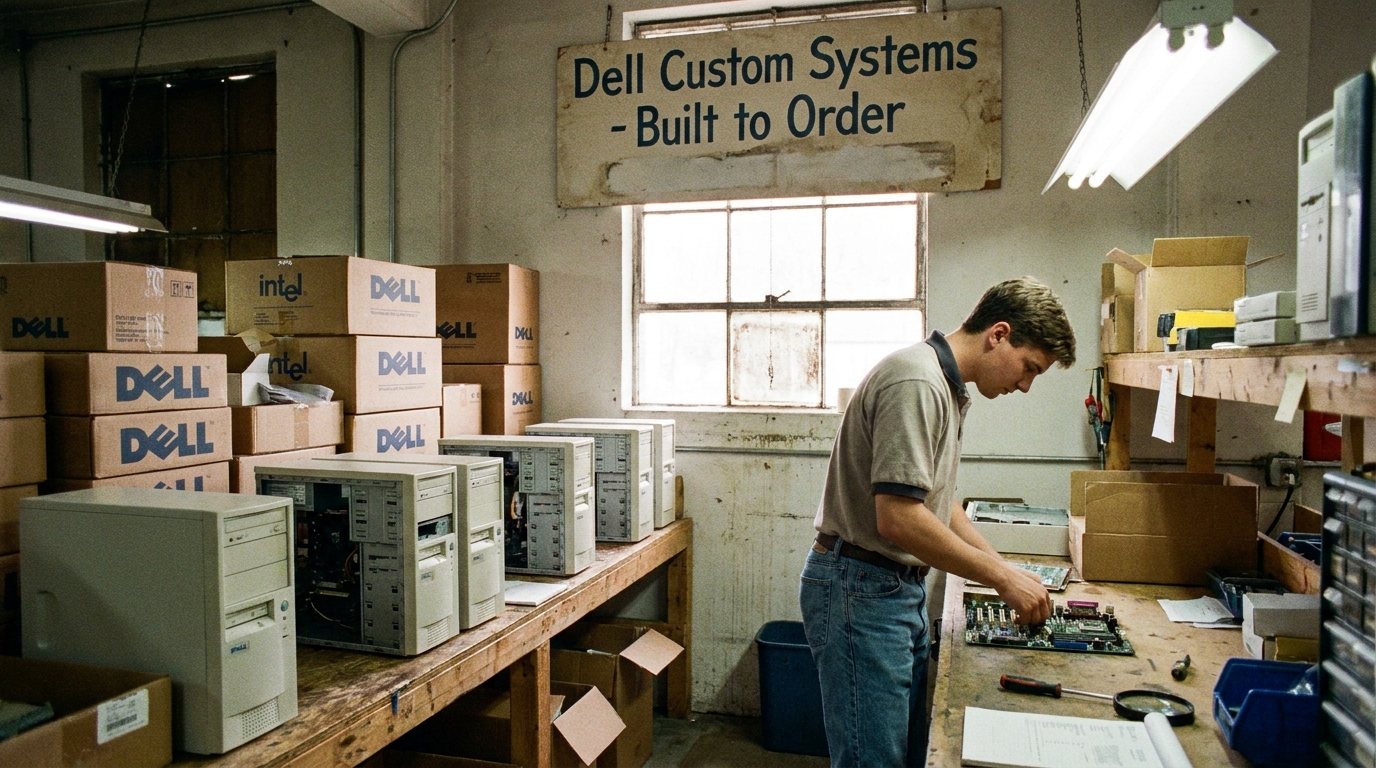
Everyone remembers Dell as the company that sold PCs by phone and, later, the internet. The more consequential invention was underneath that: build-to-order manufacturing with almost no finished-goods inventory. Orders were assembled at a nearby factory and shipped within days, with FundingUniverse noting Dell turned over inventory roughly every three days on average. Because customers paid Dell before Dell paid its component suppliers, the company effectively ran on other people's money. In an industry where a chip or a drive could lose value by the week, that turnaround was the margin.
The direct model produced a second effect nobody built a spreadsheet for at the time: customer data. Every phone order captured what buyers actually wanted, and Dell used it to spot demand shifts before store-based rivals, whose sales data sat inside someone else's cash register. By 1990, that feedback loop had helped push Dell to the top of J.D. Power's PC customer satisfaction rankings, per FundingUniverse.
The retail deal Dell almost made, then killed
Here's the detail that rarely makes the About page: Dell nearly became a big-box vendor a decade before it needed to. In 1993, Dell had a plan to sell PCs through Walmart and other big-box retailers, a channel projected to generate around $125 million a year, according to Wikipedia's history of Dell. Consultant Kevin Rollins, who would later become Dell's CEO, argued the retail margins were too thin to be worth it. Michael Dell agreed, and Dell walked away from the reseller channel entirely by 1994.
That call looked brilliant for a decade. Direct sales carried Dell past Compaq to become the world's largest PC vendor by 1999, and by 2001 Dell held the industry's top global market share. It looked much less brilliant once the PC market matured and consumers, not corporate IT departments, became the growth story. Dell had almost no retail footprint to catch them, and by 2005 the stock had dropped 25% in a single year. HP overtook Dell as the top PC maker in 2006. The company that talked itself out of Walmart in 1993 spent much of 2007 trying to get back in.
The hard chapter
The mid-2000s were not just a strategy problem. An SEC investigation opened in 2005 turned up accounting irregularities serious enough that Dell restated earnings for 2003 through 2006, and Michael Dell, then-CEO Kevin Rollins, and CFO James Schneider all faced charges over undisclosed material information, per Wikipedia. Rollins resigned in January 2007 and Michael Dell returned as CEO, launching a restructuring known internally as "Dell 2.0" that cut roughly 8,800 jobs.
What followed was a company trying to buy its way into relevance: about $13 billion in acquisitions between 2008 and 2012, including Perot Systems and Alienware, aimed at anything besides commodity PCs. None of it was enough to convince Wall Street that Dell had a second act.
Going private to go bigger
Michael Dell answered that skepticism in 2013 by taking the company off the public market entirely. The $24.4 billion leveraged buyout with Silver Lake Partners, backed by a $2 billion loan from Microsoft, was the largest private-equity-backed tech buyout in history at the time, per Wikipedia. Freed from quarterly scrutiny, Dell made its biggest move yet: a $67 billion acquisition of storage giant EMC in 2016, the largest tech deal ever done, which brought EMC's 81% stake in VMware along with it. Dell Technologies returned to public markets on the NYSE in 2018.
Why the ranking makes sense anyway
The unique thing about Dell's presence on a retailer ranking is that it earns the spot with almost no stores. The NRF listing here is specifically "Dell (Direct)," a nod to the fact that the channel Michael Dell built from a dorm room in 1984, and Kevin Rollins nearly diverted into big-box aisles in 1993, is still the one doing the selling. Forty-plus years later, a company with a global logistics operation still counts as a retailer chiefly because it never stopped being a mail-order house at heart, just one that swapped catalogs for a configurator.
Every company on this list runs on some version of the same unglamorous machinery: getting the right item, described correctly, to the right customer, at a price that still leaves room to make money. Dell just proved you could build a $6.58 billion retail business without ever needing a storefront to do it.