
Best Buy: The Electronics Chain That Nearly Died Twice
How Best Buy survived a tornado, a 1997 near-collapse, and the showrooming era that killed Circuit City, per NRF's 2026 Top 100 Retailers list.
Part of Retailer Playbooks — history-first profiles of every company on the NRF Top 100 Retailers list.
Richard Schulze put a second mortgage on his own house to open a stereo shop in St. Paul in 1966. Six decades later, that shop is Best Buy, ranked 18th on the NRF Top 100 Retailers 2026 list with $38.23 billion in 2025 U.S. retail sales. Its path there runs through a literal storm, a near-bankruptcy nobody outside Minneapolis remembers, and a rival that made almost every mistake Best Buy narrowly avoided.
The Tornado That Wrote the Playbook
Schulze and partner James Wheeler founded Sound of Music on August 22, 1966, a hi-fi and car-stereo store built on savings and debt, not backing. It grew slowly for fifteen years, a regional chain most people outside the Twin Cities had never heard of. Then, in 1981, a tornado tore the roof off the company's largest store, in Roseville, Minnesota, and gutted the showroom. The stockroom survived. Schulze responded by clearing the surviving inventory in a blowout sale advertised around a simple phrase: best buys on everything. Four days of tornado-clearance selling outsold a normal month, according to Wikipedia's account of the company's history. Two years later, with seven stores and $10 million in sales, Schulze renamed the whole operation after that ad line. Best Buy Co., Inc. was born from a disaster sale, not a strategy memo, and the instinct behind it, that the store itself is the promotion, never left the company.
Building the Superstore, Then Almost Wrecking It
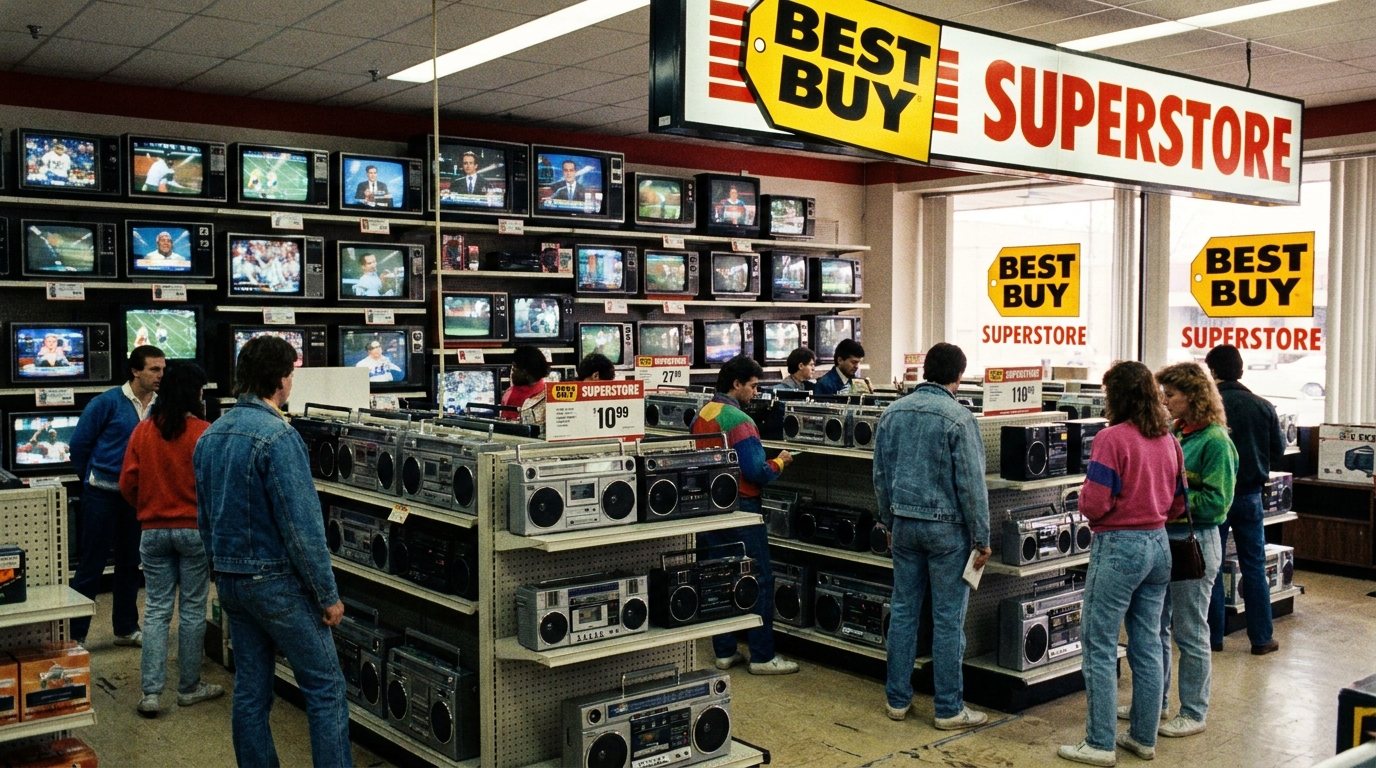
The 1983 rebrand came with a new format: Best Buy's first superstore opened in Burnsville, Minnesota, and outsold every existing location combined in its first year, per Wikipedia. Schulze pushed further in 1988 with Concept II stores, stripping out commissioned salespeople in favor of self-service floors and open displays, a bet so contrarian that Maytag, Whirlpool, and Sony briefly boycotted the chain in protest, according to FundingUniverse's company history. It worked. Best Buy went public in 1985, listed on the NYSE in 1987, and rode the superstore boom from $239 million in revenue in 1987 to $1.6 billion by 1993.
Growth that fast has a shadow side. Price wars with Circuit City and Highland Superstores compressed margins through the early 1990s, and by 1997 Best Buy had overbuilt inventory into a soft market. The stock cratered to $1.31 a share, per FundingUniverse, a number that should sit alongside the tornado story in any honest telling of this company, because it is the moment Best Buy could plausibly have joined Highland Superstores, which filed for bankruptcy in 1992, in the pile of vanished electronics chains. Management restructured, refocused on digital categories and service, and crossed $10 billion in revenue by 1999. The company also learned the limits of buying growth: its 2001 acquisition of Musicland Stores for $685 million turned into roughly $500 million in charges before Best Buy divested the chain in 2003, a mistake FundingUniverse's history calls "a very expensive, but powerful learning experience."
The Rejection That Aged Better Than the Deal
In 1988, Schulze tried to sell Best Buy to Circuit City for $30 million. Circuit City passed. It is one of the great quiet ironies in American retail: the rival that declined to buy Best Buy for pocket change built the more polished chain for the next two decades, then filed for bankruptcy in 2009 and liquidated entirely, done in by a commission-driven sales model, an ill-timed move away from experienced staff, and debt taken on during the housing crash. Best Buy absorbed a wave of former Circuit City customers and store leases and kept going. The company that got turned down outlived the company that turned it down.
When the Showroom Became the Enemy
By the early 2010s, Best Buy had a new problem, and this one had nothing to do with tornadoes or inventory. Shoppers were using its stores exactly as designed, to see and touch products, then buying them cheaper from Amazon on their phones in the parking lot. "Showrooming" nearly finished what price wars and Musicland couldn't. CEO Brian Dunn resigned in 2012 amid a personal-conduct scandal, and Hubert Joly arrived that September to run a turnaround he called Renew Blue: match online prices instead of fighting them, speed up delivery, and rebuild the store floor around vendor "store-within-a-store" partnerships with Apple, Samsung, Microsoft, and Google. The bet was that Best Buy's real asset was never the lowest price. It was 1,000-plus buildings full of trained staff and working demo units, something no warehouse could replicate. Renew Blue held, and the stores that had become Best Buy's liability became its differentiator again.
The Unique Insight
Read the two crises back to back and a pattern shows up that Best Buy's own retrospectives don't name directly. In 1997 the company nearly died because it had too much confidence in its stores, overbuilding inventory into buildings it assumed would keep selling at any volume. In 2012 it nearly died for the opposite reason, having too little confidence in what those same stores were worth once the internet made price transparent. Both times, the fix wasn't a new store format or a new CEO philosophy. It was Schulze's original tornado-sale instinct, applied twice a generation apart: treat the physical location as the differentiator, not the liability, and price honestly around what's actually there. Corie Barry, who became CEO in 2019 as the company's first female chief executive, has kept leaning on that same asset, pushing Best Buy Health and in-home advisor services that only work because there are stores and technicians in the neighborhood already.
Best Buy today runs about 1,000 stores across the U.S. and Canada. It is one of the few big-box electronics chains left standing, in a category that buried Circuit City, Highland Superstores, CompUSA, and RadioShack. The stores that almost sank it twice are still the reason it's still here.
Retail's oldest lesson keeps resurfacing in different disguises: the boring infrastructure, the store floor, the inventory system, the delivery truck, usually decides who survives long after the headlines move on. This series returns to that lesson with every company it profiles.