
AT&T Retail: How Ma Bell's Stores Became a Top 25 Chain
AT&T ranks #23 on NRF's Top 100 Retailers, per NRF. Its stores exist because of a 1984 breakup, a $41B buyback, and a bet Steve Jobs made on the weakest carrier.
Part of Retailer Playbooks — history-first profiles of every company on the NRF Top 100 Retailers list.
AT&T lands at #23 on the NRF Top 100 Retailers 2026 list, compiled with Kantar, with $22.10 billion in 2025 U.S. retail sales. That figure comes from a company that spent its first hundred years as a regulated monopoly with no retail stores at all, no competitors, and no reason to want either. The path from there to a national chain of storefronts selling phones is one of the stranger arcs in American business, and it runs through a court-ordered breakup, a corporate buyback of its own parent, and a decision by Apple to bet its most important product on the weakest carrier in the room.
A monopoly with no storefronts
Alexander Graham Bell patented the telephone in March 1876, and a year later he co-founded the Bell Telephone Company with Thomas Watson, Gardiner Greene Hubbard, and Thomas Sanders, according to Wikipedia's history of AT&T. American Telephone and Telegraph was chartered in 1885 as Bell's long-distance subsidiary, and by 1899 AT&T had absorbed its parent outright, consolidating Western Electric, Bell Laboratories, and the regional operating companies under one roof. By 1907 it controlled more than 80 percent of the U.S. telephone market. This was "Ma Bell": a regulated utility, not a retailer. You didn't shop for a phone. You leased one from the phone company, and the phone company decided what you got.
That arrangement held for most of the 20th century, propped up by regulators who treated phone service as a natural monopoly. It also funded Bell Labs, source of the transistor, the laser, and Unix, from a company with zero incentive to compete on price or experience, because there was nowhere else for a customer to go.
The breakup that created the players
The Department of Justice sued AT&T for antitrust violations in 1974. The case settled in 1982, and on January 1, 1984, the Bell System split into AT&T Corp, which kept long distance and equipment, and seven independent Regional Bell Operating Companies, the "Baby Bells," per Wikipedia. One of those Baby Bells was Southwestern Bell Corporation, later renamed SBC Communications. Under CEO Edward Whitacre, SBC spent the 1990s buying up its siblings: Pacific Telesis for $16.5 billion in 1996, Southern New England Telecommunications for $4.4 billion in 1998, and Ameritech for $62 billion later that year, according to FundingUniverse's history of SBC Communications. By 1998 the combined company was pulling in $46 billion in revenue and ranked among the top 15 in the Fortune 500.
Then, on November 18, 2005, SBC did something almost no company ever does: it bought its own former parent. SBC paid $16 billion for AT&T Corp, the entity the government had carved it out of two decades earlier, and immediately renamed itself AT&T Inc., claiming the 1877 lineage even though the surviving corporate structure and stock history were SBC's. A regional Baby Bell had, in effect, reabsorbed Ma Bell and taken her name.
The brand that beat its own subsidiary
Here is the detail that rarely makes the official version of this story, and it is where the retail business actually starts. In April 2000, SBC and BellSouth formed a wireless joint venture called Cingular, combining more than 100 regional cellular operators. In February 2004, Cingular won a bidding war against Vodafone for a struggling rival named AT&T Wireless Services, paying $41 billion, more than double where the company traded, according to Wikipedia's history of AT&T Mobility. The October 2004 merger folded 46 million subscribers into Cingular, making it the largest U.S. wireless carrier, and retired the AT&T Wireless brand.
Two years later, once AT&T Inc. bought out BellSouth's stake in December 2006 and owned Cingular outright, it renamed Cingular back to AT&T. The carrier that had just spent $41 billion erasing a company called "AT&T Wireless" put the AT&T name back on its own storefronts anyway, under a different parent that had earned the right to it by buying the original AT&T Corp the year before. It's a small irony most retail histories skip: the AT&T brand outlived the operating company that once carried it, purely because of who ended up owning the trademark, not anything that happened at the store level.
Why the stores actually matter now
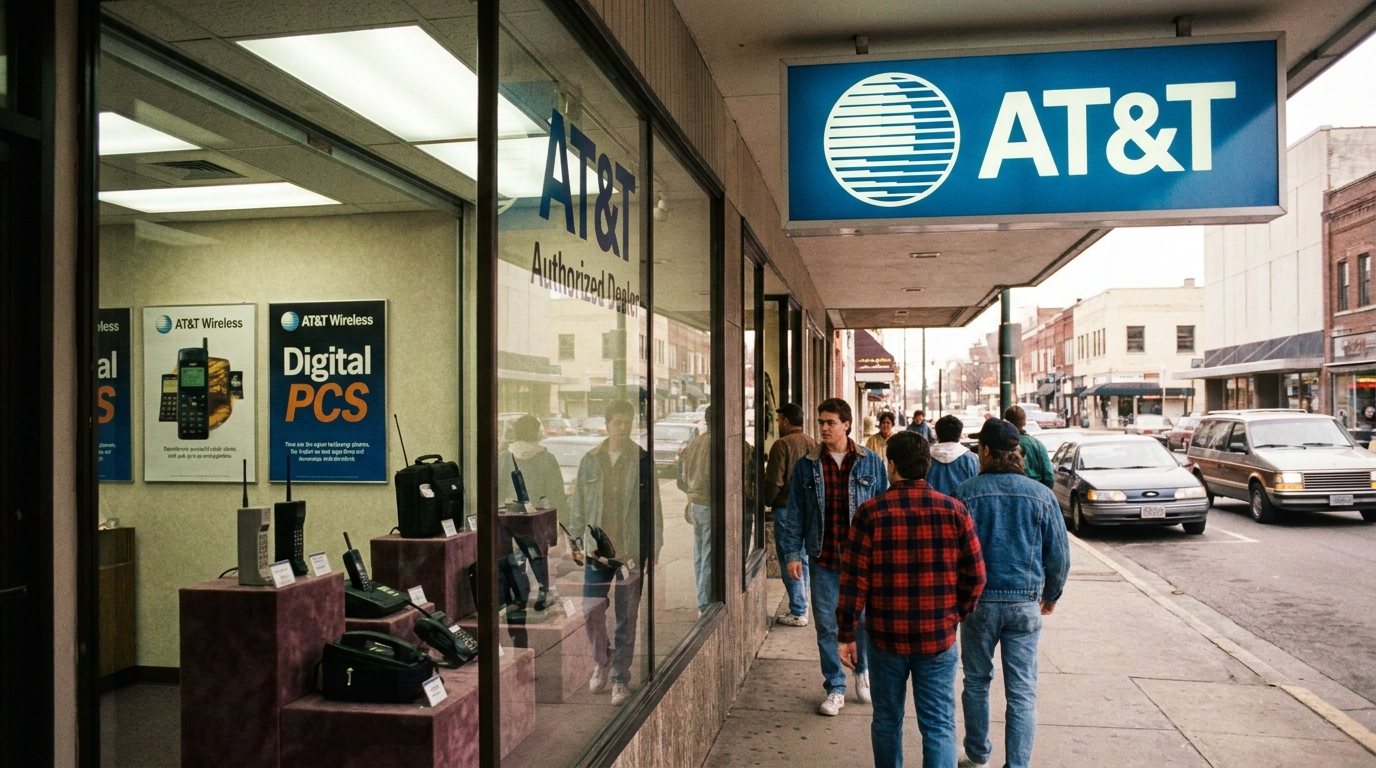
The rebrand finished in June 2007, the same month Apple launched the original iPhone, exclusively through AT&T. Apple had approached carriers with a device it refused to let anyone redesign by committee, an approach that had killed earlier phone-maker partnerships. Cingular's willingness to hand over hardware and software control, described in Wikipedia's account of the first-generation iPhone, came from a $150 million, thirty-month collaboration that a stronger, more entrenched carrier had less incentive to accept on Apple's terms. AT&T's retail footprint, dismissed for decades as a phone-company afterthought, became ground zero for the decade's biggest electronics launch, mostly because AT&T needed the deal more than Verizon did.
| Year | Pivotal bet |
|---|---|
| 1984 | Bell System breakup creates SBC and six other regional carriers |
| 1998-99 | SBC buys Pacific Telesis, SNET, and Ameritech |
| 2004 | Cingular pays $41B for AT&T Wireless |
| 2005 | SBC buys AT&T Corp, renames itself AT&T Inc. |
| 2007 | AT&T stores become exclusive iPhone launch channel |
| 2015-18 | DirecTV and Time Warner acquisitions |
| 2021-25 | WarnerMedia and DirecTV both unwound |
That store network has since been through its own churn. AT&T bought DirecTV for $48.5 billion in 2015 and Time Warner for $108.7 billion in 2018, chasing a content bundle, then reversed course under nearly $200 billion in debt: DirecTV was spun off starting in 2021 and fully sold in July 2025, and WarnerMedia merged into Warner Bros. Discovery in April 2022, per Wikipedia. What's left is a retailer whose roughly 2,300 company-owned stores, alongside authorized retailers and partners like Prime Communications, exist to sell connectivity, devices, and increasingly fiber broadband following the February 2026 purchase of Lumen's mass-market fiber business.
The unlikely retailer
AT&T's presence on a list of top American retailers is an accident of regulation and brand ownership more than a retail strategy anyone designed on purpose. A company built to have no competitors ended up running thousands of storefronts because a breakup forced a fight for customers, and because one desperate carrier said yes to Steve Jobs when a confident one might have said no.
Every catalog, contract, and store shelf in this series eventually traces back to some decision made under pressure, not in a boardroom slide deck. AT&T's is a reminder that the infrastructure behind American retail is rarely as tidy as the sales figures suggest.