
Applied Adhesives: Built By Four Straight PE Owners
Applied Adhesives made the 2026 MDM Top Distributors list in Specialty Adhesives after 20 years and four consecutive private equity owners. Here's the playbook.
Part of Distributor Playbooks — strategy teardowns of every company on the MDM Top Distributors lists.
Applied Adhesives shows up in Specialty Adhesives on Modern Distribution Management's 2026 Top Distributors list, the trade press's annual accounting of North America's largest wholesale distributors. The more revealing number about this company isn't on that list, though. It's four: the count of private equity firms that have owned Applied Adhesives, in sequence, since 2012, each one buying the platform, bolting on acquisitions, and handing it to the next sponsor.
That's the story here. Applied Adhesives, now branded APPLIED Adhesives, is a 50-plus-year-old distributor that spent the last decade behaving less like a family business finding its footing and more like a piece of industrial real estate that keeps changing hands at a higher price.
A glue supplier becomes a platform
Skip Jewett and Bob Houston founded Applied Products, Inc. in 1971 as a straightforward adhesives supplier, per the company's own mission and history page. For more than three decades it stayed roughly that: a regional adhesives distributor, not a national name.
The transformation started in 2005, when Dan Horner and Brian Webb acquired the company. It accelerated hard in 2012, when Ellipse Capital Partners took majority ownership and merged Applied Products with Ward Adhesives to create the APPLIED Adhesives entity that exists today. That merger is the real founding moment of the current company: two regional adhesive distributors combined under one PE sponsor to build something with enough scale to be interesting to the next buyer.
The ownership relay
What happened after 2012 is the part most distributor profiles skip past, because it isn't flattering to the idea of the founder-led success story. It's a sequence of financial sponsors, each holding the company for roughly four to five years, each using that window to add scale through acquisition before selling to the next owner.
| Year | Owner | What changed |
|---|---|---|
| 1971 | Skip Jewett & Bob Houston | Applied Products, Inc. founded |
| 2005 | Dan Horner & Brian Webb | Ownership transitions from founders |
| 2012 | Ellipse Capital Partners | Merger with Ward Adhesives creates APPLIED Adhesives |
| 2017 | Goldner Hawn | Adds Adhesive Brokers Inc., United Adhesive Products |
| 2021 | Arsenal Capital Partners | John Feriancek named President and CEO |
| 2025 | Bertram Capital | Positioned as a standalone "industrial distribution platform" |
When Bertram Capital announced its investment in April 2025, it was explicit that this was the firm's fourth industrial distribution platform bet and that APPLIED's "proven M&A playbook" was the asset it was buying, not just the adhesive relationships. Bertram partner Kevin Yamashita called out the company's "strong customer relationships, technical capabilities, and proven M&A playbook" as the foundation for continued growth. CEO John Feriancek, who has run the operating company since the 2021 Arsenal deal, stayed on through the sponsor change, which is itself notable. Most PE-to-PE handoffs churn management. This one kept the same operator across two ownership cycles, suggesting the acquisition engine is genuinely institutionalized rather than dependent on whichever sponsor happens to hold the equity that year.
An acquisition every two to three months
The cadence is the tell. Since 2018 APPLIED has acquired more than 20 companies, according to its own history page, and the pace has only sharpened under Bertram. A partial run from the company's press archive: L&D Adhesives and PRIME Industries in early 2022, Alliance Adhesives and Axco Adhesive Systems that summer, Engineered Adhesive Systems and In-Line Finishing Solutions that fall, Rochester Industrial Supply's adhesive division in October 2022, Heigl Adhesives and McGinley Adhesives through 2023, AutomationSupply365 in October 2024, Adhesive Solutions in April 2025, BTmix and HG Adhesive Dispensing together that July, then Interlock Adhesives in the UK in January 2026, LJD Packaging in March, and Industrial Sales and Distribution (ISD) in July 2026, expanding both silicone capability and East Coast density. That's a targeted regional or capability-specific acquisition roughly every two to three months for four straight years, a pace few distributors in any vertical sustain.
The other half of the flywheel: manufacturers, not just targets
What makes the roll-up durable rather than just fast is the second track running alongside it. As APPLIED absorbed smaller adhesive distributors, it was simultaneously winning exclusivity from the manufacturers those distributors used to represent piecemeal. It became Graco's exclusive North American distributor for the InvisiPac HM10 in 2023, joined 3M's Preferred Adhesive Distributor program in April 2026, and was named Henkel's exclusive U.S. distributor for packaging adhesives in July 2026, days before the ISD acquisition closed.
That sequencing is the unique insight worth naming plainly: scale from acquisition is what earns the manufacturer exclusivity, and manufacturer exclusivity is what makes the next acquisition target want to sell to APPLIED rather than a rival. A small regional adhesive distributor gets more value selling into a network that already holds the 3M and Henkel lines than staying independent and hoping to win that shelf space alone. The M&A and the manufacturer partnerships reinforce each other; neither works as well without the other.
The house-of-brands trade-off
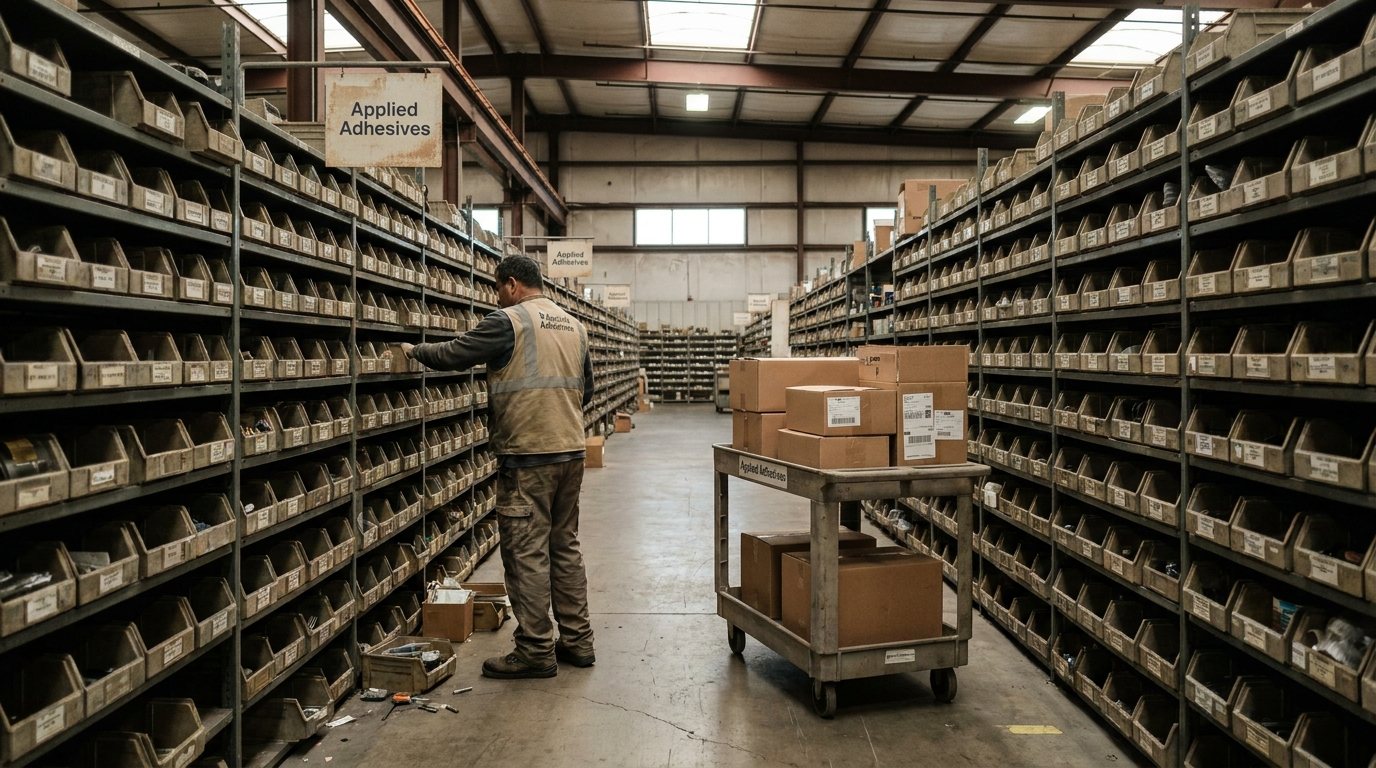
The operating model behind all this is a portfolio of named brands rather than one absorbed identity: adhesive lines like ASURE, Adhezion, ICE-TITE, infinitybond and BREAKAWAY sit alongside equipment brands including AutomationSupply365, BTmix, HG Adhesive Dispensing and KEYSTONE, per the company's brand portfolio page. Centralized underneath are 25 warehouses, five Technical Service and Innovation Centers, and roughly 300 employees across the U.S., Canada and Mexico, now extending into the UK.
That structure is a real trade-off, not a free lunch. Keeping acquired names alive preserves the customer relationships and technical reputations that made each target worth buying. It also means APPLIED is managing brand sprawl and integration risk across a dozen-plus labels simultaneously, a harder job than running one national brand, and one that four different ownership groups have now had to hand off cleanly to the next.
Distribution businesses like this one live or die on the parts of the operation nobody photographs: the warehouse network, the technical documentation behind a thousand adhesive formulations, and the catalog data that lets a buyer find the right cartridge at 2 a.m. before a packaging line goes down. This series looks at the distributors who've made that unglamorous infrastructure into a genuine strategic advantage.