
How Krayden Wins by Owning the No-Fail Adhesives Niche
Krayden made the 2026 MDM Top Distributors list in Specialty Adhesives. Its real edge is technical sales for no-fail bonding, not catalog SKUs alone.
Part of Distributor Playbooks — strategy teardowns of every company on the MDM Top Distributors lists.
Krayden showed up on Modern Distribution Management's 2026 Top Distributors list in Specialty Adhesives, one line among the largest distribution companies in North America. The Denver-based firm doesn't disclose revenue, and it has changed private-equity owners twice in less than a decade. What survived both transitions is the harder thing to build: a technical sales force that engineers trust to spec adhesives, sealants, and coatings into products that are not allowed to fail.
A distributor that sells expertise, not inventory turns
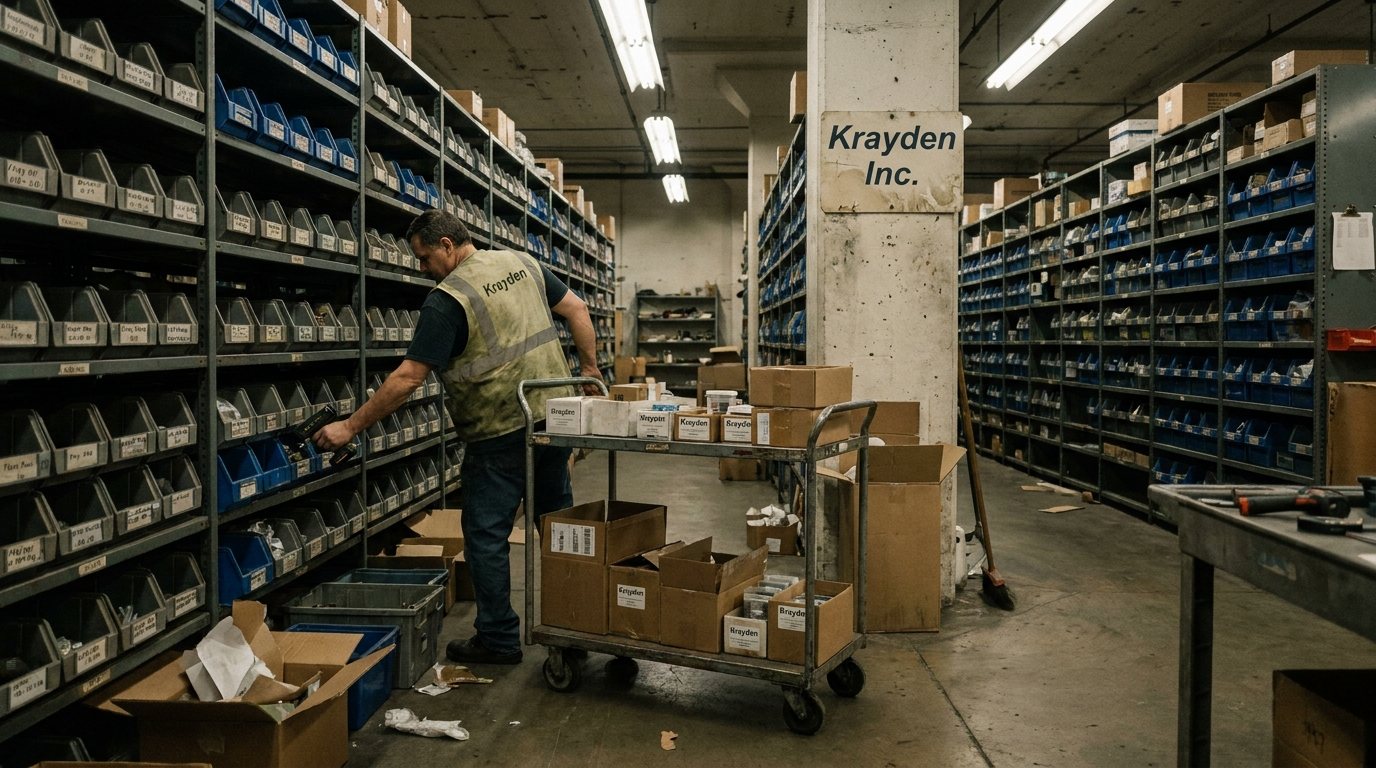
Most industrial distribution is a logistics game: stock the SKU, ship it faster and cheaper than the next guy. Krayden built something adjacent to that but distinct from it. Founded in 1989, the company distributes specialty adhesives, sealants, coatings, lubricants, soldering products, epoxy preforms, and composite-process materials into aerospace, defense, electronics, transportation, and general industrial markets, according to Audax Private Equity's portfolio description. Audax's own language for the customer base is blunt: "specialized, no-fail applications."
That phrase is the whole business model. A structural adhesive bonding a wing skin, or an encapsulant potting an avionics board, isn't a commodity purchase decided on price per pound. It's a materials-engineering decision, and the supplier relationship that goes with it, formulation guidance, cure-cycle troubleshooting, qualification paperwork, is worth more to the OEM than the tube of adhesive itself. Krayden's pitch has never been "we have it in stock," it's "we know what to put where, and we can prove it holds." That's a harder moat to copy than a warehouse network, because it lives in the sales engineers' heads and the supplier relationships those engineers have spent years building.
Two private-equity owners, one culture
The more interesting story is what happened to that model under ownership change. Quad-C Management acquired Krayden in 2017 and sold it to Audax Private Equity in April 2023, a six-year hold documented in Quad-C's own sale announcement. Krayden CEO Wayne Wagner ran the company through the entire hold: "Since 2017, the partnership we established with Quad-C was built on a shared vision and common goal to achieve the next phase of growth," he said in the release. Quad-C partner Thad Jones credited the same six-year run with Wagner and "the entire Krayden team."
That continuity matters more than it looks. Specialty distributors bought and sold by financial sponsors often get stripped for parts, folded into a bigger platform, or hollowed out as the acquiring firm cross-sells its way into the customer list. Krayden instead got passed from one PE sponsor to the next with its CEO, its culture, and its go-to-market model intact, and with the release explicitly noting the company had "executed strategic acquisitions while preserving its entrepreneurial culture" along the way. The unglamorous truth about a lot of PE-owned industrial distribution is that ownership churns while operations don't, and the operators who survive the transition are the ones whose value is genuinely portable: the technical relationships and supplier franchises travel with the team, not with any single balance sheet.
The Aerospheres bet: MRO as a second act
During the Quad-C years, Krayden also picked up Aerospheres, a subsidiary supplying high-performance materials and consumables for aviation maintenance, repair, and overhaul. It's a logical adjacency rather than a diversification stunt: the same structural adhesives, sealants, and coatings Krayden sells into new aerospace builds are the materials MRO shops need to keep aircraft flying decades later. Building a distinct MRO-facing unit instead of just selling the same catalog through the same sales channel suggests Krayden treats aftermarket aviation as its own vertical, with its own certifications, customers, and buying cycle, not an afterthought bolted onto original-equipment sales.
Reach without a retail footprint
Krayden's national and international presence follows the same value-add-over-volume logic. The company operates through leased facilities across the United States, Canada, Mexico, and Southeast Asia, supplemented by third-party logistics and warehouse arrangements, per the Quad-C release, rather than the owned branch networks that define big MRO or fastener distributors. For a business whose real product is engineering judgment, capital-light logistics makes sense: the moat isn't square footage, it's the phone call to the right sales engineer when a customer's bonding process fails a qualification test.
The tension worth naming
The trade-off is transparency. A company that doesn't disclose revenue, has changed hands twice, and competes on relationship depth rather than published pricing is hard for a customer, or a competitor, to benchmark. Krayden's MDM placement in Specialty Adhesives is one of the few external signals of scale the market gets. That opacity is a feature for a firm selling trust-based technical relationships rather than a commodity, but it also means Krayden's growth has to be taken largely on faith, or measured by who keeps choosing to own it.
Distribution rarely gets the credit it deserves for the boring infrastructure, catalogs, branches, logistics, and product data, that makes complex materials findable, specifiable, and deliverable to the people building things that can't fail. This series looks at the companies that built that infrastructure well enough to make the ranking.