
How Associated Industries Wins by Staying in One Wichita Warehouse
Associated Industries made MDM's 2026 Specialty Adhesives list from a single Wichita site, then quietly became a manufacturer of its own adhesive brand.
Part of Distributor Playbooks — strategy teardowns of every company on the MDM Top Distributors lists.
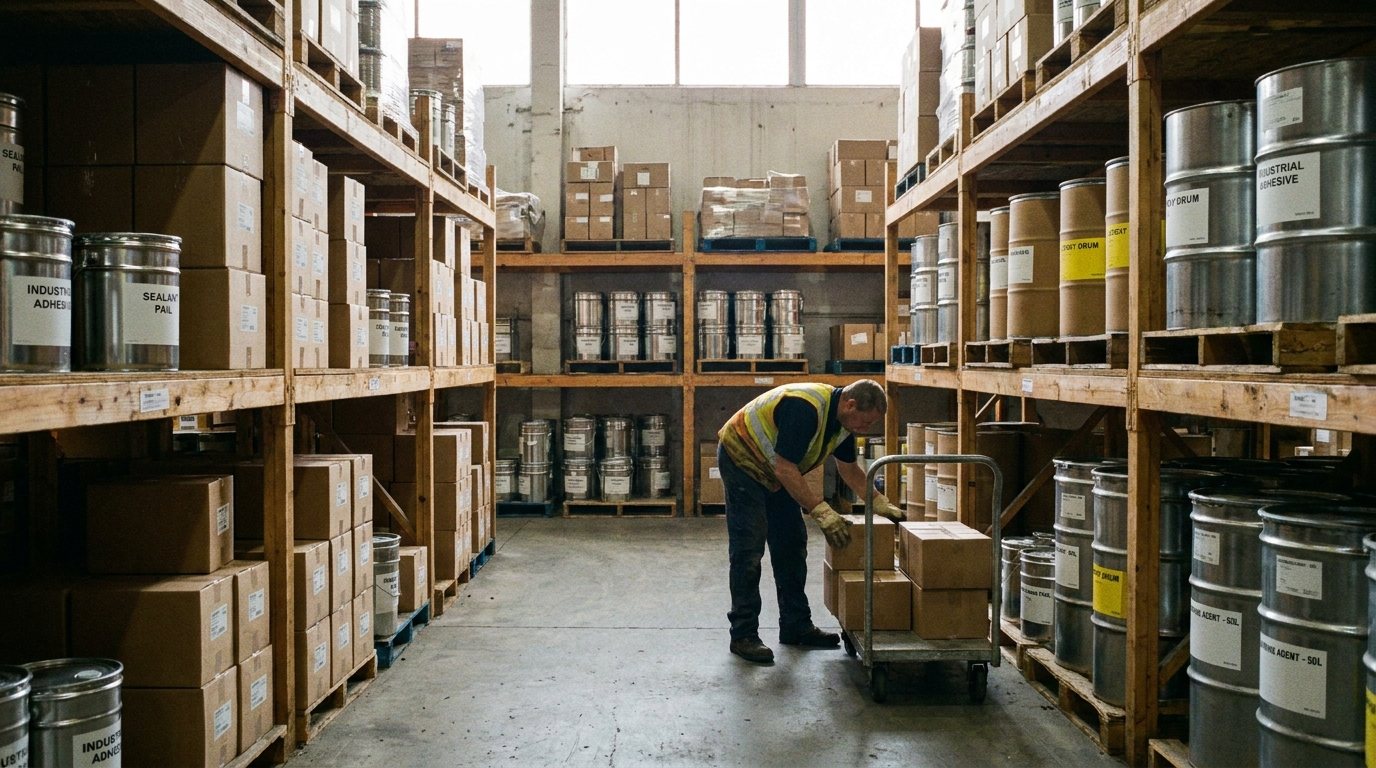
Associated Industries shows up on Modern Distribution Management's 2026 Top Distributors list in the Specialty Adhesives category, one of the smaller, more technical verticals MDM tracks. It is also one of the list's odder entries: a family-owned company that has run its entire adhesives and composites business out of a single 10,000-square-foot building in Wichita, Kansas, since long before anyone was calling supply chains "resilient." No branch network. No regional DCs. Just one warehouse, seventy-plus years, and a customer list that stretches across North America.
From manufacturers' rep to stocking distributor
Associated Industries started in 1952 as a manufacturers' representative group, the kind of firm that sold on commission for chemical and materials makers without ever touching inventory. Somewhere along the way it flipped the model, taking on stock, warehousing product at 225 N Wabash Avenue, and becoming the thing it used to sell for. The company has operated under its current ownership since 1972, and it still describes itself as family-owned today. In a distribution landscape where private equity has rolled up most specialty categories over the past decade, a fifty-plus-year ownership tenure in one family is itself worth noting.
The Wichita location is not incidental. The city has been known as the "Air Capital of the World" since the 1920s, home to Cessna, Beechcraft, Learjet, and today Textron Aviation and Spirit AeroSystems. A composites and adhesives distributor founded there in 1952 was founded, more or less, inside a standing customer base. Associated Industries didn't have to go find the aerospace industry. It grew up next to it.
Depth over footprint
What Associated Industries sells is narrow and technical rather than broad. Its site lists 19 product categories: adhesives, sealants, epoxy resins, fiberglass and carbon fiber, core materials like balsa and foam, vacuum bagging supplies, mold release systems, gel coats, urethane elastomers, and the tools that go with all of it. That is a materials-science catalog, not a generalist MRO line card. The company carries AS9120B and ISO 9001:2015 certification, the aerospace-distribution credential that signals it can be trusted with parts and materials that end up on certified aircraft, and it works with suppliers including Henkel, Hexcel, Solvay, PPG, and Airex/Baltek.
The customers match the catalog: aerospace and defense, MRO, marine, transportation, consumer recreation, and woodworking, all industries where a fabricator needs a sealant or adhesive with an exact cure time, exact temperature range, and a data sheet to match. That is the kind of order a big-box industrial supplier does not want to fill and a two-person composites shop cannot source direct from Henkel in case-lot quantities. Associated Industries sits in exactly that gap, serving more than 500 customers from one location, and has for decades chosen category depth over the branch-count arms race that defines most of MRO distribution.
The distributor that became a brand
The detail that doesn't show up in a standard About page: Associated Industries doesn't only resell adhesives, it makes and brands its own. SeamKing and SeamLock Pro are the company's proprietary lines of seaming adhesive built for solid-surface fabricators, the trade that turns sheet material into countertops and joins seams invisibly. The products come in a pouch-and-pump delivery system the company markets as an exclusive, formulated in multiple grades and color-match formats, manufactured in the U.S., and stocked for same-day fulfillment out of the same Wichita building.
That is a real strategic choice, not a marketing flourish. Most distributors resist competing with their own principals; the entire model of manufacturer-distributor relationships depends on the distributor staying on the reselling side of the line. Associated Industries crossed it, at least in one narrow niche, turning decades of formulation and application knowledge from selling other companies' adhesive chemistry into owning a chemistry of its own. It's a bet that a company small enough to fit in one warehouse can still afford to be a manufacturer in the categories where it understands the end use better than anyone selling to it does. The trade-off is real too: a private-label line invites exactly the channel-conflict questions that keep most distributors from trying it, and it works here only because SeamKing occupies a specific enough niche that it isn't going head-to-head with Henkel or PPG on their core aerospace sealant lines.
What holds the model together
Nothing here scales the way a national distributor's branch network scales. Associated Industries isn't going to open forty locations, and it likely doesn't want to. Its advantage is the opposite of geographic reach: seventy years of the same family, the same city, and the same narrow set of chemistries, deep enough that a single warehouse can serve customers nationwide and specific enough that the company could eventually put its own name on the shelf instead of someone else's.
The Specialty Adhesives category on MDM's list is full of companies solving this same problem at different scales, and the smallest ones often show the pattern most clearly: in distribution, the ceiling on size is usually set by the ceiling on how well you know your product, not by how many branches you can open.
This is one entry in a series on the operating models behind MDM's 2026 Top Distributors list, the businesses that turn catalogs, warehouses, and decades of product knowledge into the infrastructure the rest of the economy runs on.