
Bath & Body Works: The Store That Renamed Its Own Parent
NRF ranks Bath & Body Works #65 with $6.69B in 2025 U.S. sales. Its 1990 origin as a beauty add-on line hides a stranger twist: it renamed its own parent.
Part of Retailer Playbooks — history-first profiles of every company on the NRF Top 100 Retailers list.
Bath & Body Works lands at #65 on NRF's Top 100 Retailers 2026 list, with $6.69 billion in 2025 U.S. retail sales, compiled with Kantar. The number is respectable for a mall-based specialty chain in an era when mall traffic is supposedly dead. What the ranking does not show is the strangest fact in the company's history: this store, born as a minor add-on line for a sister brand, eventually became large enough to take over its own parent company's name.
A Beauty Line for Someone Else's Overflow
Bath & Body Works did not start as its own idea. It was created in 1990 in New Albany, Ohio, inside Leslie Wexner's retail conglomerate, originally conceived as a beauty line for Express, one of the many chains under what was then called The Limited. Wexner had built that empire from almost nothing: he opened his first store in a Columbus-area shopping center in 1963 after borrowing startup capital from his aunt, and by the 1980s he had assembled a portfolio that included Victoria's Secret, Lane Bryant, Lerner, and Abercrombie & Fitch. Bath & Body Works was meant to be a smaller piece of that machine, not a flagship.
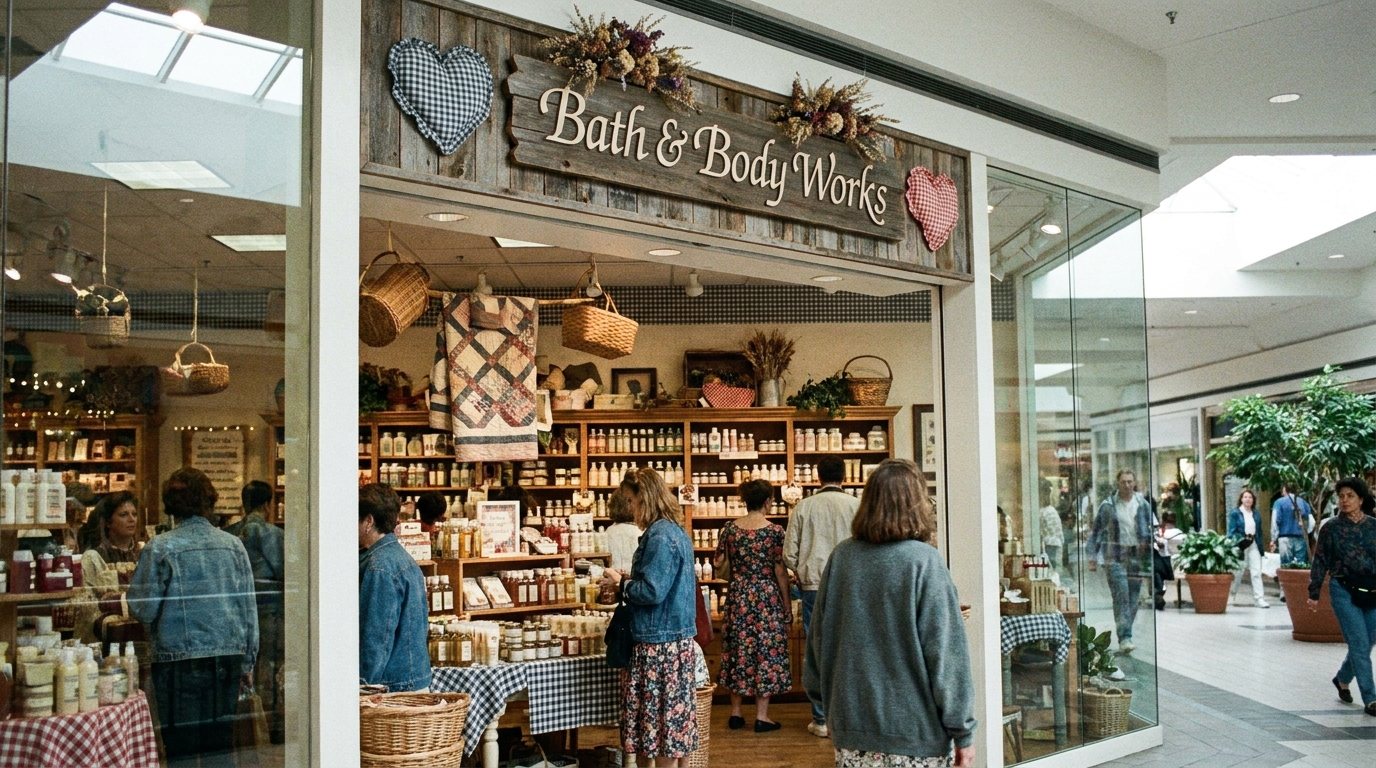
The first store opened in Cambridge, Massachusetts, in September 1990, selling soaps, lotions, and fragrances built around an accessible, ingredient-forward pitch rather than department-store glamour. It almost didn't keep its name. The Body Shop, the British bath-and-beauty chain that had built its own identity around natural ingredients since the late 1970s, sued over the similarity, and Bath & Body Works had to rework its branding within its first year on the market. A company now synonymous with its name spent its infancy defending the right to use it.
Becoming the Category, Not Just a Player In It
The chain absorbed that early scare and grew fast. By 1997, it had become the largest bath shop chain in the United States, according to Wikipedia's summary of the brand's growth. That same stretch of years brought the moves that defined its retail format: a home-fragrance offshoot, and in the late 1990s the introduction of White Barn Candle Co., which eventually folded into the core Bath & Body Works assortment and turned candles into a pillar category rather than a side item. The stores themselves became known for an open, hands-on layout where shoppers could smell and sample everything on the shelf, a format built around scent discovery rather than a locked case or a sales-associate gatekeeper.
International growth followed a similar logic of attaching to existing infrastructure. In 2008, the company expanded into Canada by acquiring La Senza, and in 2010 it opened its first stores outside North America in Kuwait, through the Middle East franchise operator M.H. Alshaya Co., a pattern of franchise-led expansion that let the brand reach new geographies without owning the real estate risk directly.
The Decade the Parent Company Reorganized Around It
The bigger story of this era is corporate, not retail. In 2007, Wexner's company sold a majority stake in The Limited chain itself to Sun Capital Partners and renamed the parent conglomerate L Brands, a signal that the founding chain was no longer the center of gravity. Bath & Body Works and Victoria's Secret had become the two businesses actually carrying the company.
Wexner stepped down from operational leadership in February 2020, ending one of the longest CEO tenures in the Fortune 500, and Andrew Meslow took over. Then came the split that most casual observers still get backward. On August 3, 2021, L Brands separated Victoria's Secret and Bath & Body Works into two independent public companies. The common assumption is that Bath & Body Works was "spun off." It was the opposite. Victoria's Secret & Co. became the new, separately listed entity, while the existing corporate parent, L Brands, simply renamed itself Bath & Body Works, Inc. and kept its listing. The store that had started life as a beauty line squeezed in under Express's roof ended up as the surviving corporate shell, with the company most people thought of as the conglomerate's crown jewel walking out the door as the new entity instead.
That is the detail worth sitting with, because it is easy to miss on the company's own About page, which understandably tells a cleaner story about candles and lotions rather than corporate structure. The retailer people think of as a mall kiosk that grew into a real chain is, legally and financially, the direct continuation of the holding company Leslie Wexner spent nearly six decades building. Victoria's Secret is the newcomer on paper.
Where the Business Sits Today
Under that structure, Bath & Body Works has kept its focus narrow: personal care, fragrance, and home scent, sold through more than 1,700 stores spanning six continents, per the same growth summary, plus a direct e-commerce business and franchise partnerships abroad. Daniel Heaf became CEO in May 2025, the latest in a leadership line that has had to run a beauty-and-home business at real scale without the halo (or the baggage) of Victoria's Secret sitting next to it on the balance sheet. The semi-annual sale events and constant new-scent drops that keep customers cycling through stores are the same operating rhythm the chain has run for decades, just now reporting to its own board instead of a parent conglomerate's.
Retail history is full of spinoffs. Fewer stories involve the smaller sibling ending up with the family name.