
Ulta Beauty: How a Chicago Drugstore Bet Built a Beauty Giant
Ulta Beauty ranks #41 on NRF's Top 100 Retailers 2026 list. Here's how a 1990 Chicago strip-mall concept became the largest U.S. beauty retailer.
Part of Retailer Playbooks — history-first profiles of every company on the NRF Top 100 Retailers list.
Ulta Beauty ranks #41 on the NRF Top 100 Retailers 2026 list, with $12.39 billion in 2025 U.S. retail sales, the National Retail Federation's annual ranking compiled with Kantar. That number represents the payoff of a bet a former drugstore executive made in 1989, when he decided the biggest problem in beauty wasn't the products. It was the floor plan.
A drugstore man's answer to a retail gap
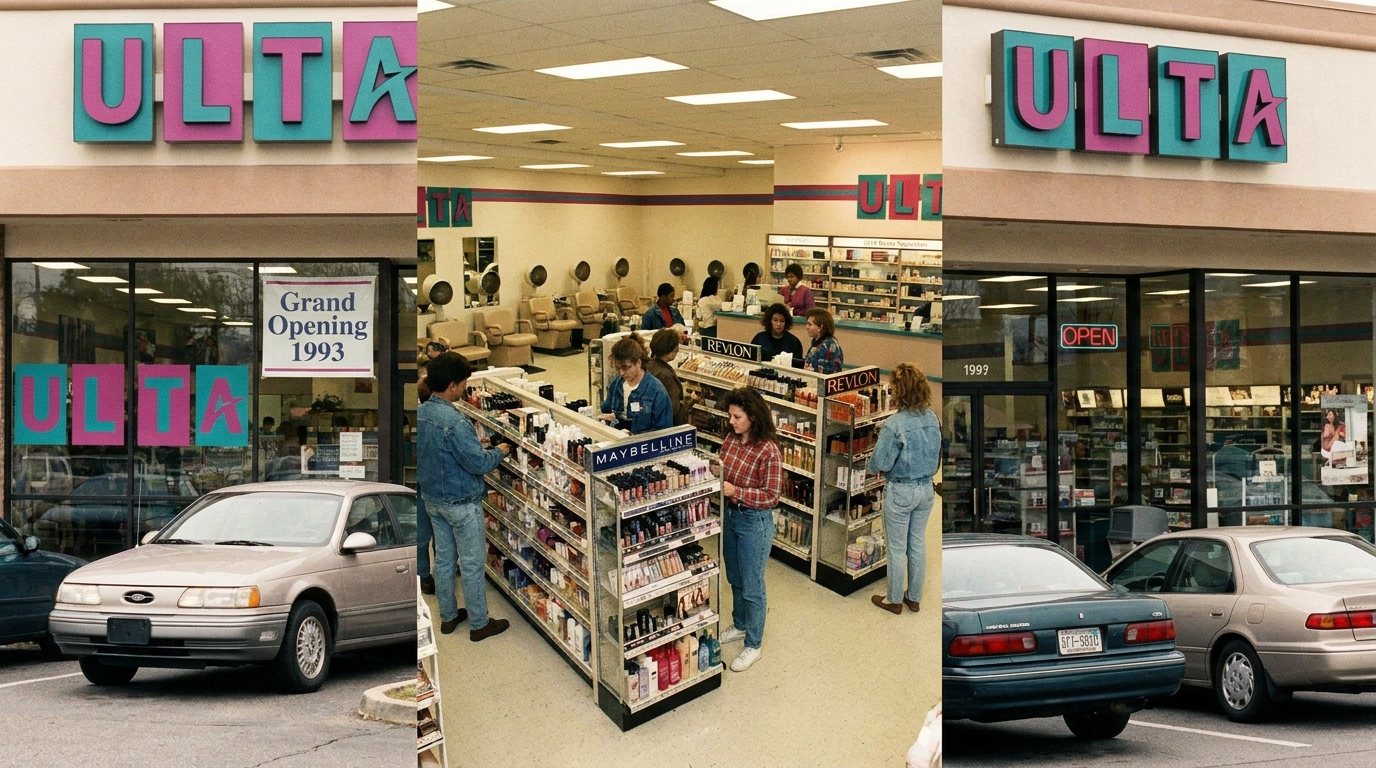
Richard E. George had spent years running Osco Drug, one of the Midwest's biggest drugstore chains, before he left in 1989 to chase an idea. Beauty shopping, as he saw it, was scattered across three disconnected worlds: mass-market drugstore shelves, department-store prestige counters staffed by brand reps, and standalone hair salons. No retailer combined them. George raised $11.5 million in venture capital, pulled in fellow Osco executives, and in early October 1990 opened five stores in the Chicago suburbs under the name Ulta3, shorthand for "a third option" beyond drugstore and department store beauty, according to Wikipedia's account of the company's founding. The first location sat in a shopping center called High Point Centre in Lombard, Illinois.
The early format was already the whole idea in miniature: mass brands, prestige brands, and a working salon, all under one roof, all self-service except the chairs. George left the company in 1995, and cofounder Terry Hanson took over as CEO. The business spent the rest of the decade proving out the model store by store across the Midwest, unglamorous work with no national press attached to it. At the end of 1999, the company dropped the "3" and became simply Ulta.
The long, quiet build to Wall Street
Ulta didn't go public until October 25, 2007, on Nasdaq under the ticker ULTA, nearly two decades after George's original plan. That gap matters. While Sephora arrived in the U.S. in 1998 backed by LVMH and department-store beauty counters had a century of brand relationships behind them, Ulta grew from a standing start in strip malls and off-mall real estate, the kind of unglamorous locations department-store chains never touched. It was cheaper to lease, easier to scale, and it let Ulta build a footprint that eventually outran both rivals in raw store count.
By 2013, the company had a real national footprint but a strategic ceiling: it still leaned heavily on mass and mid-tier brands and had struggled to win over the true luxury names that anchored Sephora's draw. That's the year Mary Dillon, formerly of McDonald's and U.S. Cellular, took over as CEO, according to her Wikipedia biography. Dillon's tenure, which ran through 2021, is the pivot point in Ulta's history: the company added long-resistant prestige brands, expanded its Ultamate Rewards loyalty program (launched in 2014), and pushed hard into e-commerce and social-driven discovery. The additions worked because they didn't replace the mass assortment, they sat next to it, preserving the original three-tier promise George had sketched out in 1989.
The part that isn't in the press releases
Here's the detail that gets skipped in most tellings of Ulta's rise: the salon was never a side amenity. It was the retention engine. A haircut or brow appointment is a scheduled, recurring reason to return to a specific physical store, something no amount of product marketing reliably generates on its own. Pair that recurring-visit habit with a loyalty program that, per public reporting, now captures the overwhelming majority of Ulta's transactions, and the company looks less like a classic specialty retailer and more like a subscription business wearing a retail store's clothes. Competitors have spent years trying to copy the assortment. Almost none have copied the chair.
That structural advantage is also why Ulta could absorb an unusual number of format experiments without losing its core identity. The company ran hundreds of shop-in-shops inside Target starting in August 2021, a partnership that grew to roughly 600 locations before winding down in 2025, short of the 800-store goal both companies had set. It opened its first store outside the U.S. in Kuwait in 2025, entered Canada, and in July 2025 acquired UK beauty retailer Space NK, giving it a physical foothold in Europe for the first time, per Wikipedia's entry on Space NK. None of those bets required rebuilding the store model. They extended it.
A leadership handoff, not a reinvention
Dave Kimbell, who succeeded Dillon as CEO in 2021, retired in January 2025, and longtime COO Kecia Steelman was promoted into the top job, a continuity choice rather than a turnaround hire. That's a telling contrast with 2013: Ulta's board didn't need an outsider to shake up the format this time, because the format built by George, refined by Dillon, and scaled through three tiers of brands under one roof has proven durable across three decades, two recessions, and the entire rise and partial retreat of mall-based retail.
Sources: Ulta Beauty on Wikipedia, Mary Dillon on Wikipedia, Space NK on Wikipedia, Ulta Beauty's company mission and history page, NRF Top 100 Retailers 2026.
Retail infrastructure rarely gets the credit it deserves, and Ulta's story is a reminder that the unglamorous parts, a strip-mall lease, a salon chair, a rewards card swipe, can end up mattering more than the products on the shelf. This profile is part of Anglera's Retailer Playbooks series, looking at the histories and operating models behind America's largest retailers.