
Sephora: How a French Perfume Shop Rewired Beauty Retail
Sephora nearly collapsed expanding too fast in the early 2000s. Here is how a Limoges perfume shop became the store that rewrote how America buys beauty.
Part of Retailer Playbooks — history-first profiles of every company on the NRF Top 100 Retailers list.
Sephora lands at number 52 on the NRF Top 100 Retailers 2026 list, the National Retail Federation's annual ranking of U.S. retail sales compiled with Kantar, with $8.89 billion in 2025 U.S. retail sales. That figure describes a company that spent decades convincing shoppers to walk into a store, pick up a lipstick they had never bought before, and try it on their own hand without a salesperson hovering. That idea was not obvious in 1969. It still isn't standard everywhere in beauty retail.
A perfumer who hated the counter
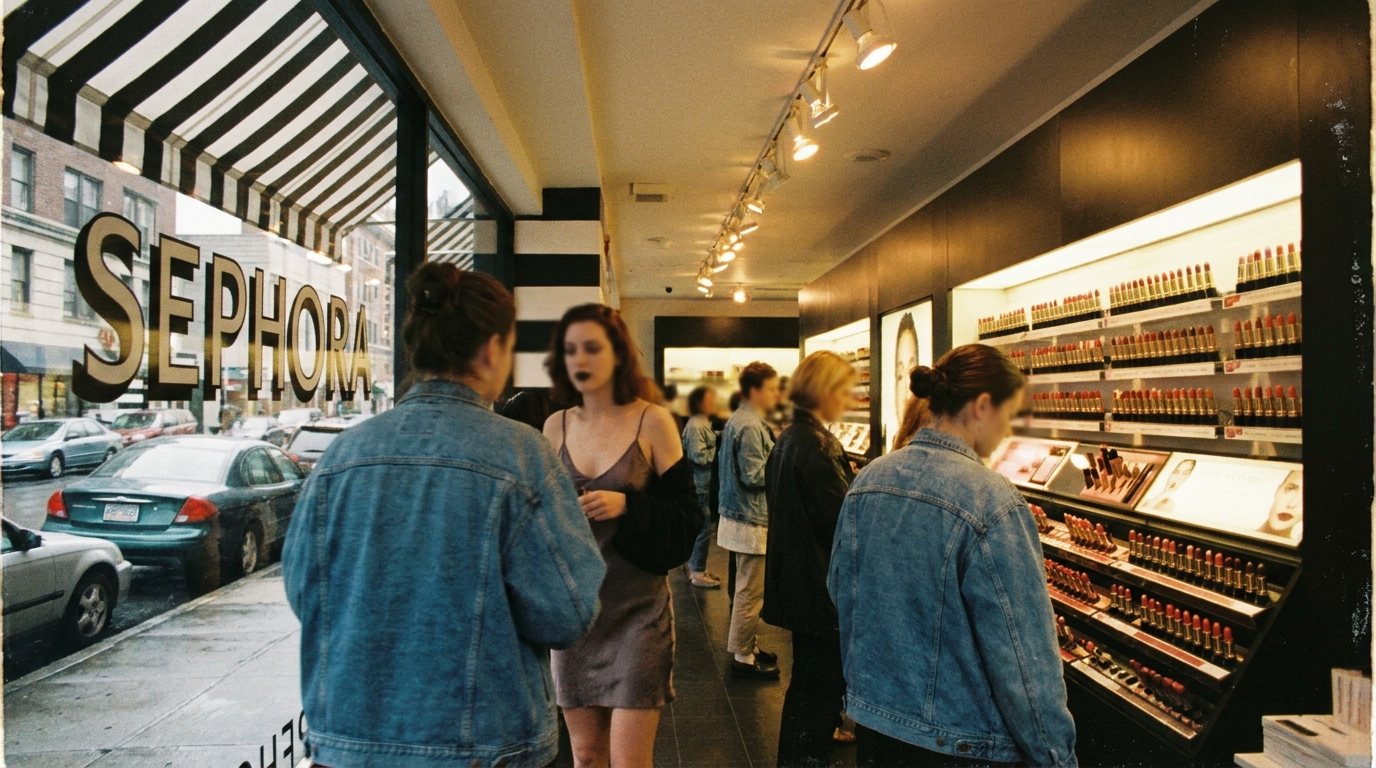
The store that became Sephora traces to Limoges, France, where Dominique Mandonnaud ran a small perfumery. In 1969 he opened what is generally credited as the first self-service perfume shop, letting customers wander the floor and sample fragrances and cosmetics themselves instead of asking a clerk to fetch a bottle from behind glass, according to the French Wikipedia entry on Sephora. That sounds unremarkable now. In an era when perfume and cosmetics were sold the way jewelry still is, locked in cases and mediated by staff, it was a genuine break from how the category worked.
Mandonnaud built a small chain around the concept under the name Shop 8. The Sephora name itself, drawn from Zipporah, the wife of Moses in the Hebrew Bible, first appeared on a store opened in Paris in 1973 by the retail group Nouvelles Galeries, according to the same source. Mandonnaud's decisive move came two decades later. In 1993 he acquired 38 French stores from the British chain Boots and converted them to the open-access Sephora format, unifying his free-browsing concept under one banner for the first time at real scale.
The sale, and the near-death that followed
LVMH bought Sephora from Mandonnaud in July 1997, according to Wikipedia's account of the company, folding a French perfume chain into the same house that owned Louis Vuitton and Moët Hennessy. The logic was straightforward: a luxury conglomerate wanted a retail channel for beauty that was not tethered to any single department store. LVMH pushed the format across borders fast, opening Sephora's first American store in New York City in 1998, then Toronto in 2004 and eventually Australia and the Middle East.
Here is the part that does not show up on Sephora's own about page. The international sprint of the late 1990s and early 2000s nearly broke the company. By 2002, Sephora was generating roughly 800 million euros in revenue but losing about 130 million euros a year, a bleed severe enough that it closed roughly twenty stores across Germany, Japan, and the United Kingdom, per the French Wikipedia history. A retailer that is now shorthand for a category-defining format was, within five years of its marquee acquisition, retreating from three major markets simultaneously. LVMH's balance sheet gave it room to absorb the losses and keep the concept alive long enough to find its footing. A standalone operator facing the same math likely does not survive it. That is the unique wrinkle in Sephora's story: the open-sell revolution people credit for the company's success is not what saved it in the 2000s. Deep-pocketed patience did.
Building the format that stuck
Once Sephora stabilized, the elements that define the brand today came into place one at a time rather than all at once. Beauty Insider, the loyalty program that turns purchase history into free samples and birthday gifts, became a template other beauty retailers would eventually copy. Sephora Collection, the private-label line sold alongside roughly 340 outside brands, gave the store margin that pure marketplace curation would not. Not every experiment landed. Play! by Sephora, a subscription box launched in August 2015 to compete with Birchbox, shut down in April 2020 as the subscription-beauty category cooled, per Wikipedia.
The harder structural bet was open-sell itself, sustained across thousands of stores worldwide. Letting shoppers test a $60 foundation with their fingers instead of a testing strip, and trusting staff to guide rather than gatekeep, meant building supply chains and staffing models around breakage and product churn that a locked-case retailer never has to solve. That plumbing, invisible to a shopper, is arguably harder to replicate than the loyalty app.
The unglamorous next chapter: leasing beauty into department stores
Sephora's most interesting recent move is not a store opening but a landlord relationship. In 2021, Kohl's struck a deal to install Sephora shops inside its stores, replacing Kohl's own in-house beauty department, according to Wikipedia's entry on Kohl's. By 2024 that footprint had passed 1,000 locations, turning a department store chain that had struggled to find its footing in beauty into one of Sephora's largest distribution channels, without Sephora building a single new freestanding store to get there.
That partnership recasts a familiar retail question. Beauty categories have historically lived inside department stores as leased counters staffed by brand representatives, a model Sephora's open-sell format was built to disrupt from outside. The Kohl's deal puts Sephora back inside a department store, but on Sephora's terms: its own footprint, staff, and multi-brand assortment, operating as a store within someone else's box. It is less a return to the old model than a rental of someone else's real estate and foot traffic to extend a model Sephora already proved.
Sephora today runs roughly 2,700 stores across 34 countries, with Guillaume Motte leading globally and Artemis Patrick installed in April 2024 as the first woman to lead Sephora's Americas business, per Wikipedia. The company that once nearly retreated from Germany, Japan, and the UK in the same year now treats geographic expansion as a solved problem. The harder problem, the one every mall-adjacent retailer is still solving, is how to keep a physical store relevant when the product discovery increasingly happens on a phone before anyone walks in.
Every category Sephora sells eventually reduces to the same unglamorous unit: a SKU, a price, an ingredient list, a photo, and the fact that gets it correctly onto a shelf or a screen. Retail history is full of formats that won the moment and companies that had to survive the years afterward to prove it was real.