
Berendsen Fluid Power: A Distributor That Builds What It Sells
Berendsen Fluid Power ranks No. 9 in MDM's 2026 Fluid Power rankings by running a lean two-hub network and manufacturing its own power units.
Part of Distributor Playbooks — strategy teardowns of every company on the MDM Top Distributors lists.
Two distribution hubs, one in Tulsa and one in Toronto, supply every branch Berendsen Fluid Power runs across the United States and Canada. That lean setup is a big part of why the company lands at No. 9 on Modern Distribution Management's 2026 Top Distributors list for fluid power, MDM's annual ranking of North America's largest distributors across 20 product verticals — the 2026 report also puts Berendsen on the Industrial Supplies list for the first time, at No. 49. It's also the clearest window into how Berendsen chooses to compete: not with the densest branch map in hydraulics, but with one of the leanest supply chains behind it.
A hub-and-spoke bet in a branch-heavy business
Fluid power distribution has traditionally rewarded local inventory. Hose, fittings, seals, and cylinders are the kind of parts a customer needs the same day a machine goes down, so the instinct across the industry has been to stock heavily at every branch. Berendsen runs the other way. Per its own company site, it operates more than 45 locations and over 400 employees across the U.S. and Canada, but purchasing and warehousing route through just two centers, Tulsa and Toronto, connected by what the company describes as a communication network linking every branch to those hubs for next-day fulfillment. Fewer stocking points mean lower carrying cost and simpler inventory discipline, at the price of leaning harder on transportation to hit the same delivery promise a heavier branch network would make on its own.
The distributor that also manufactures the product
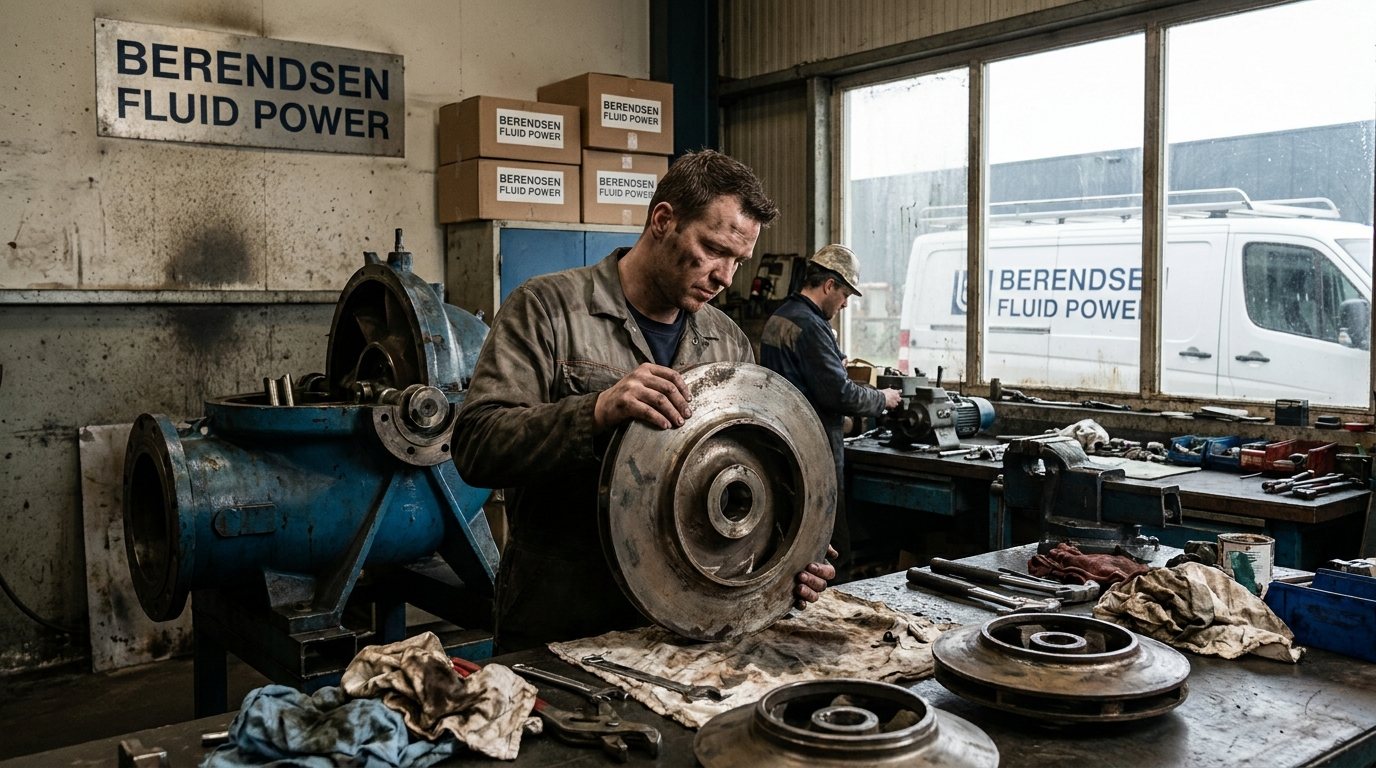
Most fluid power distributors buy finished components and resell them. Berendsen's Systems and Services group designs and builds hydraulic power units in-house, a standard line from 5 to 75 horsepower plus custom units up to 300 horsepower, each tested before it ships. That is a meaningful departure from pure distribution: it puts Berendsen in competition, on some jobs, with the very manufacturers whose components fill its own catalog. The same group runs field service and installation crews for on-site commissioning and equipment modification, which turns a parts relationship into an engineering one before a customer ever calls about a breakdown.
Repairing the brands it sells against
Berendsen's supplier list reads like a map of the hydraulics industry: Danfoss lines under both the Aeroquip and Vickers names, Eaton's Internormen and Eaton Electrical brands, Parker/Olaer, Sun Hydraulics, Baldor Electric, Barksdale, and dozens more spanning hydraulics, pneumatics, lubrication, and motion control. Carrying that many competing brands under one roof is standard for a broad-line distributor. What is less standard is that Berendsen also runs more than 20 repair facilities as factory-authorized service centers, performing warranty repairs on behalf of the same manufacturers whose products sit on its shelves.
That is the piece of the model worth naming plainly. Berendsen is not just choosing between brands for its customers; it is the outsourced service desk several of those brands rely on to keep warranty claims off their own payroll. Staying trusted enough by Danfoss, Eaton, and Parker to keep that authorization, while simultaneously distributing rival lines against them, is a balancing act most single-brand dealers never have to manage. It works because a distributor with technicians already in the field, already stocking OEM parts, is cheaper for a manufacturer to certify than to staff directly.
Remanufacturing as the hedge
Layered under both businesses is a remanufactured components program built on core exchange: a customer's worn cylinder, pump, or motor comes back rebuilt to original specification rather than replaced outright. It is a smaller line of the business, but it does real work for the model. It gives Berendsen a lower-cost option to offer price-sensitive accounts without discounting new parts, and it keeps repair volume flowing through the same 20-plus service centers that anchor the warranty relationships described above.
What staying quiet buys you
Berendsen does not disclose revenue, and MDM's 2026 report lists it that way too. There is no parent company listed, no recent acquisition trail, and little trade press about it at all, which is unusual for a company this size in a sector where private equity has spent the last decade rolling up branch networks. Per Mergr's company profile, Berendsen has operated as a privately held, Tulsa-headquartered company since the early 1990s, with no buyout on record. In a vertical where scale increasingly arrives through a platform deal, staying independent and undisclosed is itself a strategic choice, one that trades the growth multiple a sale would unlock for control over how the company is run.
None of this shows up on an About page. It shows up in a supplier list fifty names long, a logistics diagram with exactly two nodes, and a repair network built to serve manufacturers as much as customers. That is the version of "winning" fluid power distribution has rewarded here: not the loudest expansion story, but the fewest moving parts required to keep forty-five branches running like one supply chain.
Every distributor in this series earns its placement on MDM's list a different way. Berendsen's case is a reminder that the real product is rarely the part on the shelf. It is the catalog data, the routing logic, and the repair record behind it that decide whether the part shows up on time.