
How Hydraquip Turned Employee Ownership Into a Buying Machine
Hydraquip ranks #10 in fluid power on the 2026 MDM Top Distributors list. Its real edge is an ESOP structure built to keep acquiring, not get acquired.
Part of Distributor Playbooks — strategy teardowns of every company on the MDM Top Distributors lists.
Three engineers showed up in Houston in 1951 with a trunk full of hydraulic valves and no customers. Seventy-four years later, that company, Hydraquip, lands at #10 in fluid power on MDM's 2026 Top Distributors list, the annual accounting of North America's largest distributors across 20 product categories. The interesting part isn't the rank. It's who owns the company that earned it.
A family business that gave itself away
Hydraquip stayed a conventional family-owned operation for its first 34 years. In 1985, ownership shifted to an Employee Stock Ownership Plan, according to the company's own history page. That single decision is the hinge the rest of the story turns on. Every employee since has accumulated stock without buying it, and the company has stayed out of the hands of a family estate, a strategic acquirer, or a private equity sponsor for four decades running.
That matters more in 2025 than it did in 1985. Fluid power distribution has become a magnet for consolidation: strategics and PE-backed platforms have spent the last decade rolling up regional hydraulics and pneumatics houses at a steady clip. Most independent shops in this vertical eventually take a check. Hydraquip took the opposite path. Its ownership structure isn't a defensive moat against being bought so much as a financing engine for buying others.
The roll-up, run by the employees who do the work
Look at Hydraquip's own acquisition record and a pattern emerges: it has been the buyer in nearly every deal on its timeline, not the target.
| Year | Move |
|---|---|
| 1951 | Founded in Houston, Texas |
| 1985 | Converts to employee ownership (ESOP) |
| 2002 | Acquires Air & Hydraulic Components (Oklahoma) |
| 2014 | Acquires Emrick & Hill (Colorado) |
| 2021 | Acquires Flint Hydraulics (Tennessee) |
| 2022 | Elite Controls joins Hydraquip, forming the Hydraquip Electric Systems division |
| 2025 | Launches HydraCool, a data-center liquid cooling line |
(Timeline per Hydraquip's history page and EOH company news.)
Hydraquip now sits under a holding company called Employee Owned Holdings, Inc. (EOH), which runs the identical playbook across two sister platforms: Supreme Integrated Technology in New Orleans and GCC in Tampa, per EOH's corporate site. GCC itself grew by buying Valin Corporation's fluid power division, and Supreme Integrated Technology grew by buying C.S. Controls, both moves logged on the same EOH newsroom feed. This is the non-obvious part of the story: EOH isn't one distributor with an ESOP attached as a benefit. It's a holding structure using employee ownership as the capital and retention model for running three separate roll-ups in parallel, in a sector where nearly everyone else's roll-up is funded by a financial sponsor with a five-to-seven-year exit clock. No sponsor means no forced sale, no dividend recap pressure, and no portfolio-company mandate to strip branches for margin. It also means slower access to capital than a PE-backed rival waving a term sheet, a real trade-off that shows up in the pace of Hydraquip's deals: roughly one meaningful acquisition every three to four years, not the multiple-a-year cadence of a sponsor-fueled platform.
Betting the hydraulics playbook on data centers
The 2025 entry on that timeline is the one worth sitting with. HydraCool is Hydraquip's new liquid-cooling line for data centers, built as a Danfoss Premier Partner and centered on direct-to-chip cooling hardware, according to Hydraquip's data center cooling page. On its face, that looks like a diversification play chasing AI infrastructure spend. Look closer and it's a straight-line extension of what Hydraquip has sold since 1951: hose, fittings, couplings, and the engineering to move fluid safely under pressure through a system that cannot afford a leak.
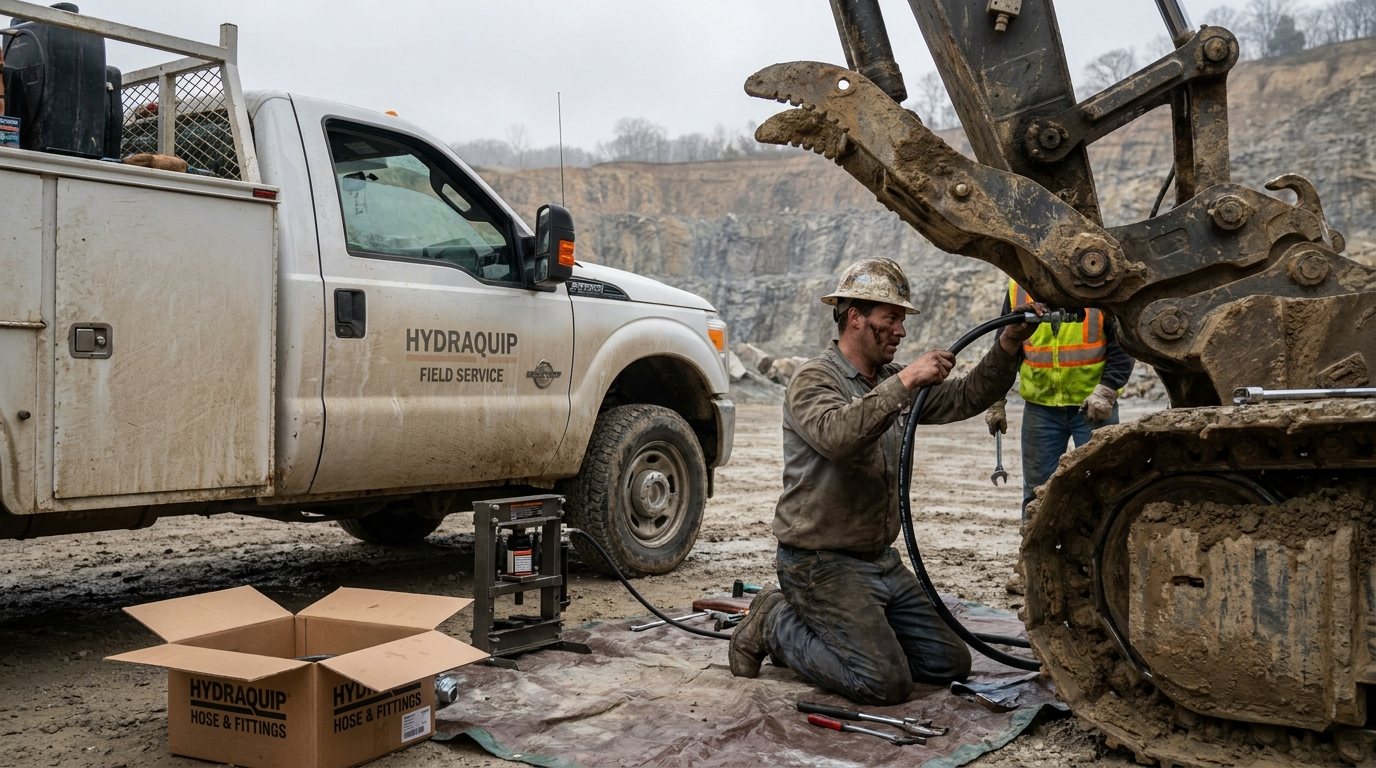
A hydraulic hose assembly built for a mining excavator and a coolant line built for a GPU rack solve the same underlying problem, just at different pressures and temperatures. Hydraquip is wagering that seven decades of fluid-conveyance expertise, not a new supplier relationship, is the actual asset here. It's a plausible bet and a risky one. Data-center cooling is now drawing dedicated entrants with deeper capital and closer ties to server OEMs, and a hydraulics distributor's brand recognition in that room is close to zero. Whether HydraCool becomes a real second leg or stays a niche line off the core hydraulics business is the open question for the next MDM cycle.
What to watch
Hydraquip's placement at #10 in fluid power measures where the company sits today. The more useful signal is the model underneath it: an employee-owned distributor using that structure to keep buying rather than get bought, in a vertical where the reverse is the norm, now spending its accumulated engineering credibility on a bet well outside its historical customer base. That combination, patient capital plus a willingness to stretch the core competency into new territory, is a harder thing for a rival to copy than a bigger territory map.
Every distributor on this list runs on the same unglamorous inputs: a catalog that has to be right, a branch network that has to be staffed, and data about what's actually in stock that has to move as fast as the trucks do. The companies worth studying are the ones that turn that infrastructure into a decision nobody else was willing to make.