
Berkshire Tool Supply Group: Wholesaler for Independents
How a 1951 Detroit tool store became Berkshire Hathaway's bet on arming independent distributors instead of replacing them, per MDM's 2026 rankings.
Part of Distributor Playbooks — strategy teardowns of every company on the MDM Top Distributors lists.
In 1951, Dan Kahn opened a tool store near Detroit with three employees and a Rolodex of local machine shops. Sixty-six years later, Berkshire Hathaway bought it, and instead of rolling it into a national chain, built it into a wholesale supplier for the independent distributors it could easily have driven out of business. That company, now Berkshire Tool Supply Group, lands at #18 on the Industrial Supply list and #16 on MRO Industrial in MDM's 2026 Top Distributors rankings — Industrial Supply has climbed steadily from #24 in 2022, while MRO Industrial has slipped back after climbing as high as #9 in 2025.
A hardware counter that outlasted its category
Production Tool Supply, as it was known for most of its life, grew the way most Rust Belt distributors did: one branch, one buyer relationship, one decade at a time. By 1976 it had outgrown its original footprint and built a headquarters in Warren, Michigan. It kept adding branches through the '80s and '90s, printed its first full-color 1,700-page catalog in 2001, and by the 2010s was running a private-label vending program and an early e-commerce storefront for reseller customers, according to the company's own career-page history. Nothing about that arc was unusual. Hundreds of regional tool distributors followed the same script and either sold to a roll-up, shrank, or quietly closed.
The acquisition that didn't fit the thesis
What happened next did not follow the script. In fall 2017, Berkshire Hathaway acquired Production Tool Supply outright, a modest-sized deal for a conglomerate built on insurance float and railroads, and used it as the seed for a new division called Berkshire eSupply, according to Industrial Distribution's reporting at the time. Berkshire Hathaway does not typically buy small industrial distributors to compete harder in a fragmented category. It buys cash-generative businesses and leaves management alone. Here it did something closer to venture-building: fund an entirely new go-to-market layer on top of a company it had just bought.
The company backed that bet with real capital. In 2018 it broke ground on a $45 million, roughly 210,000-square-foot headquarters and fulfillment center in Novi, Michigan, projected to add 240 jobs, according to Crain's Detroit Business. The distribution arm was rebranded PTSolutions in 2019; the wholesale arm kept the Berkshire eSupply name. Both now sit inside the umbrella entity Berkshire Tool Supply Group, alongside Morse Cutting Tools and a vendor-managed-inventory unit called Matrix.
The bet: arm the competition instead of replacing it
Here is the part that would not show up on a company timeline. Berkshire eSupply's actual product is a white-labeled catalog, website, and fulfillment network that small and mid-size independent tool distributors, typically $10 million to $50 million in revenue, can put their own name on and sell as if it were their own inventory. The distributor keeps the customer relationship and the margin on top; Berkshire eSupply carries the SKUs, the warehouse, and the shipping.
That is the opposite of how most master distributors and marketplaces behave. A conventional platform, an Amazon Business or a Grainger, owns the customer data and the storefront, and pushes the cost and risk of holding inventory onto third-party sellers. Berkshire eSupply flips that: the independent owns the customer and the brand, and the wholesaler absorbs the working capital and logistics. A 2019 analysis from Distribution Strategy Group called this an "upside-down marketplace" for exactly that reason, and flagged the obvious tension: eSupply carries most of the variable cost of the business while giving up the data and platform leverage that make marketplace economics scale. It is a strategic choice to be the arms supplier to thousands of small distributors rather than the chain that replaces them, and it only works if those small distributors keep their independence worth defending.
That is the insight worth sitting with. A Berkshire Hathaway-owned company, sitting on the balance sheet and patience to build a national chain that could out-price every regional tool shop in North America, chose instead to build the back office those shops need to survive. It is a bet on the durability of the independent distributor as a channel, made by one of the few owners with the capital to bet against it instead.
What the model has produced since
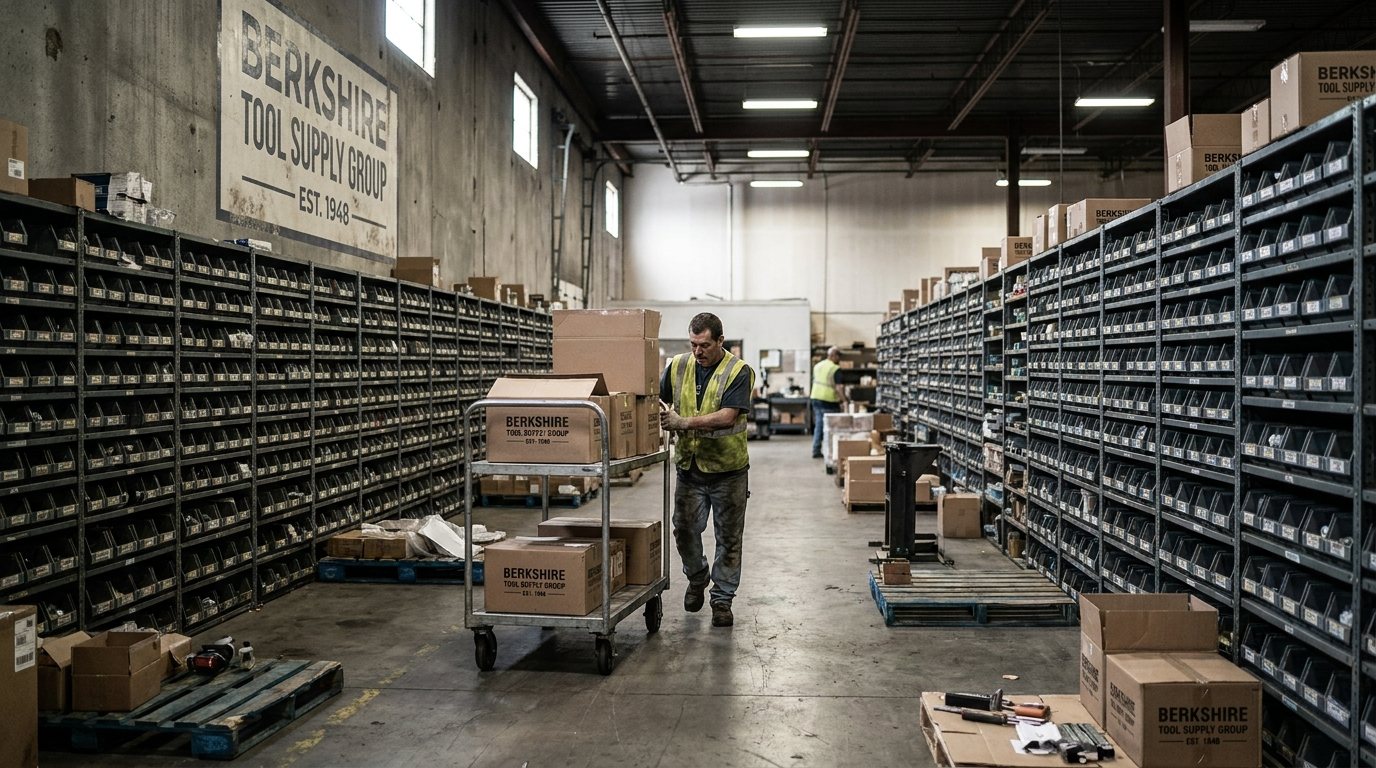
The infrastructure kept compounding after the headquarters opened in 2020. Berkshire Tool Supply Group now runs product out of distribution centers in Detroit, Houston, and Los Angeles, carrying more than a million industrial and MRO SKUs from over 1,000 suppliers. In May 2024, PTSolutions signed an exclusive cutting-tool partnership with the National Tooling and Machining Association, giving NTMA's member shops preferred pricing and access to same-day shipping and factory-trained technical support, according to the partnership announcement. That is a trade-association deal, not a headline acquisition, and it fits the pattern: growth through deeper channel relationships rather than branch count.
| MDM List | 2022 rank | 2026 rank |
|---|---|---|
| MRO Industrial | #12 | #16 |
| Industrial Supply | #24 | #18 |
The Industrial Supply climb over four years suggests the model is gaining share on that list while wearing someone else's name on the box. MRO Industrial tells a different story: it climbed as high as #9 in 2025 before slipping to #16 in 2026, and the rankings don't say why.
The unglamorous parts of this business, the catalog data, the branch inventory, the fulfillment network, are what let Berkshire eSupply's partners look like national players without becoming one. That is the quiet infrastructure question every distributor on this list has answered differently, and it is the thread this series keeps pulling.